How to Specify Facade Lighting for Hot Climates (Middle East Guide)
To specify high-temperature facade lighting, match the complete lighting assembly to the temperature at its actual installation position. Confirm the luminaire's rated operating ambient temperature (Ta), the driver limits, any installation restrictions and any power derating. A high chamber-test temperature alone does not prove the fixture can run continuously outdoors at that temperature.
LNJAMI manufactures LED wall washers and linear facade lighting for architectural projects, and this guide reflects the questions our engineers review on hot-climate projects. It is written for lighting designers, consultants and contractors working on projects in Saudi Arabia, the UAE and the wider Gulf. The same method applies to other hot, sunny regions, such as the US Southwest.
Quick checklist for hot-climate facade lighting
Define the design ambient temperature for each mounting position, not one figure for the whole building.
Confirm the Ta rating for the exact model, wattage and mounting arrangement.
Check the driver location, its case temperature limit and its derating curve.
Review gasket, cable and sealant materials for heat and UV exposure.
Link test reports, packing labels and site records to the approved fixture schedule.
Start with a marked-up elevation
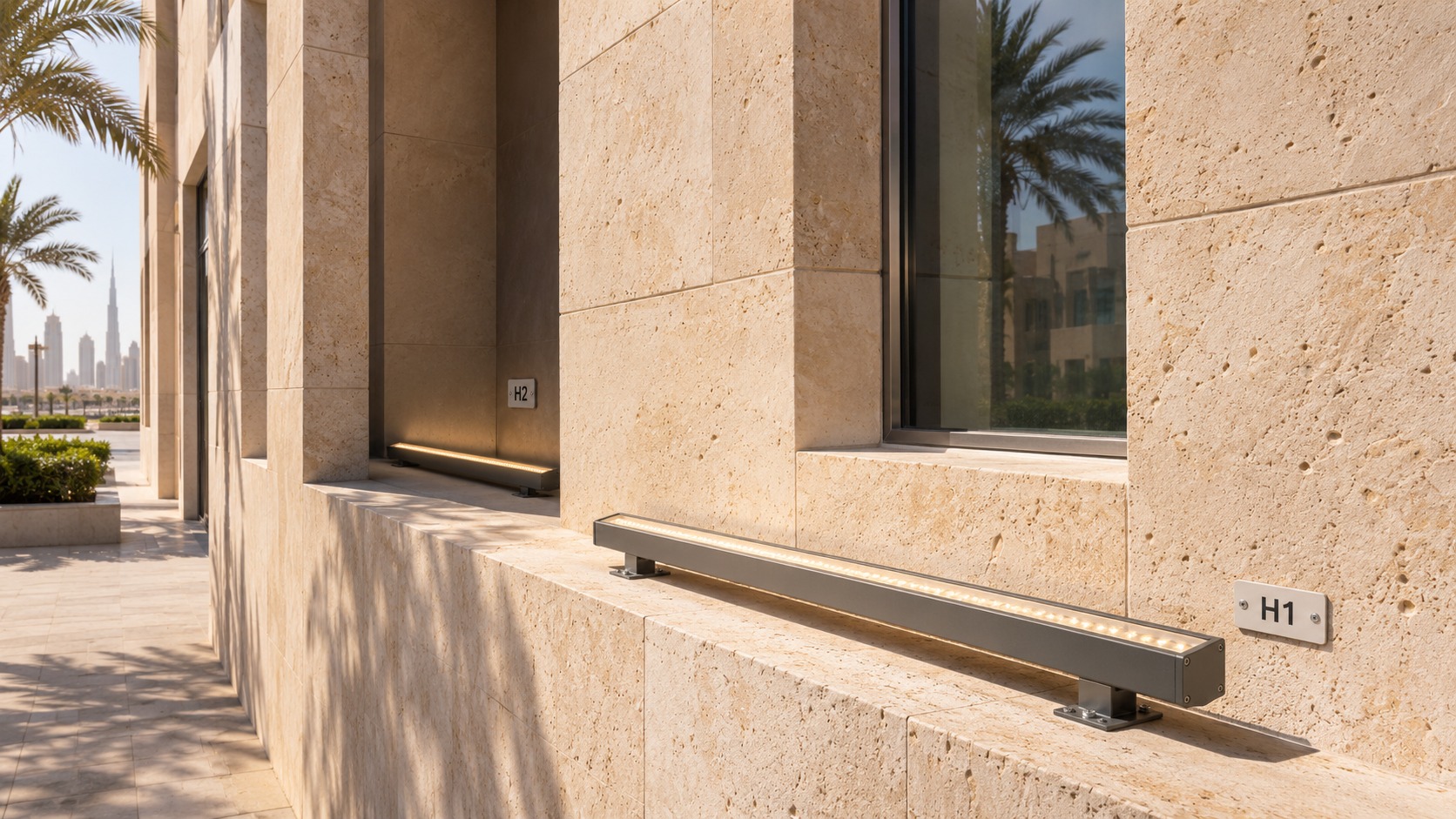
For a building in Saudi Arabia or the UAE, the most useful starting point is a marked-up elevation. It should show which luminaires receive direct sun, which sit behind cladding and where the drivers will be installed. Coastal humidity, wind exposure and cleaning access also vary by site, so avoid assigning one assumed "Middle East temperature" to every position on the building.
1. Define the design temperature before selecting a fixture
Ask the project designer to set the design ambient conditions and operating schedule from the project brief and local climate data. Separate daytime solar exposure from powered operation. A daytime scene or maintenance test may need a different assessment.
Pay special attention to start-up after solar exposure. During the day, direct sun heats the housing, the mounting cavity and the surrounding cladding, even when the fixture is switched off. At dusk the luminaire may therefore start from an already elevated temperature, and its own heat is added on top. Ask how the rating and test evidence account for this pre-heated start, especially for recessed and dark-finished positions.
| Item to record | Question for the supplier or designer |
|---|---|
| Luminaire ambient (Ta) | What operating ambient range applies to this exact model, wattage and mounting arrangement? |
| Mounting cavity | Is the unit in free air, a recess, a covered channel or behind glazing? What are the dimensions and clearances? |
| Driver environment | Is the driver integral, remote, shaded or inside a sealed box with other equipment? |
| Electrical load | Which input supply, output current and maximum simultaneous scene were used? |
| Operating pattern | When is the system powered, and what happens at start-up after a day of sun exposure? |
Ambient air temperature, housing surface temperature, driver case temperature (Tc) and LED junction temperature (Tj) are not interchangeable. Each describes a different point, so every measurement in the review record should state its location and its applicable limit.
2. Check thermal test reports against the supplied configuration
LNJAMI's thermal cycling test article explains what thermal cycling testing involves and is a useful guide to which records to request. For procurement approval, ask for the report covering the proposed model and revision, including the driver, seals and mounting arrangement. A general article is not a substitute for a model-specific rating.
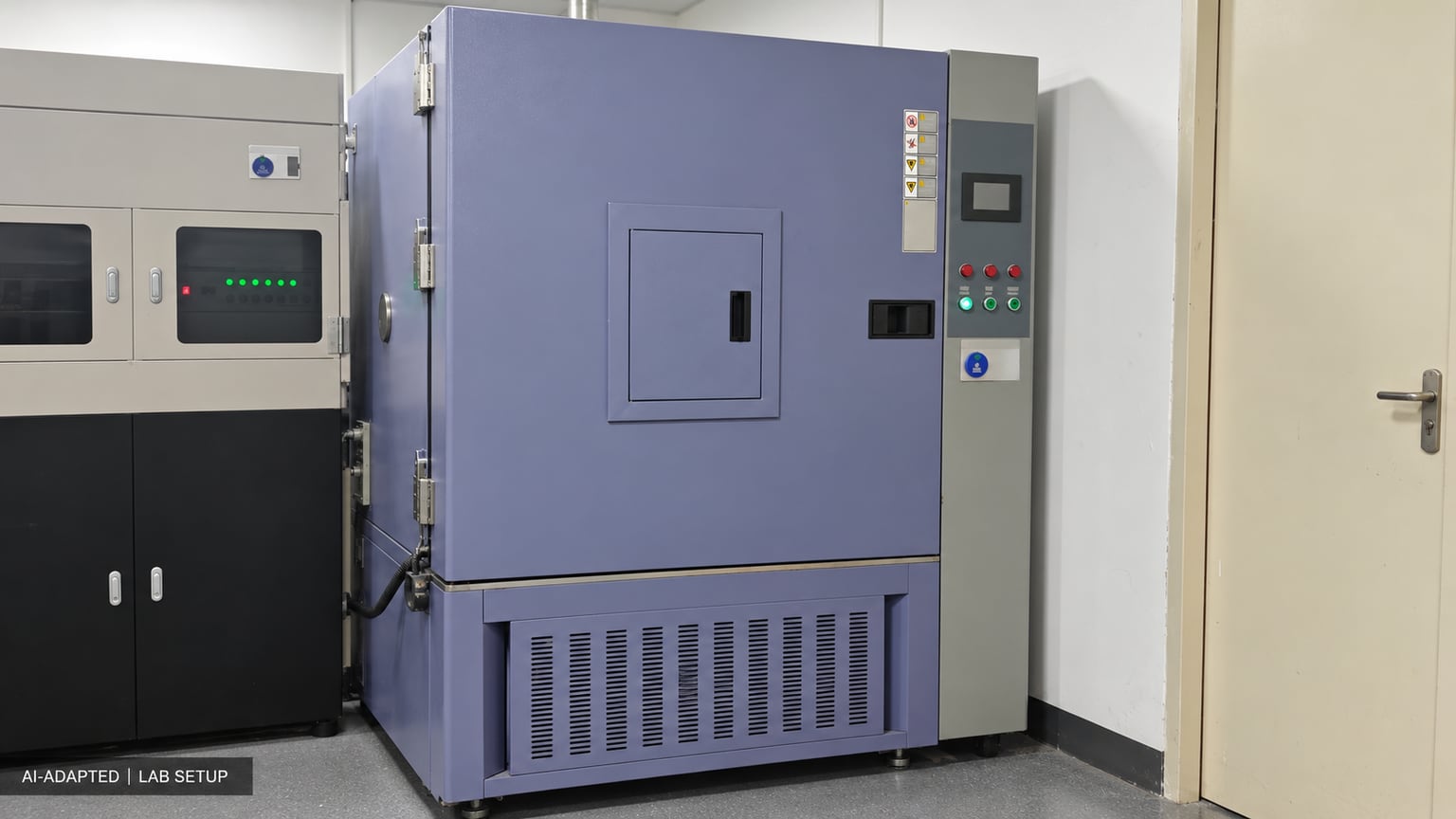
A useful temperature-rise report identifies:
sample numbers and ambient conditions
supply voltage and operating current
mounting orientation and enclosure dimensions
measurement points and the criterion used to confirm thermal stability
Ask for the temperature traces and the limits applied, not a single photo of a chamber display. If the test used an open bench but the design uses a narrow recess, ask how that difference will be addressed.
Thermal cycling and continuous thermal testing answer different questions. Cycling examines repeated temperature changes. Continuous powered testing shows whether the assembly stays within its limits under the intended load and installation. Neither result should be turned into a service-life guarantee without supporting evidence.
Standards to reference in the review
Standards tell you what a report actually covers. Ask the supplier which standard and edition each report was tested to, then check that it matches the product category and the project specification.
|
Standard |
What it covers |
Why it matters in a hot-climate review |
|---|---|---|
|
IEC 60598-1 |
General safety requirements and tests for luminaires |
Includes thermal tests; check the rated ambient used in the test |
|
IEC 60598-2-x |
Particular requirements by luminaire type (e.g. -2-1 fixed, -2-5 floodlights) |
Confirms the correct part was applied to the fixture type |
|
IEC 61347-1 / 61347-2-13 |
Safety of LED control gear (drivers) |
Defines the driver case temperature (Tc) point to check on site |
|
IEC 62031 / IEC 62717 |
Safety and performance of LED modules |
Shows the module limits the luminaire design relies on |
|
IEC 62722-2-1 |
Performance of LED luminaires |
Rated light output and life claims are tied to a stated ambient |
|
IEC 60529 |
IP degree of protection |
IP rating covers dust and water, not heat or UV ageing of seals |
|
UL 1598 / UL 8750 |
Luminaire and LED equipment safety (North America) |
Relevant for US projects in hot regions |
Also check local conformity requirements, such as SASO requirements in Saudi Arabia and the relevant UAE authority approvals, plus any corrosion-resistance requirements for coastal sites. A listed standard is not, by itself, proof of high-temperature performance.
Not sure whether a test report covers your installation? Send it to our engineers for a free review →
3. Check driver location and derating together
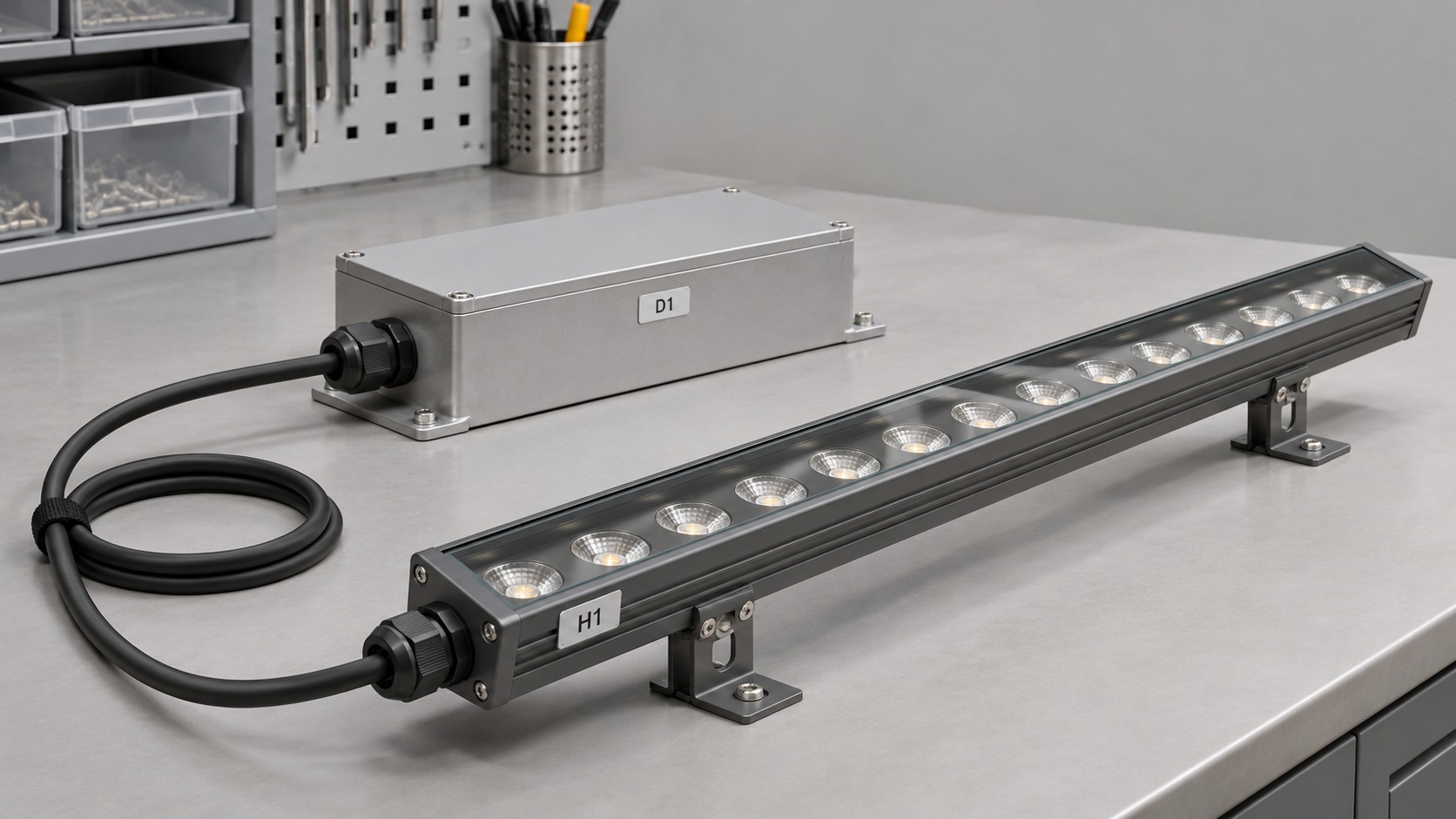
A remote driver can improve access and separate heat sources, but its enclosure still needs assessment. Draw the cable route, box orientation and nearby heat-producing equipment. Check the driver's permitted case temperature at the specified measurement point, its output limits and its cable restrictions. Moving the driver out of the luminaire does not automatically solve overheating.
MEAN WELL's power-supply guidance directs users to model-specific derating curves that show available output against temperature. Apply the selected driver's own curve and installation notes rather than one universal percentage. Then confirm that the reduced output still covers the load and that the light output still meets the design brief. For sizing drivers on long runs, see our outdoor lighting power supply sizing guide.
When comparing quotations, ask whether the quoted wattage is available across the full required operating range. Record any permitted output reduction, how it is controlled and who approves the revised photometric result. Thermal shutdown is a protective feature and should not be presented as normal operation.
This matters most for long runs of linear facade lighting and high-power LED wall washers, where one remote driver box often feeds several fixtures. Ask the supplier to show the driver allocation per run, so the derated output can be checked against each run's actual load.
4. Review seals, dust and maintenance access
Request the specified gasket, cable-jacket and sealant materials with their temperature, UV and compatibility data. A material name alone is not enough, because geometry, compression, assembly and exposure all affect performance. Do not approve a field-applied sealant or substitute cable gland just because it is described as waterproof.
An IP66 rating confirms protection against dust and powerful water jets at the time of test. It does not show how the gaskets hold up after years of heat cycling and UV exposure, so review the material data alongside the IP report.
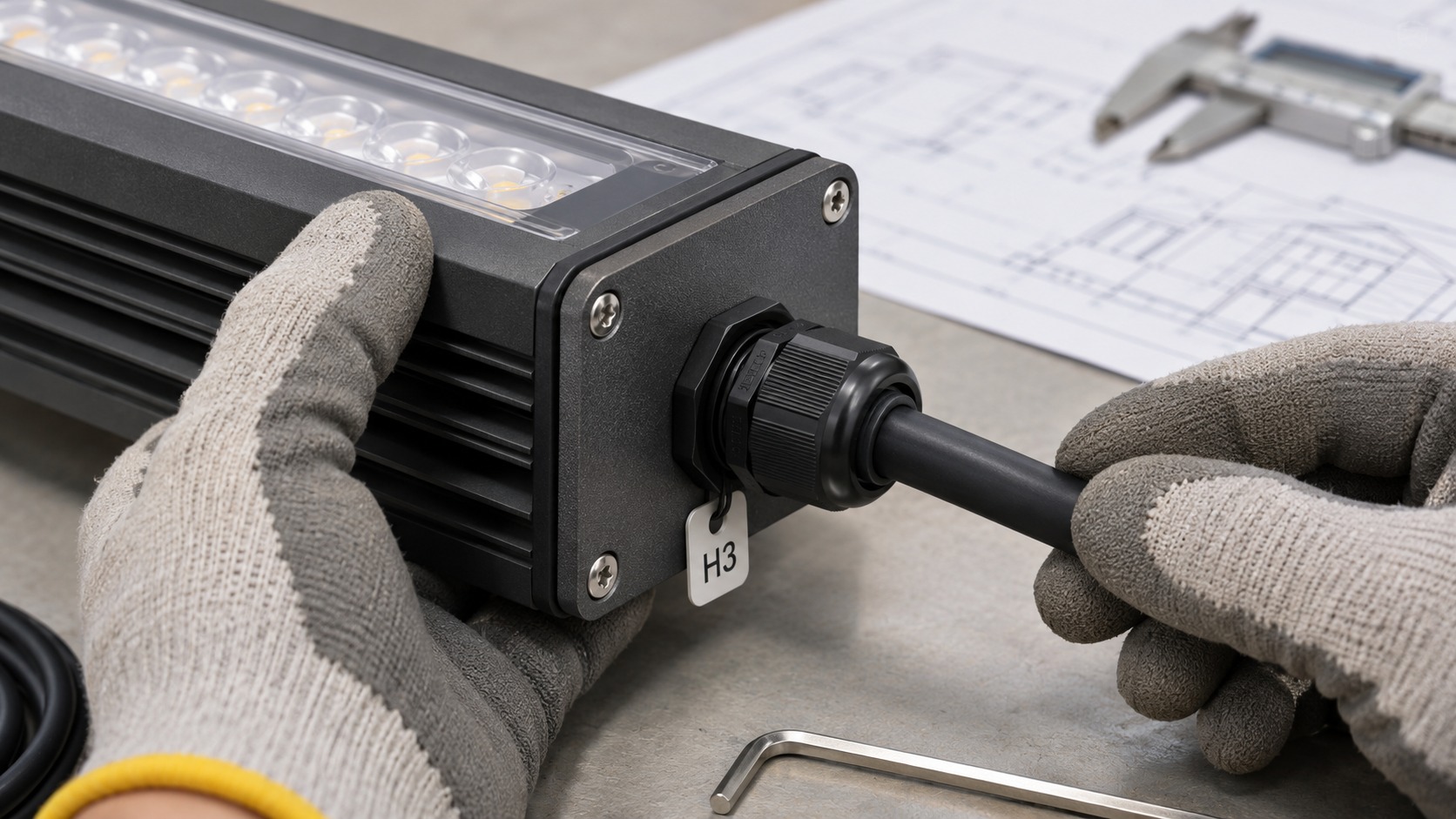
Plan access to heat-dissipation surfaces and lenses, since desert dust reduces both cooling and light output. Use the manufacturer's approved cleaning method and adjust inspection intervals to the dust build-up actually observed on site. Take photos before and after cleaning. Do not specify pressure washing, aggressive solvents or a fixed cleaning interval without checking the finish and enclosure instructions.
5. Link packing, installation and acceptance records
Before loading, match carton and sample labels to the approved model, driver, optical option and drawing revision. Protect lenses and brackets, keep connector accessories separate, keep packaging dry and follow the approved stacking plan. On site, check for transport damage before installation.
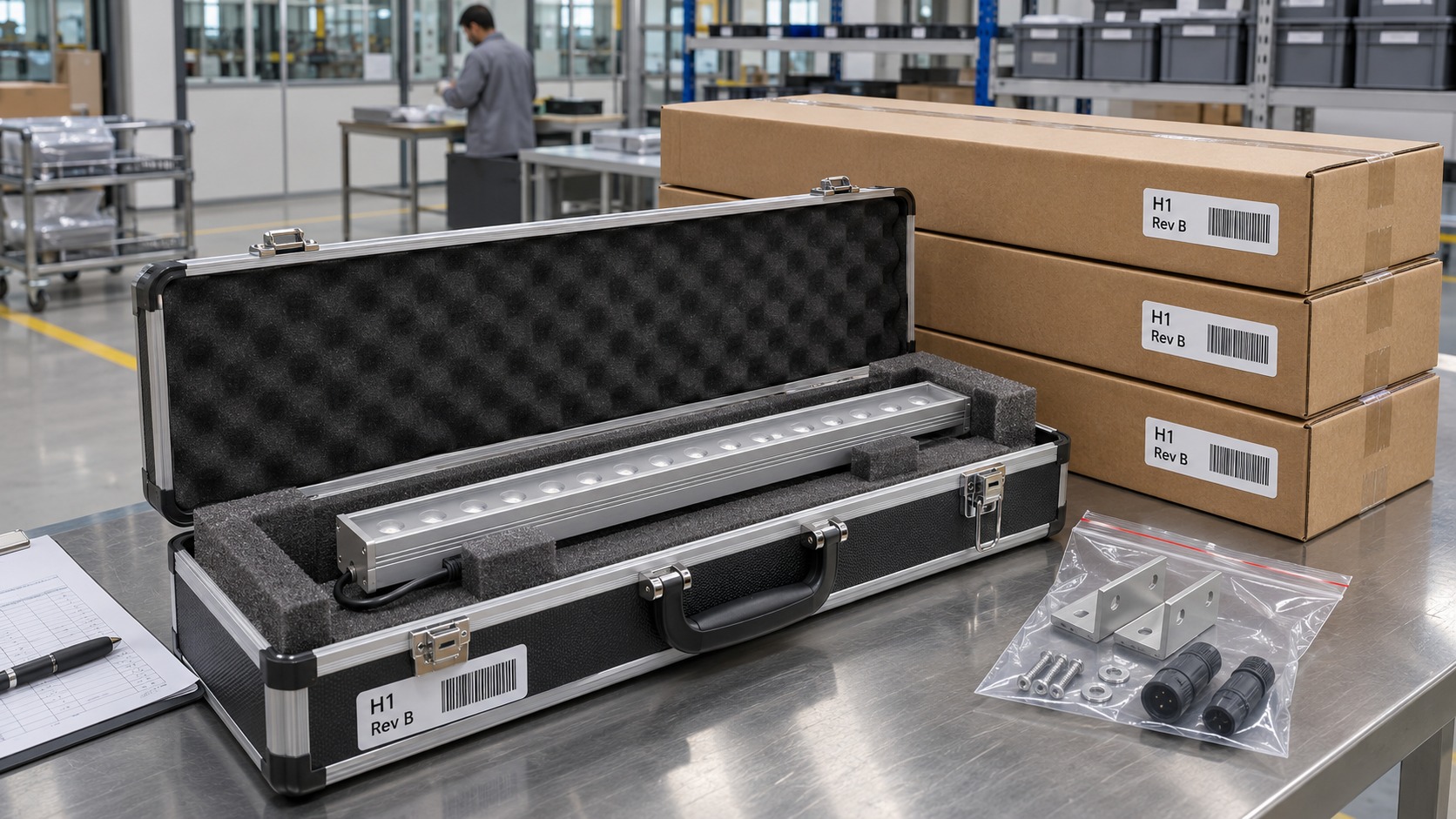
Acceptance checklist (see also our outdoor lighting waterproofing handover checklist):
Mark each fixture position and driver box on the elevation with matching IDs.
Attach the datasheet, thermal report and installation restrictions.
Record the mock-up conditions and measured points.
Resolve any change in enclosure, driver or output before repeating the detail.
Keep final installation photos and a clear cleaning route.
Example: thermal assessment of an LED wall washer in Riyadh
The scenario below shows how the steps above fit together. It is an illustrative example, not a record of a specific project, so it contains no test temperatures or results. For a real LNJAMI project in the region, see our architectural lighting project in Saudi Arabia.
| Project item | Assumed condition |
|---|---|
| Location | Riyadh, Saudi Arabia |
| Fixture | Linear LED wall washer |
| Mounting | Recessed facade channel |
| Driver | Remote driver in a wall-mounted box |
| Exposure | Direct afternoon sun on the facade |
Ambient at the fixture. The designer sets the design ambient for the recessed channel, not just the outdoor air temperature, because the channel traps heat from the sunlit cladding.
Profile and cavity. The review compares the channel's dimensions and ventilation with the mounting arrangement in the test report. A test on an open bench would not cover a closed channel.
Driver box. The team checks whether the box is in direct sun, what else is inside it and whether the driver's Tc stays within its limit. The derating curve shows whether the quoted output is still available.
Seals. Gasket and cable materials are checked for heat and UV exposure, not only for the IP rating.
Selection and acceptance. The final fixture, driver and output setting are approved together, a mock-up is measured at the agreed points, and the records are linked to the elevation IDs.
The outcome is a specification where each position has its own evidence, rather than one temperature claim for the whole building.
Frequently asked questions
What Ta rating do I need for facade lighting in Saudi Arabia or the UAE?
There is no single correct figure. The required rating depends on the design ambient at each mounting position, including solar gain and enclosure heat. Set the design conditions first, then confirm the rated Ta for the exact model and mounting arrangement.
Does a 70°C test mean a luminaire is rated for 70°C operation?
No. Check what was tested, for how long, at what load and in which mounting arrangement. The rated operating range must come from the documentation for the supplied configuration.
Can the same model be used in an open bracket and a recessed channel?
Possibly, but the thermal conditions are different. Ask for installation limits and evidence that covers each arrangement.
Is a remote driver always better in hot climates?
Not always. It separates heat sources and eases maintenance, but the driver box itself can overheat in the sun or a sealed cabinet. Assess its location and derating curve the same way as the luminaire.
What should I send for a high-temperature lighting review?
Send the project location, design ambient conditions, elevation, cavity details, operating schedule, fixture schedule and proposed driver locations. Note any assumptions the project designer still needs to confirm.
Why choose LNJAMI for high-temperature facade lighting projects
Customized facade lighting. Wall washers and linear fixtures in custom lengths, wattages, beam angles and color temperatures. See our custom wall washer and linear light solutions.
48-hour burn-in before shipment. Fixtures go through a 48-hour burn-in (aging) test before they leave the factory, so early failures are caught before installation.
Remote driver options. Integral or remote driver configurations, with MEAN WELL drivers available.
Custom aluminum profiles and mounting. Profile and bracket design for recessed channels and open mounting.
Project engineering support. Thermal review of elevations, fixture schedules and installation details before purchase.
Get a free project-specific thermal review
Send LNJAMI your marked-up elevation, fixture schedule and temperature conditions. Our engineers will reply with:
the applicable model datasheets and installation documentation
recommended LNJAMI fixtures and driver options for each position
a list of open installation questions to resolve before purchase
Request a Thermal Review → · Explore LED Wall Washers · Explore Linear Facade Lighting
Note: The images in this article are AI-generated illustrations. They are not records of a specific project or test.