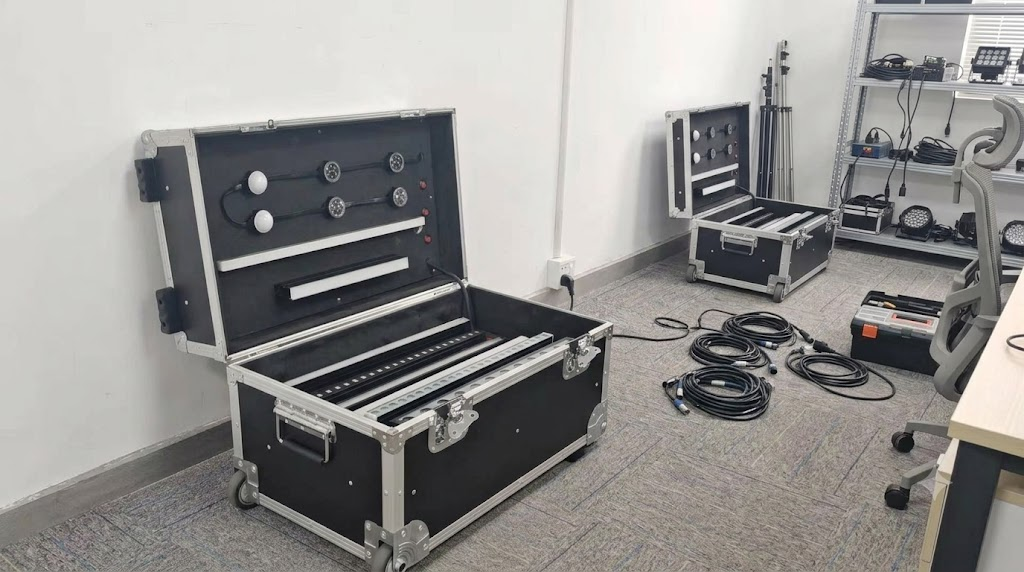
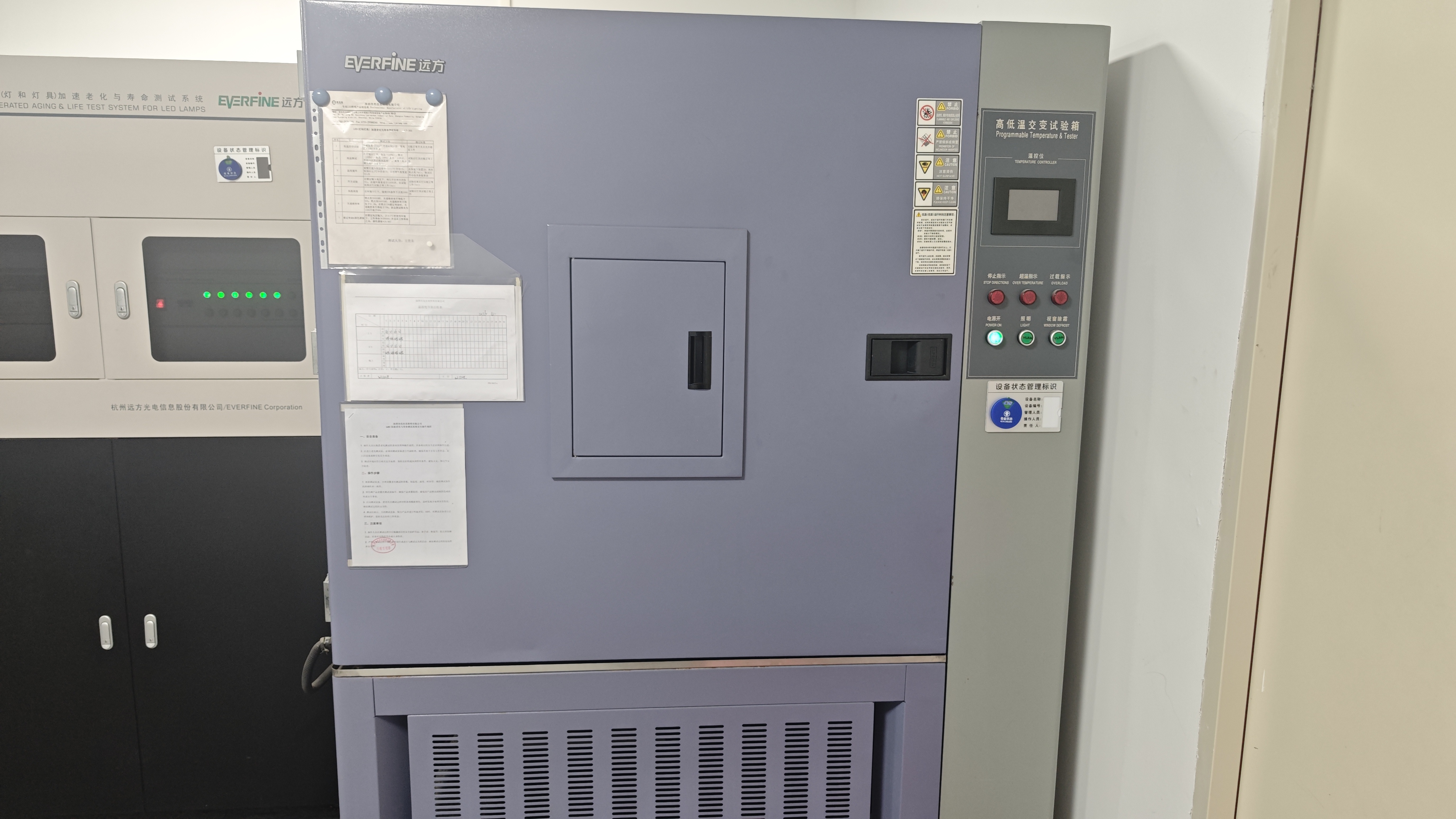
Custom Wall Washer and Linear Light Solutions for Complex Facades
The client doesn't know the technical term for what's wrong. They just say: "It looks cheap." That's the one-fixture trap. Single-layer lighting makes a building look like a two-dimensional cutout. It's not a design failure — it's a strategy failure.
The fix is simple in concept but precise in execution: two layers, not one. A wall washer for the surface. A linear light for the edges. One fills. One defines. Together, they give a building back its volume, its rhythm, its presence. This article is for architects and engineers who are tired of fighting with standard products that don't fit the actual site. We make custom solutions for facades that standard catalogs can't handle.
Defining the Two Layers
Wall Washer — The Base Layer
A wall washer's job is to cover a vertical surface evenly. It does this with an asymmetric (ASYM) lens that concentrates light at a grazing angle — typically 15° to 30° off vertical. This "shoves" the light down the wall, minimizing the falloff that you get with symmetric optics. In practice, mounting height is usually 0.5m to 1.5m from the wall base, fixture spacing runs 0.8m to 1.5m depending on wall reflectivity, and the beam angle determines coverage height. The result is a smooth, even glow with no visible scalloping.
Key spec: wall washers are defined by their graze angle. A 15° unit throws light farther down the wall, better for tall facades, but requires tighter mounting tolerance. A 30° unit is more forgiving but covers less vertical height per fixture. Choose based on wall height, not on fixture wattage — the optic does the work.
Linear Light — The Accent Layer
A linear light does one thing differently: it points sideways. Its optic is symmetric — typically 120° to 180° — and it projects light horizontally along the facade plane, not vertically down it. Mounting position is at horizontal transitions (floor lines, window heads, canopy edges), with output parallel to the wall surface. A milky PC cover over the LEDs converts point sources into a continuous line of light.
The result is a crisp, continuous line that traces the building's horizontal geometry. Key spec: linear lights are defined by line continuity — gaps between fixtures kill the effect. One sentence captures the difference: wall washers paint, linear lights draw.
Why "Down + Side" Beats "Down Only"
Visual Hierarchy
Human vision craves contrast — not just brightness contrast, but contrast of direction and edge versus surface. A wall washer delivers environmental light: the background, the canvas. A linear light delivers focal light: the detail, the line, the "look at this." On a facade, the wall washer creates the base brightness; the linear light picks out the horizontal grammar — floor lines, window heads, canopy edges.
One without the other is incomplete. The wall washer alone is a blank canvas; the linear light alone is a line drawing without background. Together, they produce what designers call layering — the same principle theater lighting uses: wash light for the stage floor, backlight for the actors' silhouettes. The facade reads as three-dimensional, not flat.
Glare Control
A wall washer points downward. The light hits the facade and reflects off it; the beam angle is shallow enough that glare doesn't hit pedestrians' eyes. A linear light points sideways, parallel to the wall, not perpendicular to it. At a floor line, the light travels across the facade, not out into the street or into the windows above.
The combination is self-protecting. Both fixtures direct their output where it belongs — onto the building, not into the surrounding space. You can't control glare with spec sheet numbers alone; you control it with geometry. The "down + side" geometry is inherently lower-glare than any single-direction approach.
Integration — The Structure Hides the Lights
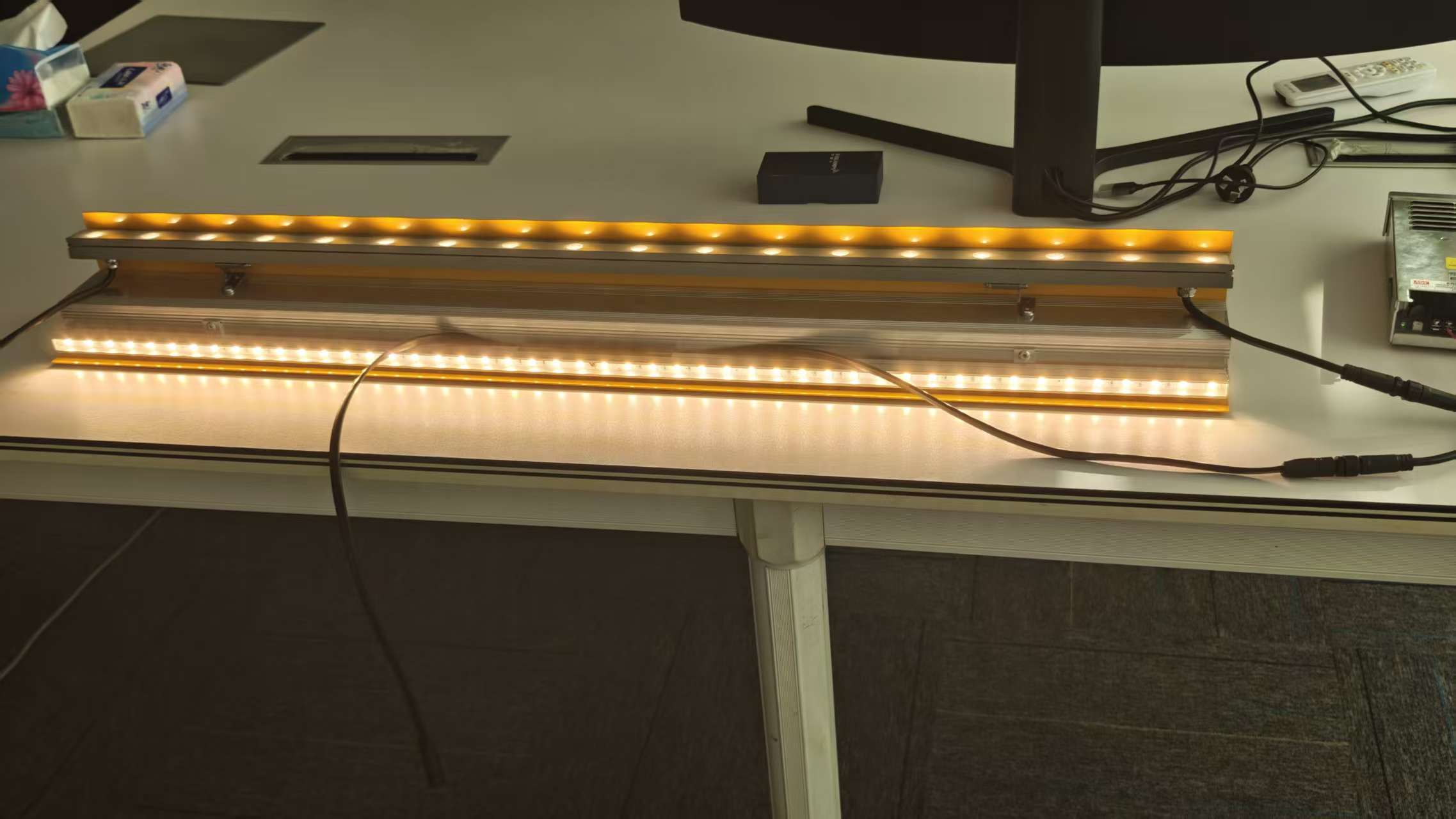
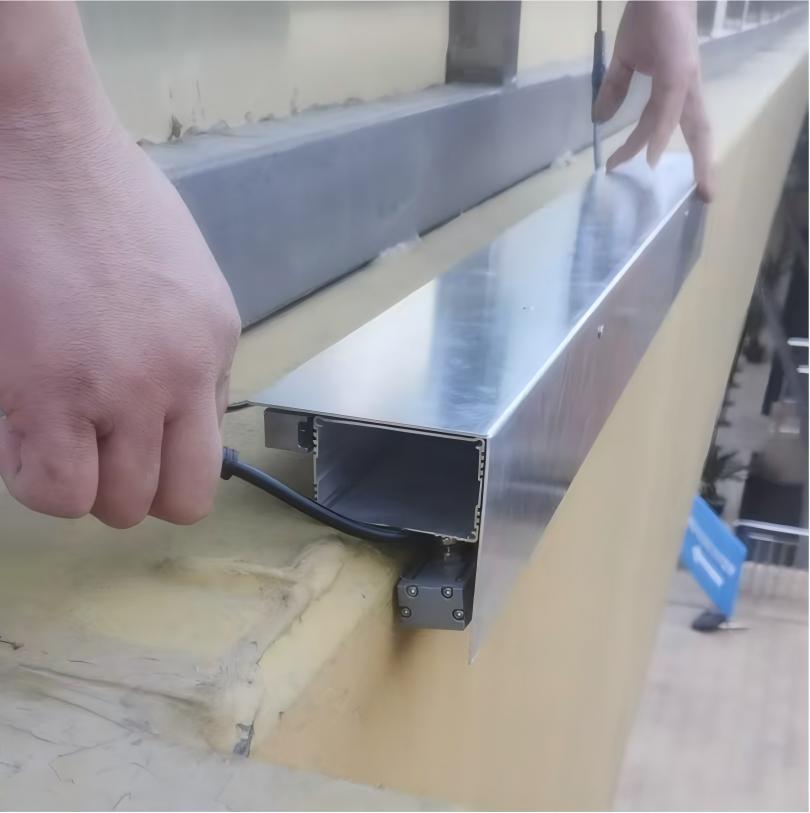
When you design a combined wall washer + linear light system, you can mount both fixtures in the same extrusion. The wall washer occupies one channel, the linear light occupies another. The extrusion becomes part of the building's horizontal detail — a shadow line, a drip edge, a reveal. Done right, the fixtures disappear in daylight. You don't see them, or wires, brackets, or junction boxes. You only see the building.
At night, the fixtures reappear — but as light, not as hardware. This is what architects mean when they say "the architecture is the lighting." The system is integrated because we customized the housing, the brackets, and the optical alignment to match the facade's geometry — not the other way around. Standard products can't do that.
What We Customize Based on Site Conditions
A Real Project: Down + Side in One Extrusion
Here's how this played out on an actual job.
The client's facade had a horizontal metal panel band running across the entire building. The requirement: light needed to project downward across the face of the panel, and light also needed to project sideways along the mullion line. Two directions, one physical location.
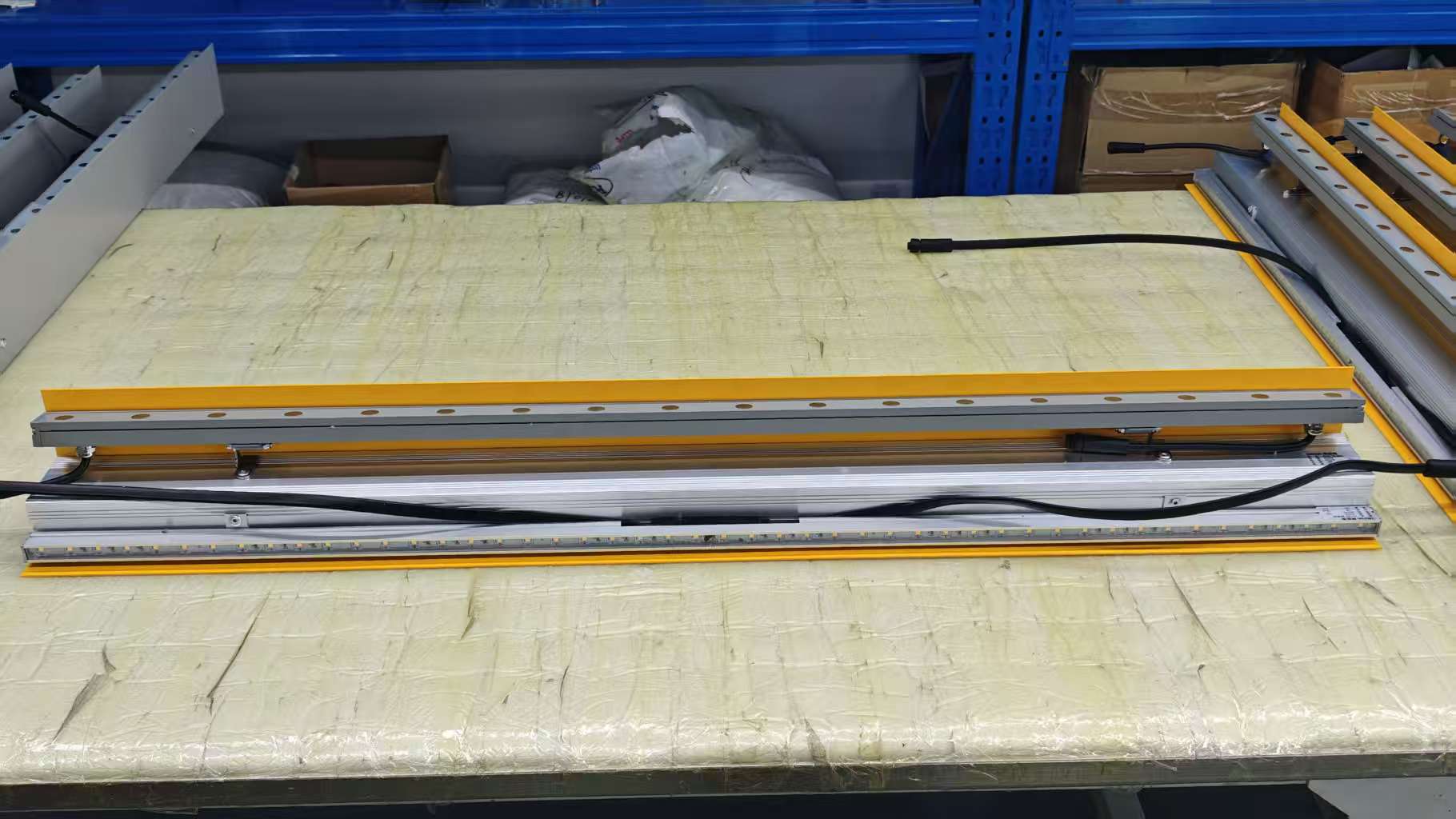
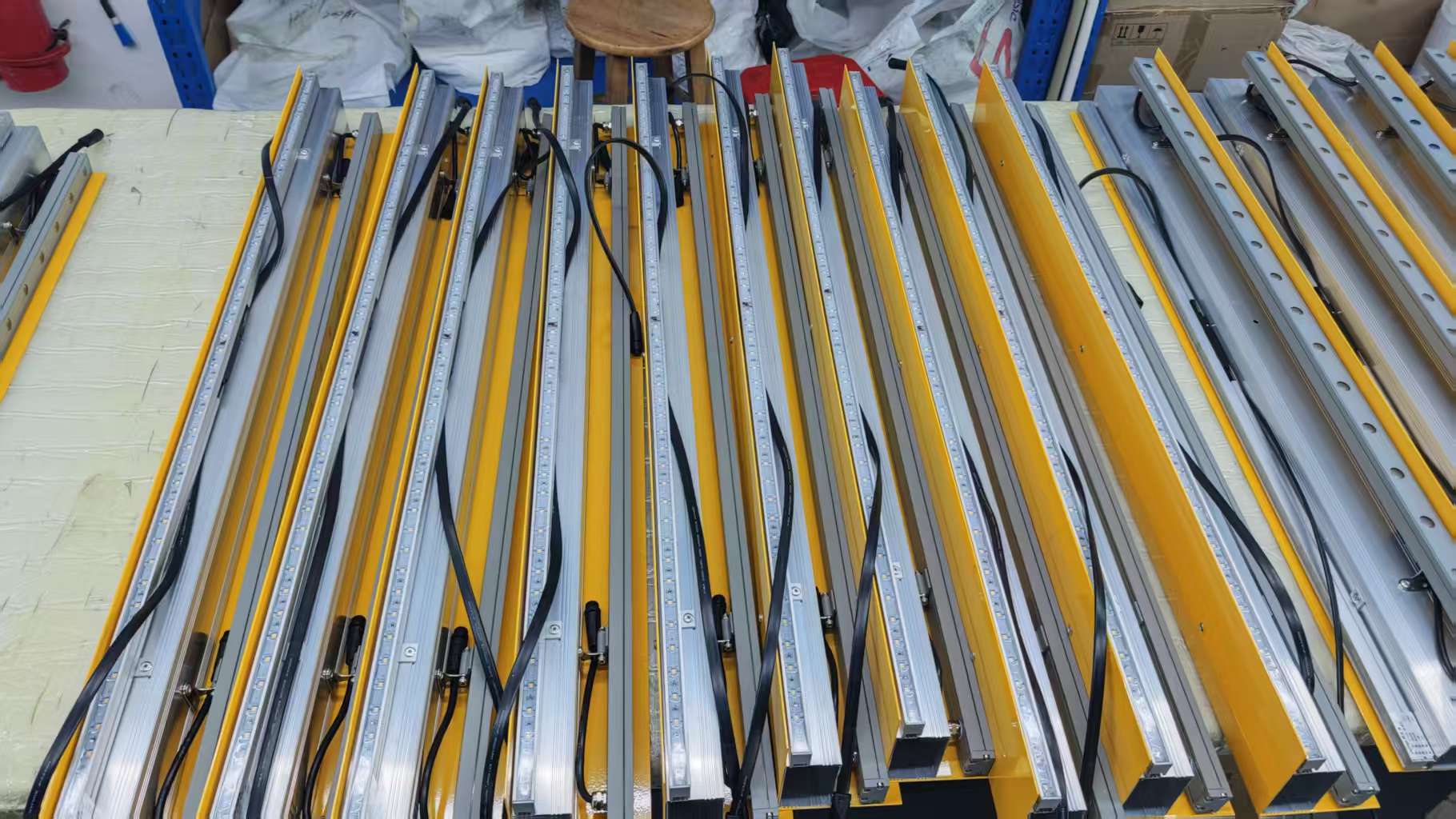
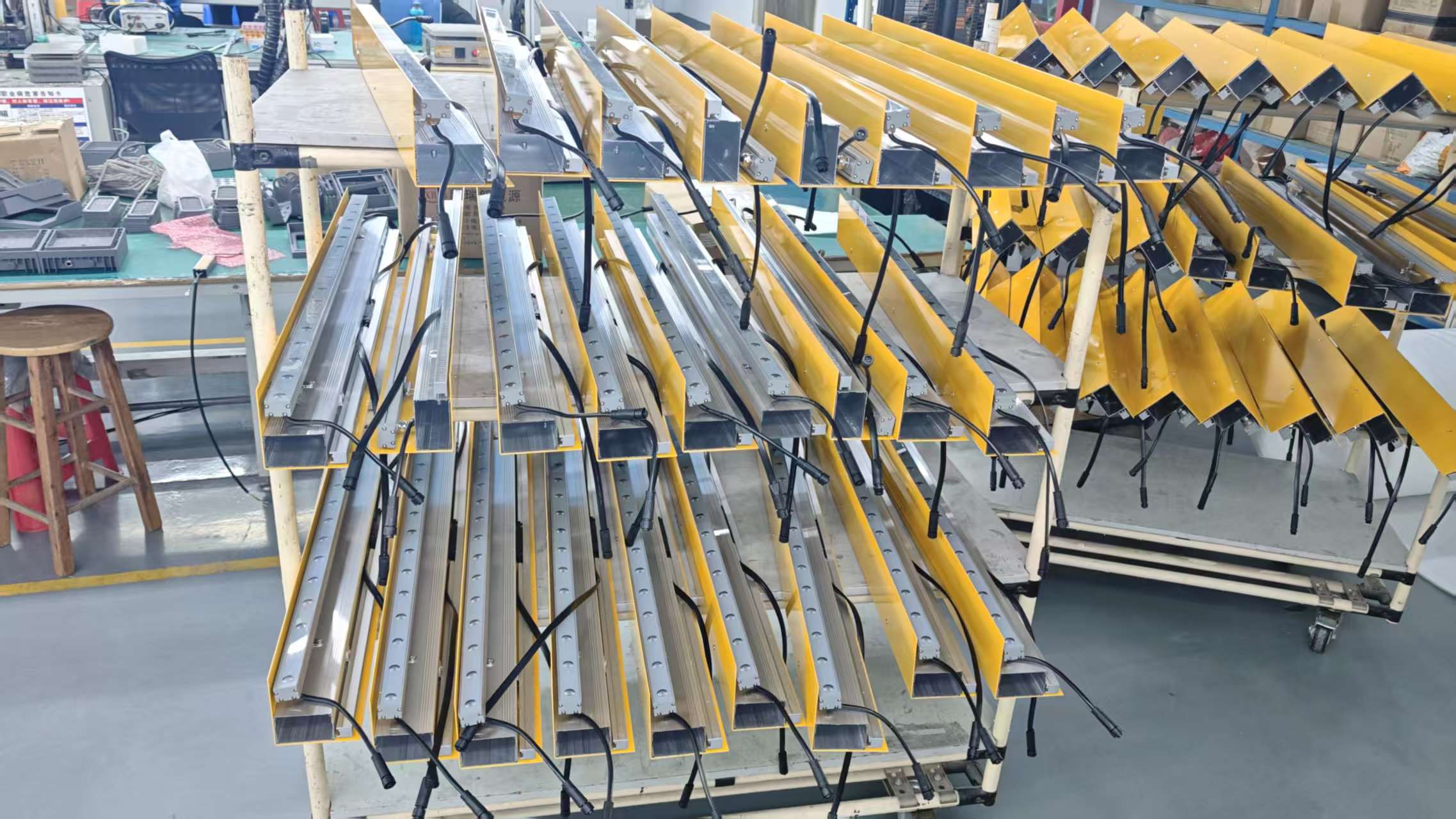
The site also had a specific constraint we don't see in every project: the building's exterior used a warm-tone metal finish. Standard black or silver housings would have stood out like a sore thumb during the day. The client didn't explicitly ask for a color change — they just assumed we'd figure it out. We did. We custom-ordered the extrusion in a yellow powder coat that matched the surrounding metal panels. The fixtures disappeared into the facade, even in full daylight.
The installation was straightforward once we defined the hardware. A single fixed aluminum channel runs across the panel band. The wall washer occupies one side of the channel, pointed downward; the linear light occupies the other side, pointed sideways. Two fixtures, one extrusion, two optical directions, one finish. No visible brackets, no exposed wiring, no daylight clutter.
That's the difference between a product catalog and a custom solution. The catalog says "what we have." We asked "what does your facade need?" — and built that.
Installation Details That Make or Break the Look
Detail 1: Leveling
A wall washer's asymmetric lens is unforgiving. A 2° tilt off level shifts the light beam horizontally across the facade — on a 6-meter wall, 2° equals about 200mm of shift at the bottom. The effect: the light pattern no longer aligns with the architectural grid. You see a slant in the illumination line, impossible to correct after fixtures are sealed.
Install with a digital level, not a bubble level. Mark alignment targets on the facade before mounting. We've seen beautiful fixtures produce ugly results because of a 2° tilt — and the client blamed the product, not the installation.
Detail 2: Joint Continuity
Where two linear light sections meet, a gap — even 2mm — reads as a dark line on a dark night. It breaks the continuity. Our solution: end-to-end optical compensation. The light-emitting area at each section's end is extended 3mm past the physical housing, so adjacent sections' emitting areas overlap, eliminating the gap.
Installers must butt the sections together — not space them for thermal expansion. Aluminum expands 2-3mm per 10°C over a 10-meter run; our internal slip joints take the movement while the optical face stays continuous. The installer doesn't need to calculate expansion — the hardware handles it.
Detail 3: Waterproofing at Connections
The IP rating applies to the fixture body, not the joint between sections. Water can enter through the gap between housings. The standard fix — a silicone gasket — often fails because installers over-torque connector screws, squeezing the gasket out of position. Our connectors have gasket capture grooves — a shallow channel in the housing face that holds the gasket in place regardless of screw torque.
The installer can't misalign the seal. It's a small detail, but it's the difference between a 10-year installation and a 3-year failure.
Detail 4: Cleaning the Optical Surface Before Power-On
During installation, the lens accumulates fingerprints, dust, and silicone residue. On a wall washer at grazing angle, a single fingerprint creates a visible shadow — roughly 5x to 10x the size of the fingerprint on the wall. We've seen clients blame fixtures for "uneven output" when it was just dust.
We now include a cleaning cloth and isopropyl alcohol wipe in every shipment. Installation teams are trained: power on, quick clean, stand back and inspect. Two minutes of cleaning prevents two weeks of troubleshooting.
Where This Combo Works Best
Scenario 1: Office Lobby Entrances
The wall washer, installed at the canopy soffit and pointed down at the logo wall, provides the background glow that makes the logo stand out. The linear light, installed along the entry floor edge and pointing sideways across the lobby floor, defines the threshold — visually separating the exterior walkway from the interior. The combined effect: the lobby reads as a "box of light," bright inside with a clean horizontal line at the floor that anchors the composition.
This works because the two layers serve different visual purposes. The wall washer establishes the space; the linear light establishes the transition. Neither competes; they collaborate.
Scenario 2: Pedestrian Bridges and Skywalks
The wall washer, mounted under the handrail and pointed downward at the deck surface, lights the walking surface — safe and visible from a distance. The linear light, mounted on the bridge's underside and pointing sideways at the structural truss, picks out the diagonal members, giving the structure visible geometry that was invisible by day.
The combined effect: the bridge is safe to walk on and beautiful to look at from below. No wasted light upward, no glare for drivers below. Safety and aesthetics from one installation — that's the value proposition.
Scenario 3: Curved and Free-Form Facades
Standard straight lights only cover a flat segment of a curve. At the transition, there's a dark spot. For curved facades, we custom-curve the linear light's housing to the building's radius — flexible PCB inside a CNC-machined, anodized extrusion. The wall washer, mounted at intervals along the curve, uses a wide horizontal spread lens (120° to 140°) to cover the curved surface without scalloping.
The combined effect: the building's curve is defined, not hidden. The wall washer keeps the surface illuminated; the linear light makes the curve visible. The facade reads as continuous, even where the geometry isn't straight.
|
Parameter |
Wall Washer |
Linear Light |
Notes |
|
=Beam direction= |
Downward (0°-30° from vertical) |
Sideways (parallel to facade) |
Glare control is the key constraint |
|
Optic type |
Asymmetric (ASYM), grazing |
Symmetric (SYM), 120°-180° |
Wall washer optic defines coverage height |
|
Power density |
24W-48W per meter |
10W-20W per meter |
Based on illuminance target; vary with mounting height and wall reflectivity |
|
CCT |
2700K-6500K |
Must match wall washer |
Critical: same bin, same batch |
|
IP rating |
IP65 min, IP67 preferred |
IP65 min, IP67 preferred |
IP68 for coastal/tropical projects |
|
Mounting options |
3 options per housing |
3 options per housing |
Custom bracket options available |
|
Custom options |
Bias angle, power, housing color |
Diffusion transmissivity, light width, housing color |
MOQ: 50 units for custom optical work |
Combination checklist when using both together:
Same CCT bin. Order both fixture types from the same LED batch. Even a 150K difference will be visible at night.
Separate circuits. Wall washers and linear lights should be on separate electrical circuits or dimming zones for independent control.
Coordinate spacing in CAD. The wall washer grid and the linear light placement affect each other's visual balance — design them together.
Thermal compensation. At runs over 5 meters, consult us on thermal expansion details for the combined housing.
Here's the Bottom Line
A standard fixture works on a standard facade. But if your project has structural shadows, curved profiles, tight cavities, or just a design that needs to feel premium — off-the-shelf won't cut it. Custom wall washer + linear light solutions aren't more expensive; they're just more thoughtful. We manufacture the extrusion, spec the LED bin, design the optic, test thermal and photometric performance, and ship one SKU that works — not three SKUs that might.
If you're working on a project where the facade doesn't fit the catalog, send us a section drawing. We'll tell you what's possible. Your building has a character. We help you light it.
FAQs
Q1: Why does facade lighting sometimes look flat even with high-quality wall washers?
Facade lighting can look flat when only one lighting layer is used. A wall washer can illuminate the surface evenly, but it may not define architectural edges, horizontal lines, or structural details. Combining wall washers with linear lights creates multiple layers of light, adding depth, contrast, and visual hierarchy to the building facade.
Q2: What is the difference between a wall washer and a linear light for facade lighting?
A wall washer is designed to illuminate large vertical surfaces evenly, usually using an asymmetric optic to distribute light across the facade. A linear light is designed to highlight architectural elements such as floor lines, window frames, edges, and structural details. In simple terms, wall washers paint the surface, while linear lights draw the architectural lines.
Q3: Why choose custom facade lighting instead of standard LED fixtures?
Standard LED fixtures work well for standard buildings, but complex facades often have unique challenges such as structural shadows, curved surfaces, limited installation space, or special mounting requirements. Custom facade lighting allows manufacturers to adjust optics, housing dimensions, brackets, and installation methods to match the actual architectural design.
Q4: How do custom wall washers improve lighting performance on complex facades?
Custom wall washers can use modified asymmetric optics, adjusted beam angles, and tailored light distributions to solve problems such as uneven illumination caused by canopies, deep facade structures, or irregular wall surfaces. This allows better uniformity without adding unnecessary fixtures.
Q5: Can wall washers and linear lights be installed together in one facade lighting system?
Yes. A combined wall washer and linear light system can be integrated into the same extrusion housing or coordinated as separate fixtures. This approach creates a layered lighting effect where wall washers provide overall facade brightness and linear lights emphasize architectural details.