7,000 km to Jeddah: Demonstrating DMX512 Architectural Lighting for a Building Facade Project in Saudi Arabia
This February, Jeddah's weather wasn't as scorching as we had imagined—mid-20s Celsius, dry, with the occasional gust of wind. As we dragged that black flight case out of the airport, I won't lie, our arms were aching. Inside that case was our "entire showroom."
The case was custom-built—thick black flight case panels, metal-reinforced corners, built to take a beating. We weren't heading to Saudi Arabia for an exhibition. We were going to visit a new client, bringing our architectural lighting samples directly to his office to demonstrate what we could deliver—in person, with real hardware, not renderings. Why make the trip ourselves? Because some things—no matter how many pictures you send on WhatsApp—just don't compare to plugging in a light and watching it turn on right in front of you.
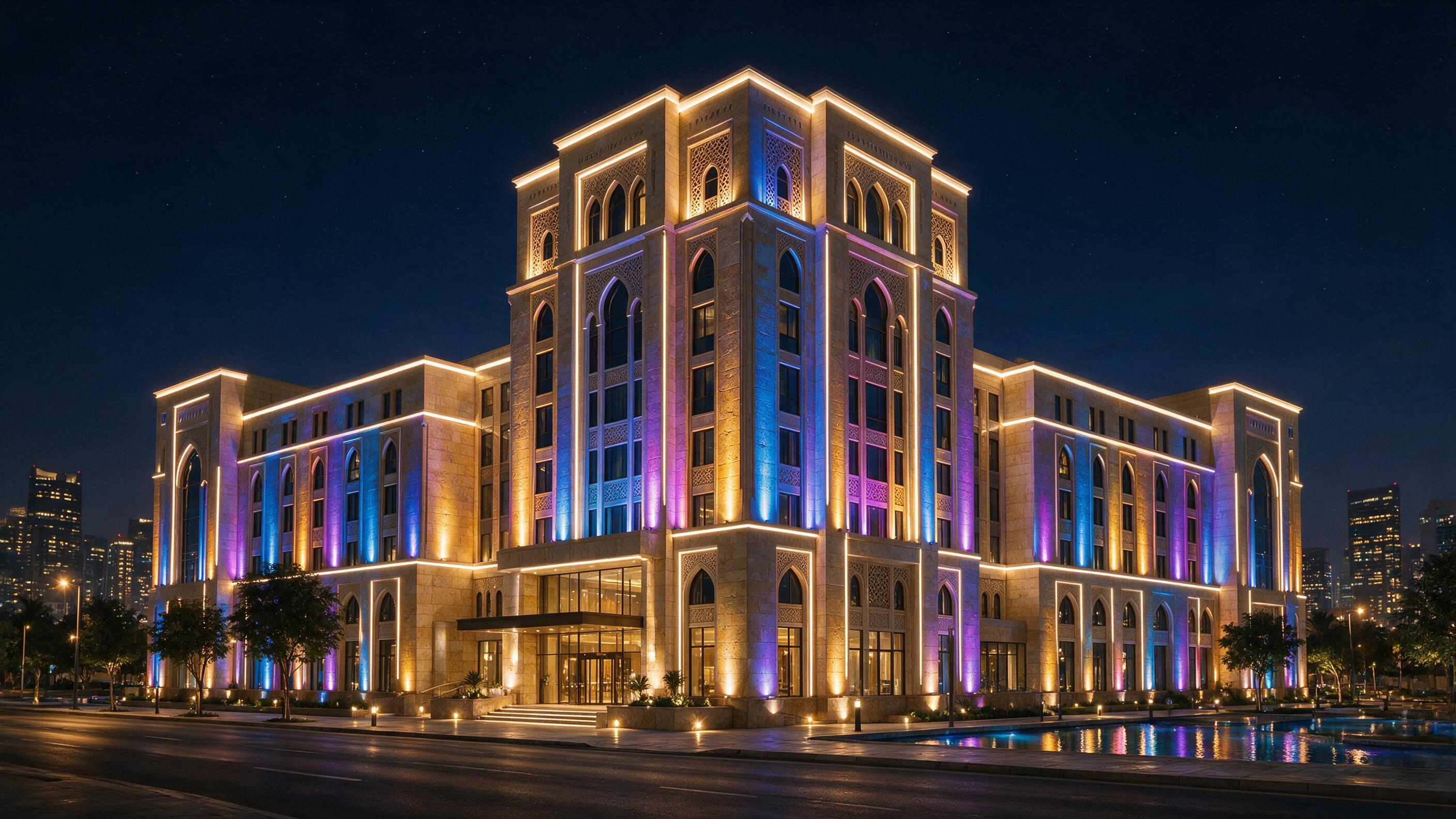 building facade illuminated with DMX512 LED architectural lighting solutions in Saudi Arabia">
Project Snapshot
|
Category |
Details |
|---|---|
|
Location |
Jeddah, Saudi Arabia |
|
Application |
Commercial Building Facade & Outdoor Architectural Lighting |
|
Key Products |
DMX512 Wall Washer, LED Linear Light, Pixel Dot Light, Flexible LED Strips |
|
Core Value |
On-site DMX512 testing, mounting bracket alignment, and risk elimination for high-power lighting contracts |
The Challenge: Overcoming Trust & Distance in High-Power Outdoor Lighting Sourcing
We first connected with this Saudi-based client in late 2024 through industry channels. They had a building facade project in Jeddah and needed a batch of high-performance outdoor lighting fixtures. After a few rounds of conversation, they were interested—but we could sense their hesitation. Who wouldn't be cautious? Half a world away, with only a few product photos and spec sheets to go on, placing a large order for architectural lighting is a major commitment.
The core challenge was threefold:
Trust gap — They'd never worked with us before and had no reference point for our build quality or optical performance.
Technical uncertainty — DMX512 synchronization, color uniformity across fixtures, and IP-rated durability can't be verified through images alone.
Logistics risk — Large-scale outdoor lighting orders involve significant investment. Any misalignment in mounting design or optical performance would be expensive to correct.
So we made a decision: we'd go there in person. Bring the sample case. Light up the products face-to-face. No intermediaries, no video call lag—just real fixtures, real light, and real answers.
 wall washers, linear lights, and pixel lights for a Saudi Arabia building facade project">
Saudi Arabia offers visa-on-arrival for Chinese citizens, making the logistics straightforward. We booked the flights, arranged the hotel, packed the samples, loaded the custom flight case, and set off. In February 2025, our export sales representative—equipped with deep product knowledge—flew roughly ten hours with that black flight case, landing in Jeddah.
Inside Our Portable Demo Case: DMX512 Wall Washers, Linear Lights & Pixel Dots
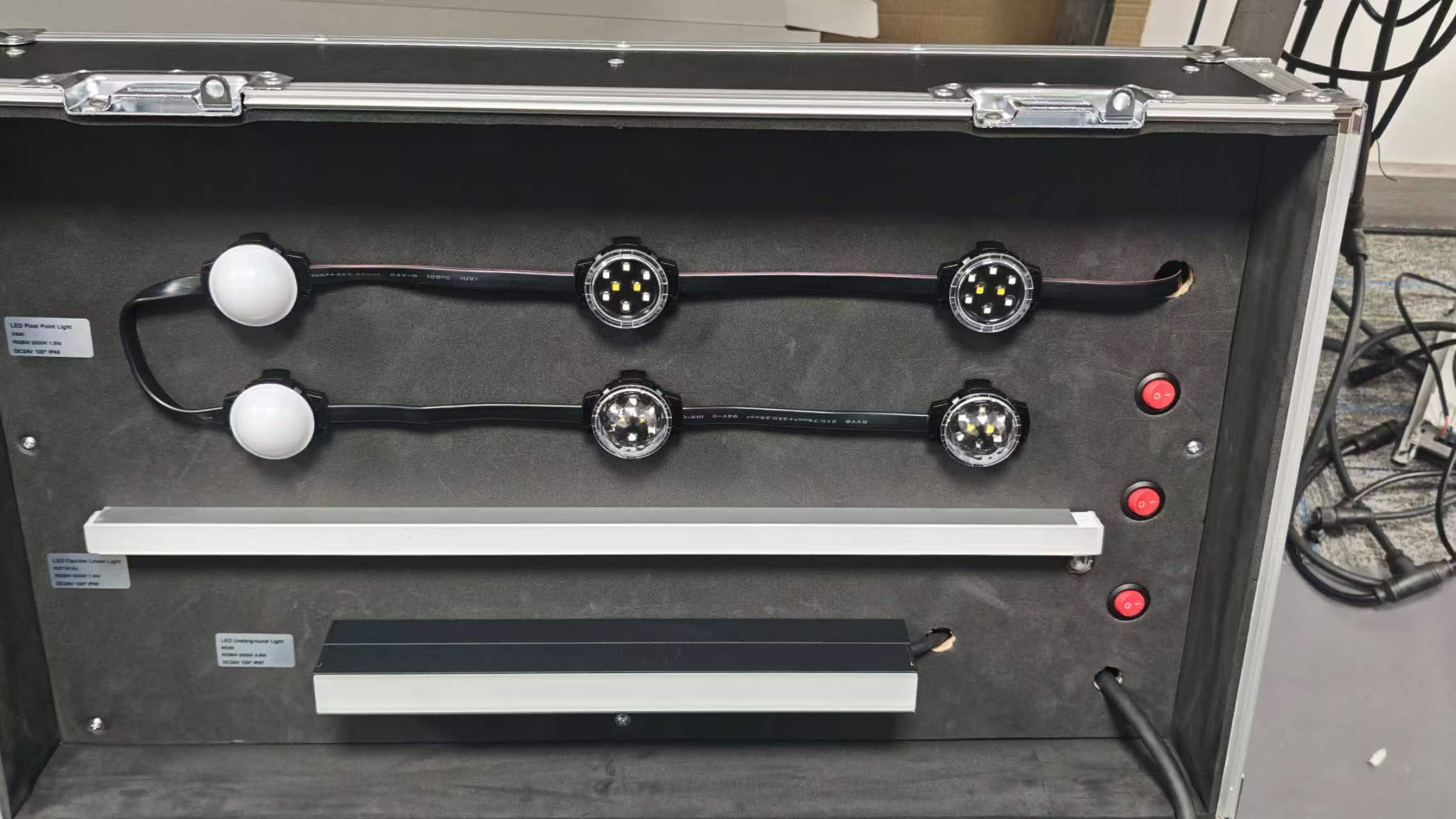
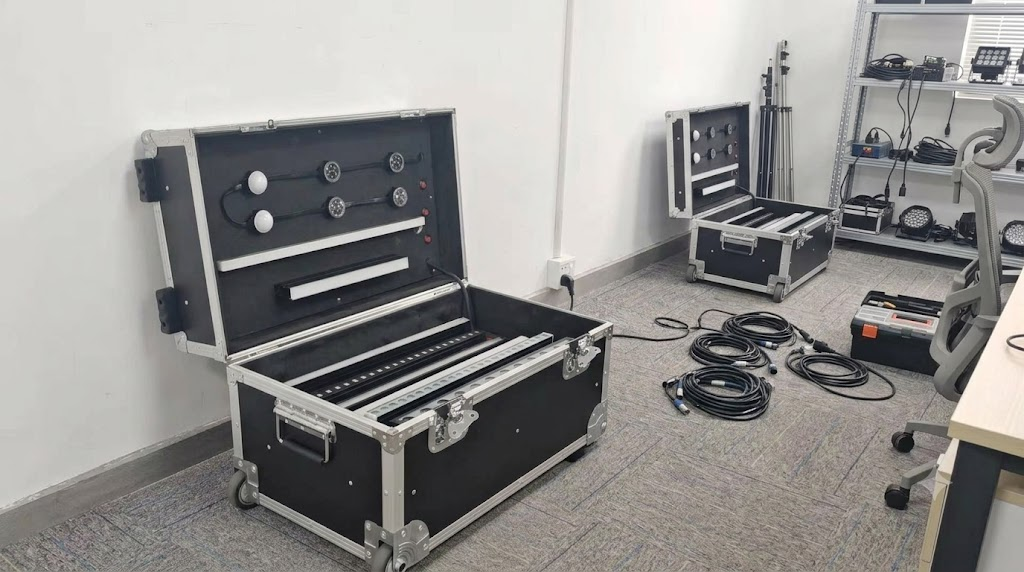
The flight case itself took some careful engineering. This wasn't just a matter of "throw the lights in and go." We designed it with a three-layer internal structure to maximize display efficiency and protect the fixtures during transit.
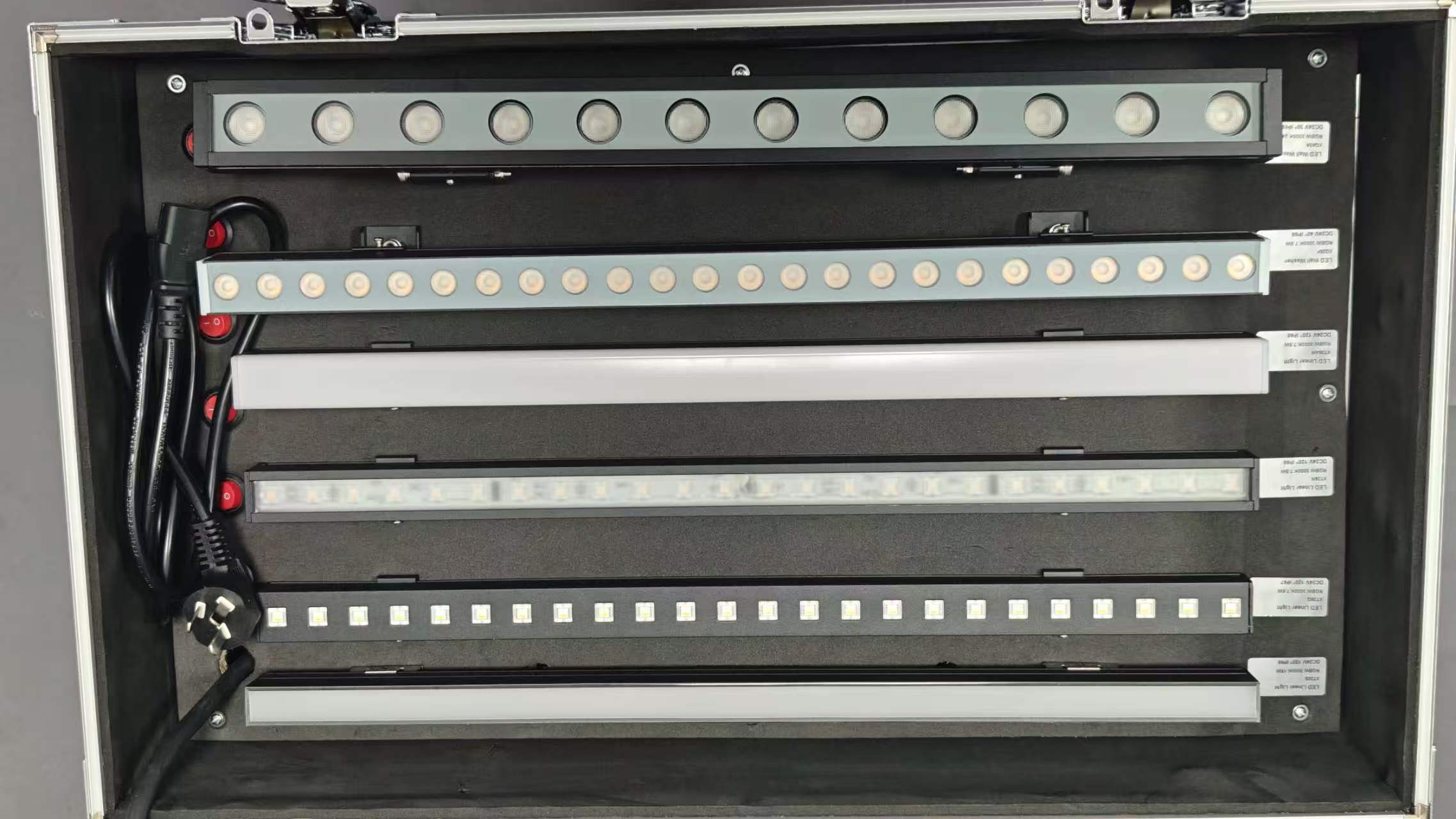
Open it up, and both sides display fixtures like exhibits in a gallery—neatly arranged, so the client sees the full range the moment the lid opens. On the thicker side, there's an additional middle compartment, bringing the total to three storage layers. The very bottom holds the power supplies and the DMX512 controller. Everything above that is lighting samples.
So what was inside? Let me walk you through the product lineup:
|
Product Type |
Specification |
Primary Application |
|---|---|---|
|
Pixel Dot Lights |
1 string (addressable) |
Building outline, dynamic effects |
|
Flexible LED Strip |
0.5-meter sample |
Curved surface accent lighting |
|
Flexible LED Strip |
0.3-meter sample |
Tight-space linear illumination |
|
DMX512 Wall Washer |
0.5-meter sample |
Building facade grazing & washing |
|
LED Linear Light |
0.5-meter sample |
Edge definition, architectural outlining |
It may not sound like a lot, but the variety covers our main outdoor product lines—dot lights for outlining, flexible strips for curved accents, wall washers with optical lens systems for broad surface illumination, and linear lights for crisp edge definition. Whatever the client wanted to see, we could pull it out, power it up, and demonstrate on the spot.
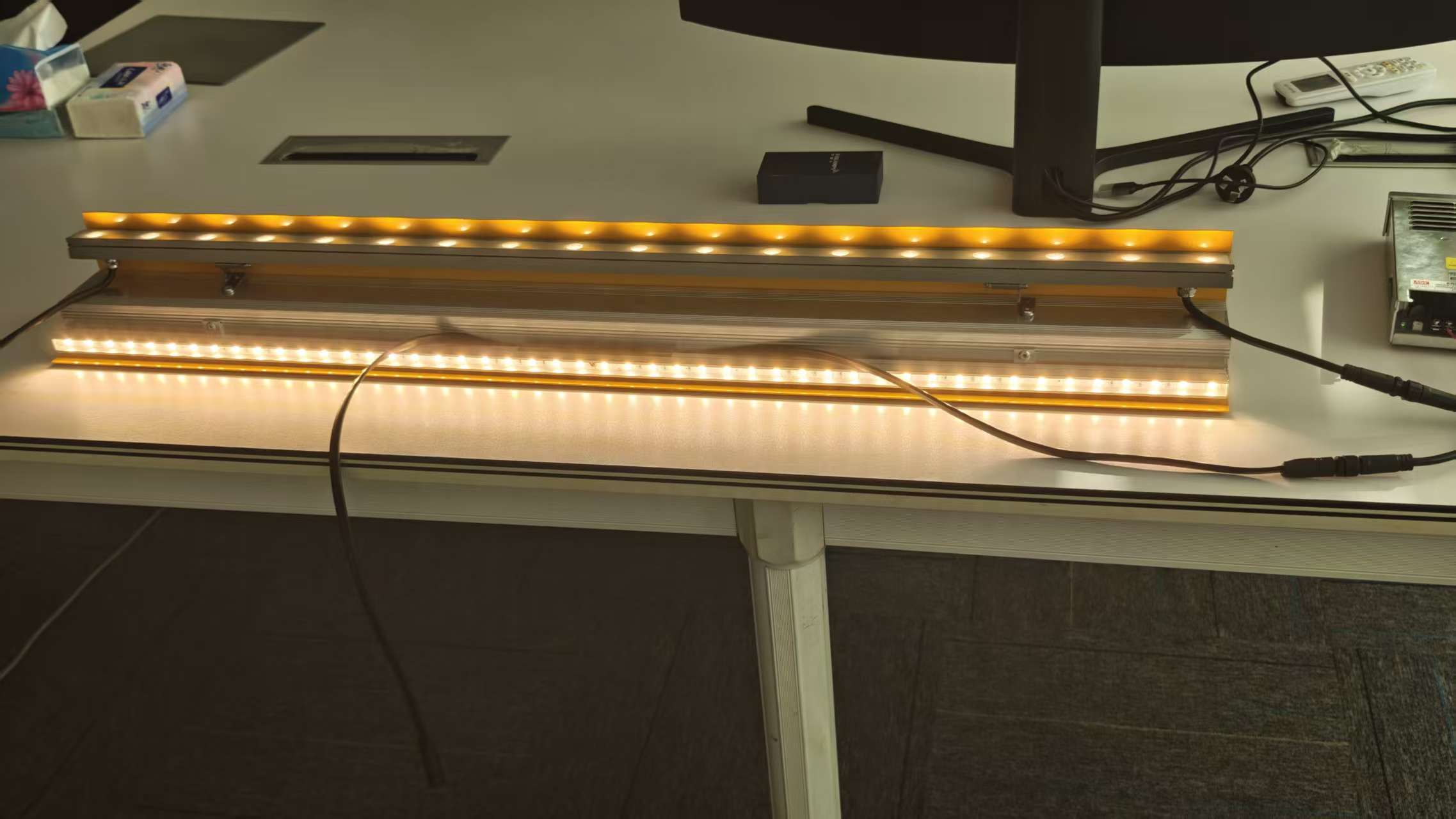
And here's the killer feature: every single fixture in that case is DMX512-controlled. That means one controller, one power connection, and every light synchronizes—RGBW color changing, dimming, dynamic sequencing—all in perfect harmony. This integration is critical for building facade projects where multiple fixture types must work together as a single lighting system.
On-Site Demonstration: Testing DMX512 Color Synchronization & Mounting Design
When we arrived at the client's office, there was no showroom, no testing facility. Just a desk and a power outlet. We opened the flight case, plugged in the power, connected the DMX512 controller.
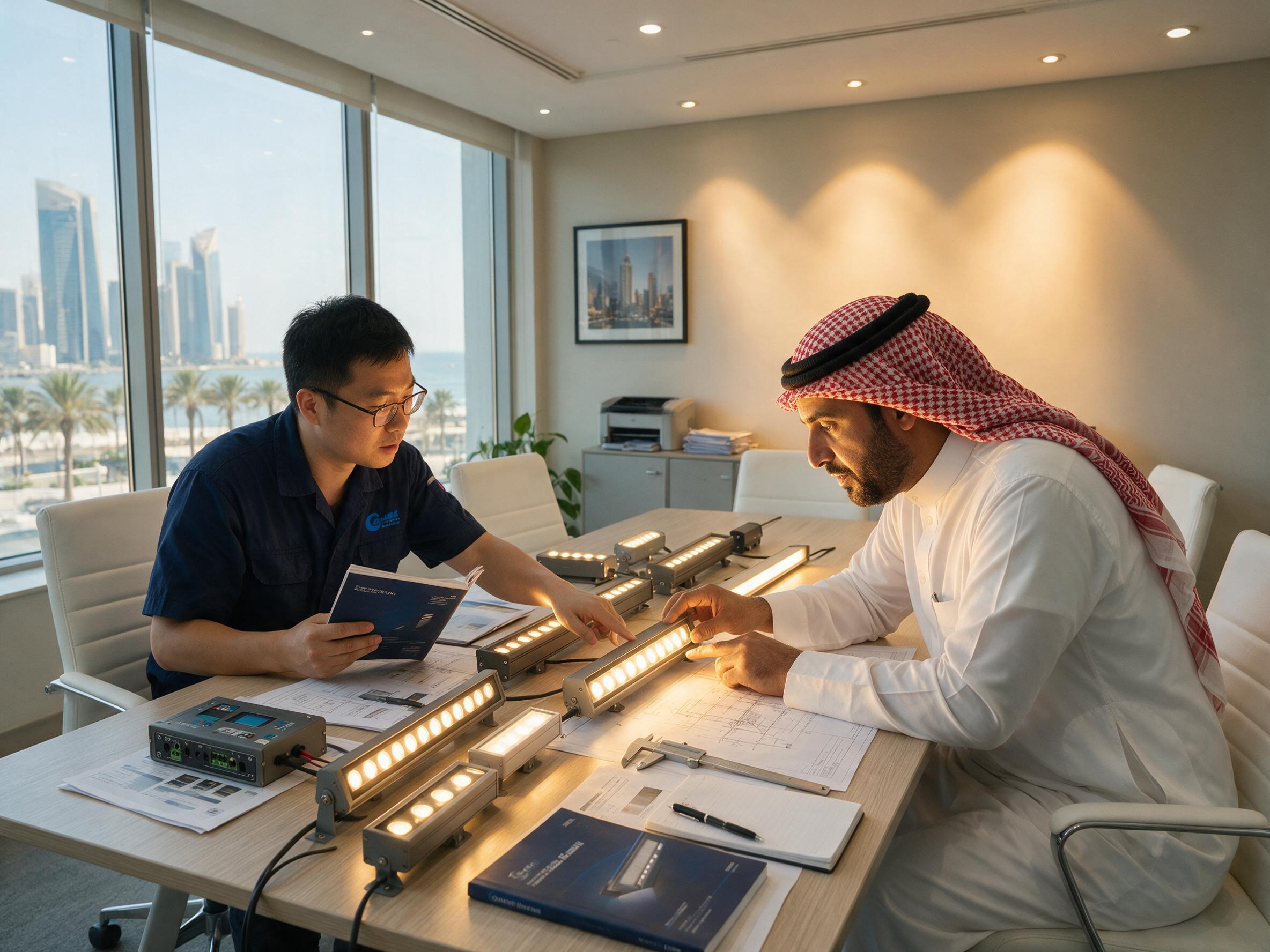
And then the lights came on.
What the client saw in real time:
Pixel dot lights pulsed through RGBW color cycles, demonstrating dynamic building outline effects.
Wall washers cast smooth, uniform grazing light across the office wall—confirming beam angle precision and color uniformity.
Linear lights delivered crisp, shadow-free illumination with consistent color temperature.
Flexible strips showed their adaptability for curved or tight architectural details.
Our sales representative walked through each product's technical specifications—lumen output, beam angle, IP rating, optical lens configuration, DMX512 channel assignment, and mounting bracket design—while the fixtures cycled through synchronized color sequences.
To be honest, seeing lighting effects under fluorescent office lights isn't the same as experiencing them at night in their intended application. But here's what mattered: the client verified critical parameters firsthand. He saw the color uniformity, assessed the beam angle precision, confirmed the build quality, and validated the DMX512 optical synchronization—all in real time. These are things you simply cannot appreciate through a phone screen or a video call.
The client's questions came fast and technical:
Pointing at the wall washer: "How does the mounting bracket handle different facade materials? Is it adjustable for varying surface angles?"
Examining the linear light: "What's the maximum continuous run length? Can we extend it without noticeable brightness drop-off?"
Testing flexibility: "Can we customize the DMX512 programming for specific animation sequences to match our facade design?"
Specific, technical questions mean one thing: he was seriously evaluating how to integrate these products into his project. We opened the bottom compartment right there, pulled out the mounting brackets, connectors, and accessories, and walked him through every engineering detail he needed.
One business trip condensed what could have been two months of back-and-forth emailing into a two-hour face-to-face engineering review. The project timeline didn't just stay on track—it accelerated.
Why On-Site Sample Testing Outperforms Video Calls for Architectural Lighting Projects
On the flight back, we reflected on the whole experience.
We could have just sent DHL samples and hosted a video call demonstration. But that approach has three major problems—especially for high-value architectural lighting projects:
|
Remote Method |
The Problem |
|---|---|
|
DHL sample shipping |
5-10 days transit + unpredictable client-side testing delays. The momentum stalls. |
|
Video call demonstration |
Phone cameras artificially compress dynamic range. Color rendering, uniformity, and beam quality are impossible to verify through a screen. |
|
Email/WhatsApp follow-up |
Long reply cycles, misaligned expectations, and technical details lost in translation. |
Face-to-face sample validation eliminates all three issues:
Immediate technical verification — The client confirms color uniformity, beam angle, IP rating, and DMX512 synchronization in person. No ambiguity.
Mounting and integration clarity — Bracket alignment, wiring, and fixture orientation can be physically demonstrated and adjusted on the spot.
Trust through transparency — Watching someone open the case, power the system, and demonstrate every function builds credibility that no PDF or video can match.
Moreover, being physically present allowed us to gather critical project intelligence that wouldn't surface in emails:
Actual site conditions — Facade materials, surface angles, environmental exposure
Installation constraints — Access limitations, mounting substrate, existing infrastructure
Budget and decision timelines — Realistic project parameters that inform engineering adjustments
These details are rarely shared in writing. But in person, they come out naturally—and they're often the difference between winning a project and losing it to a competitor who's willing to show up.
Accelerating Project Timelines: From Sample Verification to Engineering Execution
Since returning from Jeddah, our communication with the client has shifted gears entirely. Where emails used to take a week to get a reply, we now exchange project updates almost daily via WhatsApp and direct calls.
The collaboration has entered the execution phase:
The client shares construction site photos and asks precise application questions: "Which fixture works best for this corner detail?" "What's the recommended mounting approach for this facade surface?"
We've moved from "product introduction" to engineering consultation—aligning DMX512 programming, fixture placement, and system integration.
Technical documentation, installation diagrams, and custom DMX512 channel mapping are now in active development.
The order details are still being finalized, but the path forward is clear. The sample verification eliminated the risk that typically kills large lighting contracts: uncertainty about performance, compatibility, and installation feasibility. The client knows exactly what they're getting—because they've seen it, touched it, and tested it themselves.
That black flight case sits in the corner of our office now, a few more scuffs and scratches from baggage handling, the metal edges a little more worn. It looks like it's got stories to tell. Next time we're visiting a client in another country, it'll be rolling out again. Because compared to glossy brochures and PowerPoint presentations, a case full of real DMX512 architectural lighting fixtures is still the best sales tool there is.
FAQs
Q1: Why did you bring physical samples all the way to Saudi Arabia instead of shipping them?
We brought physical samples because architectural lighting performance cannot be verified through photos or videos. Color uniformity, beam angle precision, DMX512 synchronization, and build quality must be assessed in person—especially for high-value building facade projects. On-site testing eliminates technical uncertainty and builds trust faster than any remote method.
Q2: Which DMX512 products are best suited for Saudi Arabia's building facade projects?
Based on our Jeddah demonstration experience, the DMX512 wall washer is ideal for facade grazing and surface washing, while the LED linear light handles architectural outlining and edge definition. Pixel dot lights add dynamic effects for building outlines. All our products are IP65-rated and tested for high-temperature performance—critical for the Gulf region's climate.
Q3: What makes your DMX512 lighting system different from other suppliers?
Our key differentiator is system integration. We manufacture all fixture types (wall washers, linear lights, pixel dots, and flexible strips) to work seamlessly under a single DMX512 controller with synchronized RGBW color changing. This eliminates compatibility issues and simplifies installation for large-scale projects.
Q4: Can you customize DMX512 programming and mounting designs for our project?
Absolutely. We offer full DMX512 programming customization—from specific color palettes and animation sequences to integration with existing building management systems. Our mounting brackets can be customized to match different facade materials and surface angles, as demonstrated during our Jeddah on-site meeting.
Q5: Do your outdoor lighting products handle Saudi Arabia's extreme heat and dust?
Yes. All fixtures in our sample case are IP65-rated for dust and water resistance and undergo high-temperature testing for sustained operation in desert climates. We've engineered them specifically for infrastructure and architectural projects across the Gulf region.