Bending Light: A Custom DMX512 Four-Color LGP Journey Along an Expressway Guardrail
A long-term customer who had worked with us for years approached us with a new highway lighting project. Having experienced our strong customization capabilities in previous collaborations, he knew that we could handle complex lighting solutions beyond standard products. This project, however, presented a significant challenge: installing light guide panels along both sides of a completely dark highway to create dynamic RGBW four-color lighting effects. The fixtures had to strictly match the customer's predefined design profile, including a specific shape and size that could not be modified. This requirement meant that a fully customized LED lighting solution was necessary, as no existing standard product could meet the project specifications. Furthermore, this highway serves as a major gateway to the city's international airport, making the lighting design an important part of the city's modern image rather than simply a decorative feature.
The customer's vision was ambitious: creating synchronized lighting effects across several kilometers of highway guardrails, with programmable color changes for holidays, festivals, and special events. At the same time, the system needed to ensure complete glare-free performance and driving safety. The lighting fixtures had to be installed directly onto existing guardrails without drilling or structural modifications. The most challenging requirement was that the custom light guide panels (LGPs) needed to perfectly follow the natural curve of the guardrails while maintaining consistent brightness and color uniformity throughout the entire installation.
Based on our understanding of optical engineering, we were initially cautious about the feasibility of this project. Traditional acrylic light guide panels rely on precisely designed micro-dot structures to control light extraction and distribution, and these structures are typically optimized for flat surfaces. Once the panel is curved, the optical path becomes much more difficult to predict, which can result in uneven illumination and inconsistent lighting effects. In addition to the optical challenge, the fixtures would be exposed to harsh outdoor environments, requiring excellent waterproof performance, corrosion resistance, and long-term durability to ensure reliable operation on the highway.
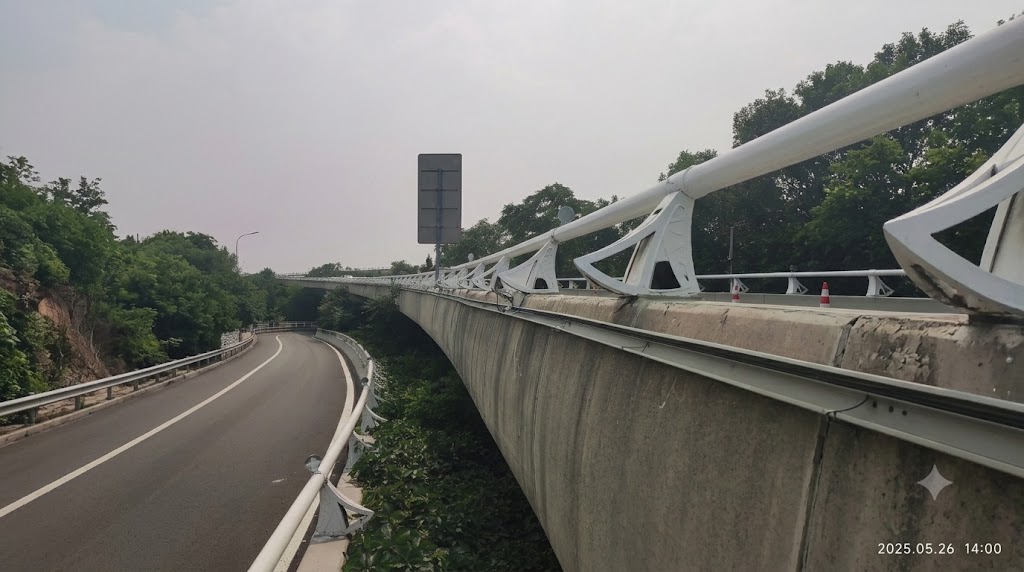 light guide panel LGP fixtures mounted along elevated highway guardrail during daytime.">
Why Light Guide Plate (LGP) Technology for Highway Guardrails?
Before this project, our LGP experience was primarily indoor—architectural applications like shopping mall atriums, corporate lobbies, museum display cases, and signage backlighting. The principle is straightforward: LEDs mounted along the edge of an optical-grade acrylic panel inject light into the material, and precision-engineered micro-dots (created via laser etching) scatter that light uniformly across the entire surface.
For this highway application—especially given the airport gateway location—LGP offered four distinct advantages that no competing technology could match:
|
Advantage |
Description |
|
Zero Glare |
Light emanates from the entire surface rather than discrete points. No hotspots, no blinding reflections—just a soft, even glow that delineates the road edge without distracting drivers at highway speeds. |
|
Uniform Coverage |
No dark zones between fixtures. The guardrail presents a continuous, seamless band of light—critical for the high-visibility airport corridor. |
|
Slim Profile |
The 8mm-thick acrylic panel sits flush against the guardrail, appearing almost invisible by day and transforming into a luminous ribbon by night—aesthetic enough to complement the city's gateway image. |
|
Design Flexibility |
The edge-lit architecture allows the fixture to conform to the customer's predefined exterior profile without compromising optical performance. |
But there was one glaring problem: we'd never curved one before. And honestly, we weren't certain it was physically feasible.
The First Prototype: A Beautiful Failure
We knew that laboratory tests, no matter how precise, couldn't fully replicate the real-world conditions of an active highway—the ambient darkness, the vibration from passing trucks, the visual context of the guardrail against the road. So we made a decisive move: instead of continuing with small bench samples, we fabricated twenty full-scale LGP modules on spec, paired them with a single 500W power supply, and took them directly to the project site for an on-location proof of concept.
By that time, we had already put the optical design through several rounds of refinement—adjusting micro-dot density gradients, laser-etching parameters, and thermal management strategies—but nothing beats seeing the actual fixture on the actual guardrail. We mounted the twenty units along a test section of the highway, wired them to a portable DMX512 controller, and waited for dusk.
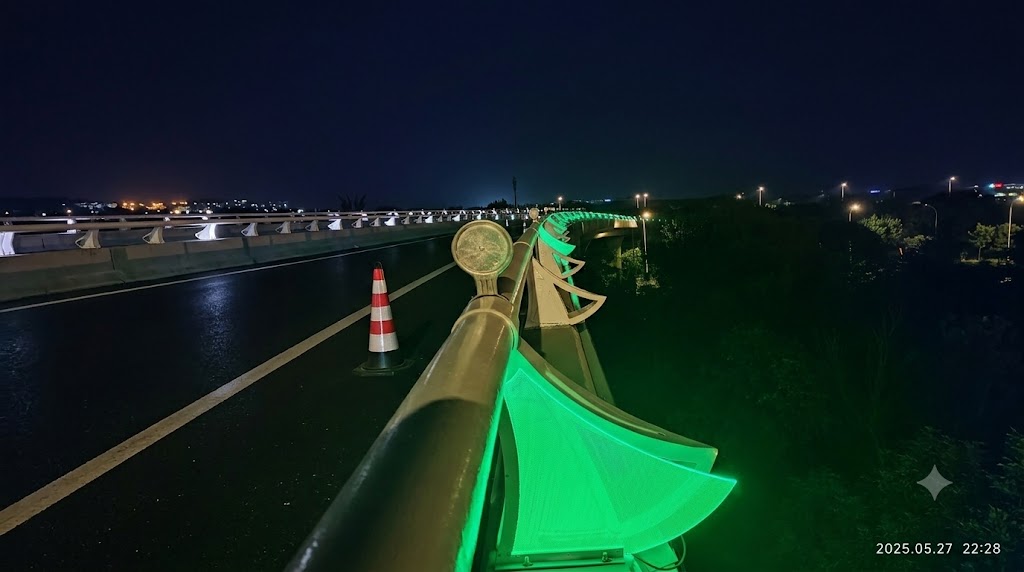
When we powered them on, the result was everything we'd hoped for. The light spread evenly across every panel—no hotspots, no dark zones, no edge halos. The curved acrylic followed the guardrail's contour seamlessly, and the RGBW color transitions were smooth, vibrant, and perfectly synchronized. More importantly, the glare was virtually nonexistent; the diffuse surface glow delineated the road edge without any distracting reflections—a critical safety requirement for highway speeds.
Our customer team was on-site with us that evening. Watching their reactions—nodding, taking photos, exchanging approving glances—we knew we had delivered. They later told us that the live demonstration exceeded their expectations, especially given the airport gateway's high visibility and the stringent aesthetic demands.
That moment of shared satisfaction made all the prior iterations worthwhile. We had proven that curved LGPs could work in the field—not just in theory, but with real hardware on the real road. From that night on, we knew the project was in good hands.
DMX512 Control: Running Digital Signals Across Kilometers of Guardrail
With the optical challenge solved, we turned to the control architecture. The customer wanted synchronized color changes across several kilometers of highway—both sides, hundreds of individual fixtures, all responding to the same master signal. This wasn't just about aesthetics; for a high-profile airport gateway, the lighting needed to run dynamic sequences during holidays and civic events, projecting a vibrant, modern image of the city to arriving visitors.
DMX512 is a robust, time-tested protocol. It's the industry standard for stage lighting, architectural installations, and entertainment venues worldwide. But scaling it to highway distances introduces its own set of headaches.
The main issue: signal degradation. DMX512 is built on RS-485 physical layer, which can reliably run several hundred meters under ideal conditions. But on multi-kilometer runs, signal attenuation and reflection become critical problems. We had to split the system into multiple DMX universes, each with its own opto-isolated signal booster, then synchronize them all through a central timecode generator with GPS-referenced timing.
The secondary issue: cable selection. We specified shielded twisted-pair cable with a characteristic impedance of 120Ω—strictly matching the DMX512 specification—and used daisy-chain topology with active terminators at each universe's endpoint. This ensured clean signal rise times and minimal ringing, even on the longest runs.
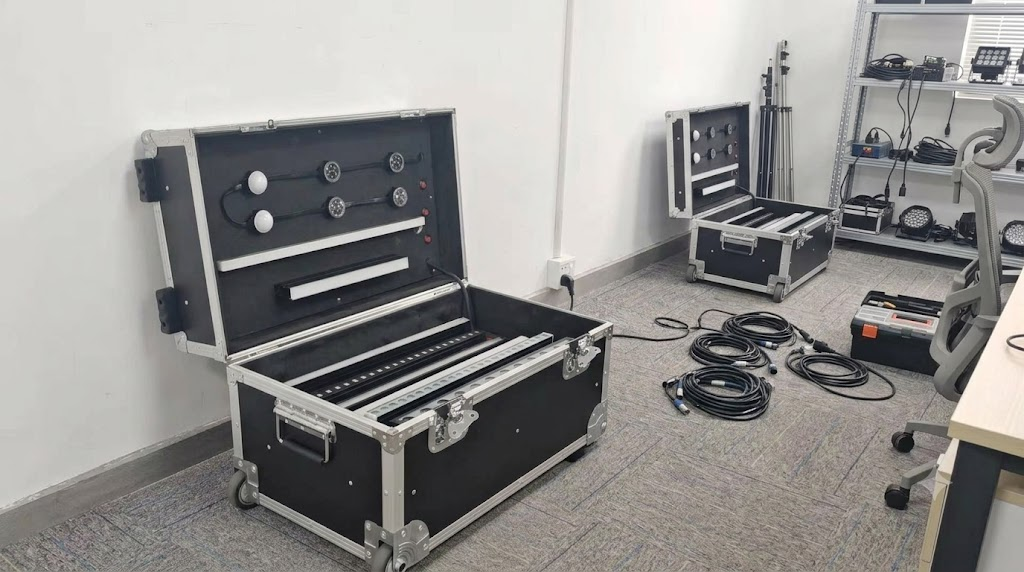
The factory validation test was memorable. Our lead technician set up 48 units on the production floor—the maximum we could physically accommodate in the available space—and ran a full 256-level grayscale ramp test across all four channels (Red, Green, Blue, White). The fixtures cycled through the entire 16.7-million-color spectrum, flicker-free, with step transitions smooth enough to be imperceptible to the human eye.
Meanwhile, to help the customer better visualize the final lighting performance, we recorded the entire testing process and shared the videos with them, allowing them to clearly evaluate the lighting effects before moving forward with production.
Installation: Clamp-On Mounting and On-Site Realities
The clamp-on bracket—what we call a 抱箍 (bào gū) in our internal documentation—was our answer to the "no drilling" mandate. We designed a two-piece stainless steel bracket that wraps around the existing guardrail post and secures the LGP fixture with rubber-lined clamps. No holes. No modifications. No compromise to the guardrail's structural integrity.
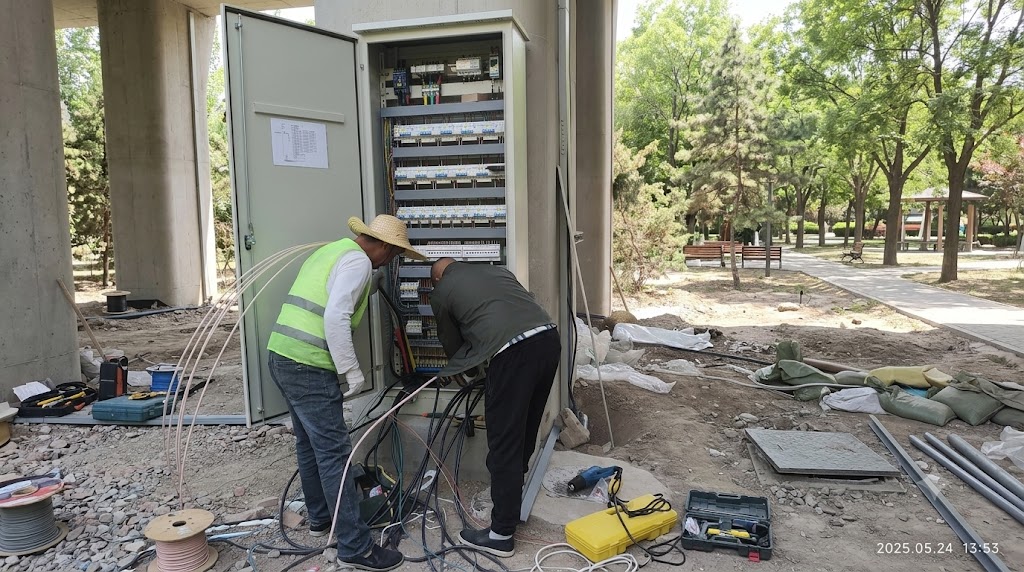
But installation week was anything but smooth. The first issue: vibration. This highway is a major freight artery, and heavy trucks pass continuously at speeds exceeding 90 km/h. The initial clamp design, while secure during static testing, didn't hold tight enough under sustained dynamic load. After two days of operation, several units had shifted slightly out of alignment, creating visible gaps in the continuous light line—a problem that would have been especially noticeable on the airport gateway route.
We had to retrofit every single bracket—all 187 of them—with additional anti-vibration neoprene pads and high-torque lock nuts. Our engineering team developed the fix on-site, working alongside the installation crew until 11 PM on a Thursday night. It wasn't glamorous, but it worked.
The second issue: weather. It rained for three consecutive days during the installation window—unusually heavy for that time of year. The fixtures themselves are IP65-rated, so they were unaffected, but the electrical terminations had to be kept perfectly dry during splicing and connection. The crew erected temporary tarps over each work zone, losing approximately two full days of schedule to weather delays.
The third issue: access coordination. The highway couldn't be closed during installation. All work had to be performed during off-peak hours (11 PM to 5 AM) with rolling lane closures. This compressed our effective work window to just six hours per night, turning a two-week installation into a three-week marathon.
The customer was understanding—they had worked with us long enough to know we deliver, even when challenges arise—but they were watching closely. Every delay was documented. Every adjustment was justified. We maintained daily progress reports with photographic evidence—a practice that ultimately built trust rather than invited scrutiny.
The Results: Two Sides, One Synchronized Corridor
Three weeks after installation completed, we returned to the site for a nighttime inspection. The fixtures had been running daily from dusk to dawn, and the visual effect was everything we'd hoped for—and everything the airport gateway deserved.
By day, the sail-shaped LGP panels blend seamlessly into the guardrail structure. The 8mm acrylic is transparent and unobtrusive—almost invisible unless you're specifically looking for it. The stainless steel brackets are powder-coated in a dark gray finish that matches the existing guardrail hardware. Travelers arriving at the airport would never notice the fixtures during daylight hours—exactly as intended.
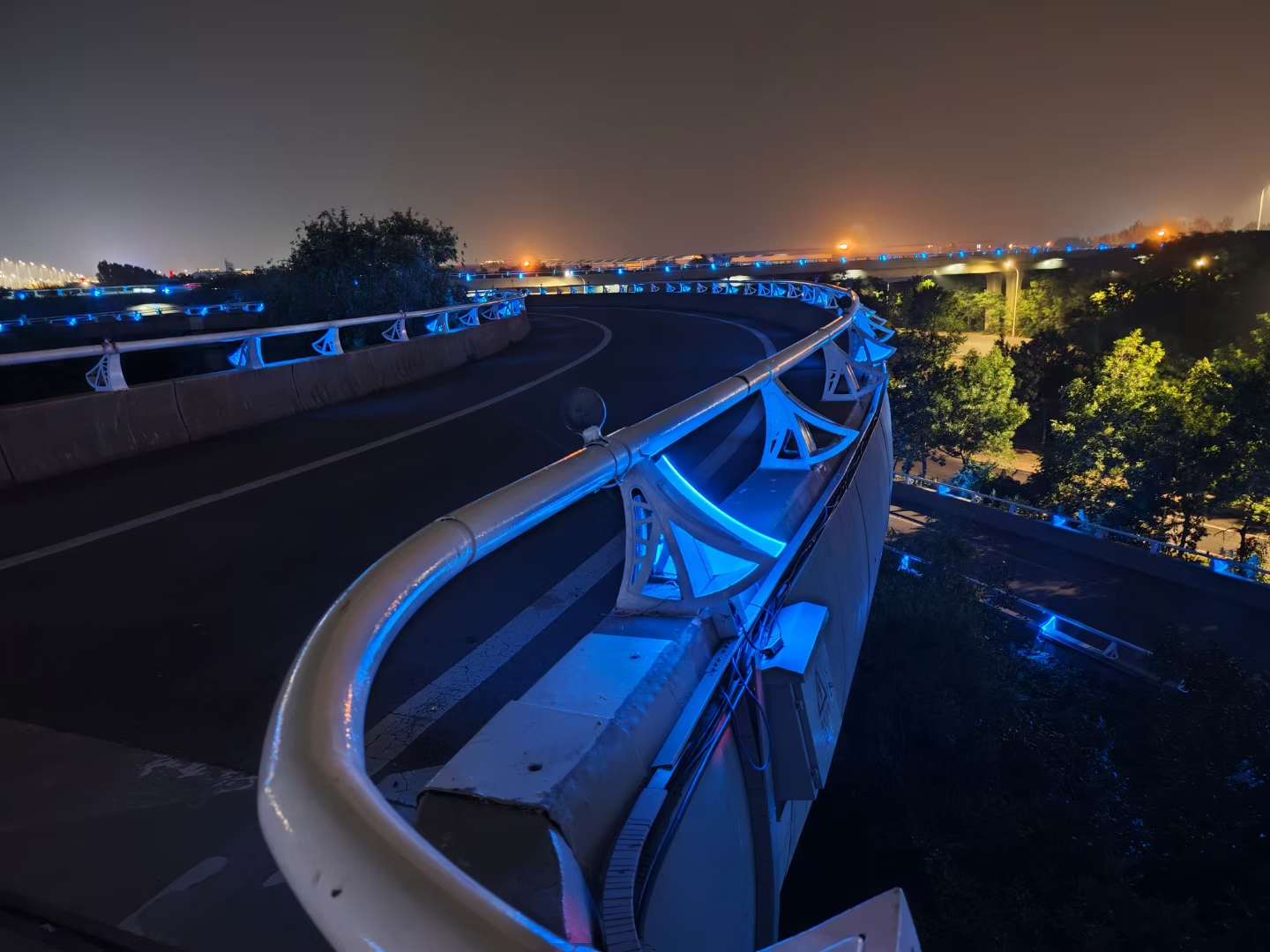
By night, the corridor transforms completely. Running at 60% brightness for standard weekday operation, the RGBW system produces a clean, warm white light (3000K) that gently delineates the road edge without any glare whatsoever—a critical safety feature validated by an independent photometric study commissioned by the transportation authority.
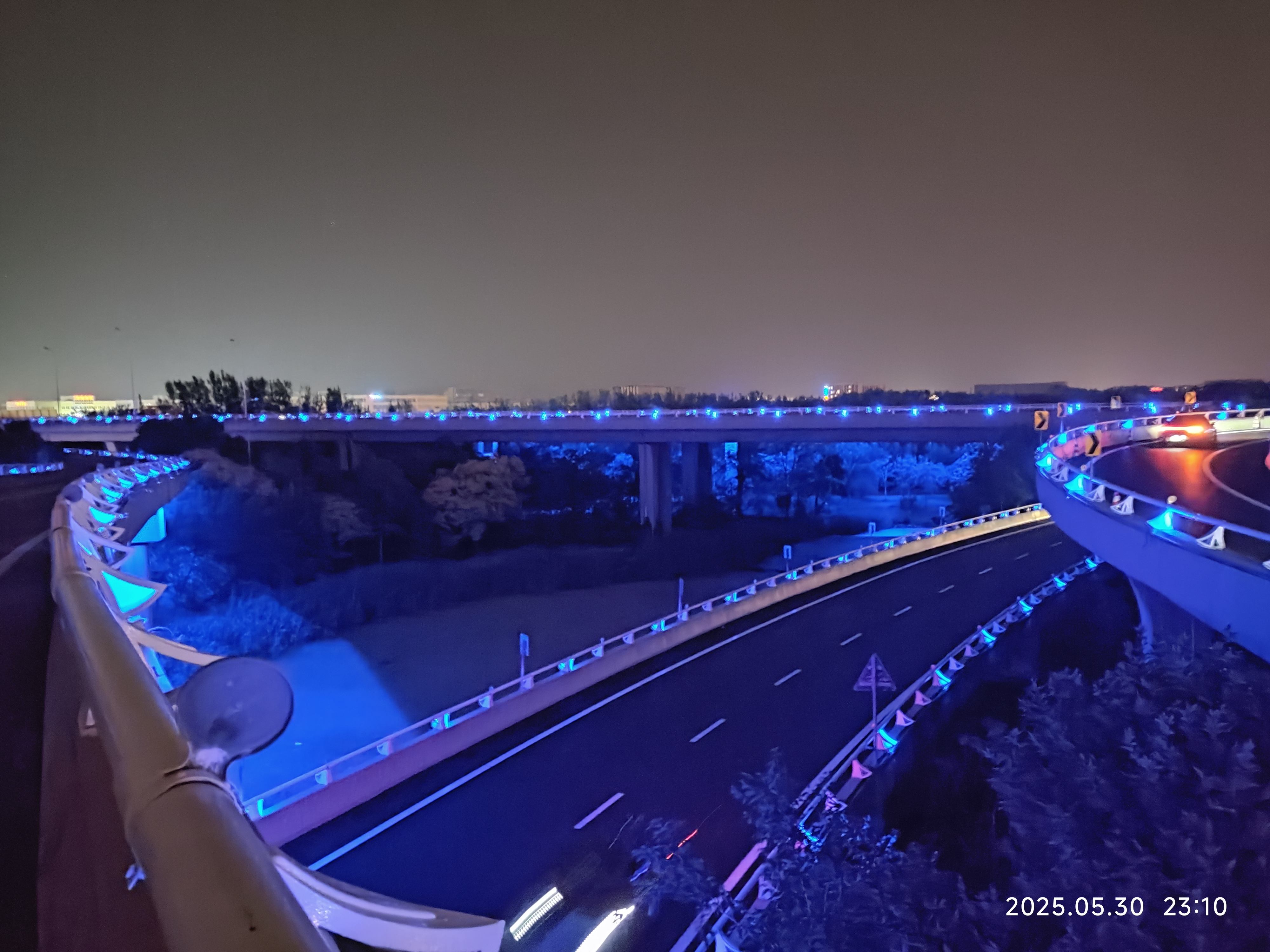
On weekends and holidays, the DMX512 programming switches to dynamic mode. Color waves move in the direction of traffic, synchronized across both sides of the highway. The transitions are smooth, the color palette is rich, and the overall effect is striking without being distracting—a balance that required careful tuning of both speed and saturation parameters. For visitors arriving at night, the corridor now offers a memorable first impression of the city.
Conclusion: A Gateway Transformed, A Capability Proven
Looking back, this project was never just about lighting a highway. It was about meeting the trust of a long-term customer who believed we could solve a problem that others dismissed as impossible. It was about delivering a visual experience worthy of a city's front door—the route that greets travelers arriving from around the world. And it was about proving to ourselves that curved light guide plates, once a technical fantasy, could become a reliable, field-tested reality.
We didn't get there overnight. We got there through late nights at the test bench, on-site adjustments under tarps in the rain, and countless iterations of micro-dot patterns that most people will never notice—but that make all the difference between a glare hazard and a luminous ribbon of light. We got there because our customer gave us the freedom to fail, and then the confidence to try again.
Today, that stretch of highway is no longer a dark corridor. It's a synchronized canvas of RGBW color that moves with traffic, celebrates holidays, and welcomes visitors with quiet elegance. The fixtures blend into the guardrail by day and transform the roadside by night—functional safety and aesthetic ambition working in perfect harmony.
About Us
We are a professional LED lighting manufacturer specializing in customized outdoor architectural lighting solutions, including LED wall washers, linear lighting systems, light guide panel (LGP) solutions, and DMX512-controlled lighting projects. We focus on developing lighting products that go beyond standard solutions and meet the unique requirements of global engineering projects.
With strong capabilities in optical design, structural customization, and outdoor lighting engineering, we work closely with architects, lighting designers, contractors, and project owners to transform complex lighting concepts into reliable solutions. From prototype development and testing to final production, we provide complete technical support throughout the entire project process.
Over the years, we have delivered customized LED lighting solutions for commercial buildings, urban landscapes, public spaces, and large-scale architectural projects worldwide. By combining innovation, engineering expertise, and manufacturing experience, we help customers create lighting systems that achieve both outstanding visual effects and long-term performance.
FAQs
Q1: Can light guide panels (LGPs) be customized for curved surfaces?
Yes. Traditional light guide panels are mainly designed for flat applications, but through customized optical design and micro-dot distribution adjustments, LGPs can be adapted to curved structures. In this project, we developed a curved acrylic LGP solution that perfectly followed the natural shape of the highway guardrail while maintaining uniform brightness and smooth RGBW color transitions.
Q2: Why choose LGP technology instead of traditional LED strips for highway guardrail lighting?
Light guide panel technology provides a more uniform and glare-free lighting effect compared with traditional LED strips or point-source lighting. Since the light is distributed across the entire surface, it eliminates visible hotspots and reduces direct glare, making it ideal for applications where visual comfort and driving safety are critical.
Q3: Can the RGBW lighting effects be controlled remotely?
Yes. The lighting system supports DMX512 control, allowing hundreds of fixtures to be synchronized across long distances. Different lighting scenes, color changes, brightness levels, and dynamic effects can be programmed for holidays, festivals, and special events.
Q4: How were the LGP fixtures installed without modifying the existing guardrail?
To meet the requirement of no drilling or structural modification, we developed a customized clamp-on mounting system. The stainless steel brackets securely attach the lighting fixtures to the existing guardrail structure while maintaining installation stability and protecting the original infrastructure.
Q5: Are customized LGP lighting systems suitable for outdoor environments?
Yes. For outdoor architectural and infrastructure projects, customized LGP systems can be engineered with waterproof housing, corrosion-resistant materials, and optimized thermal management. These designs help ensure reliable operation under challenging weather conditions and long-term outdoor exposure.