How to Spec and Size Outdoor Lighting Power Supplies: An Engineering Guide
The twilight check was a disaster. The client pointed to the far edge of the retaining wall—the LED strips there were dull and visibly warmer than the bright fixtures near the transformer. Three hours of testing confirmed my suspicion: severe voltage drop across the long run. That's why I wrote this guide — to get the selection and design of outdoor lighting power supplies right from the start.
What Is an Outdoor Lighting Power Supply?
An outdoor lighting power supply is a device that converts AC mains voltage into the low-voltage DC required by outdoor LED fixtures, while regulating current and voltage within specified tolerances. Often referred to as the "heart" of any architectural or landscape illumination system, this component is critical because LEDs are highly sensitive semiconductor devices; without a stable, regulated power source to buffer them from thermal fluctuations and utility grid anomalies, even the most premium fixtures will suffer from premature lumen depreciation, color shifting, or outright driver failure.
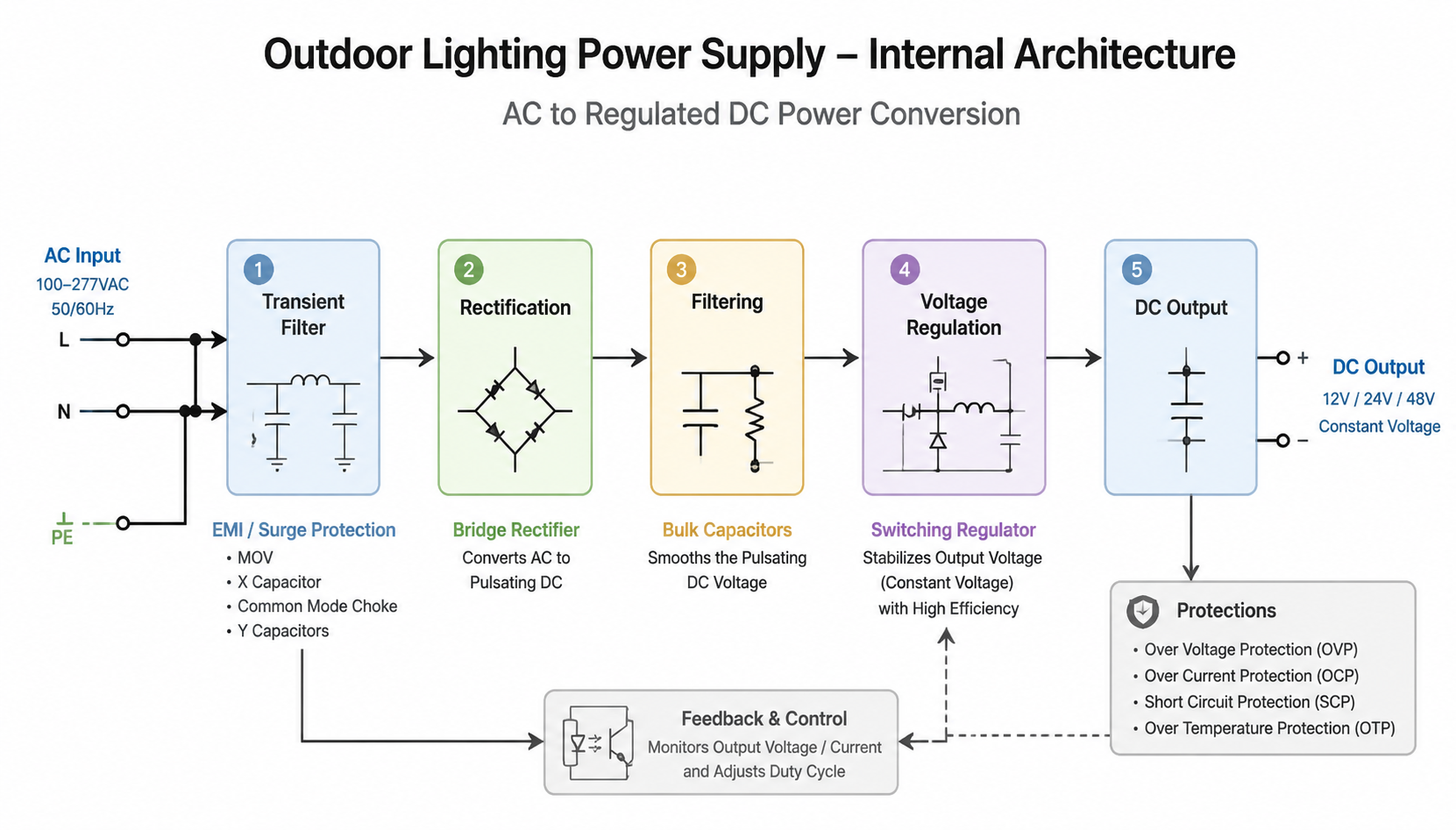
On a component level, the power supply manages this transformation through a tightly coordinated sequential process rather than a simple step-down. The process begins at the AC Input, where raw utility power (typically 120V to 277V AC) enters the driver and immediately meets a transient filter stage to block line surges. Once stabilized, the signal undergoes Rectification, employing a bridge rectifier to convert the bidirectional alternating current into a unipolar direct current. This raw DC, however, is too turbulent for LEDs; it must pass through a heavy Filtering stage—utilizing bulk capacitors and inductors—to smooth out dangerous voltage ripples and suppress high-frequency electromagnetic interference (EMI). Finally, the smoothed signal enters Voltage Regulation, where a high-frequency switching regulator (typically running a buck or flyback topology) maintains a razor-sharp, stable DC Output (usually 12V or 24V DC) to shield the downstream LEDs from grid fluctuations.
While indoor and outdoor power supplies share the same basic electrical topology, their physical and thermal architectures are engineered for entirely different operational realities. The three core differences that dictate survival in exterior environments are:
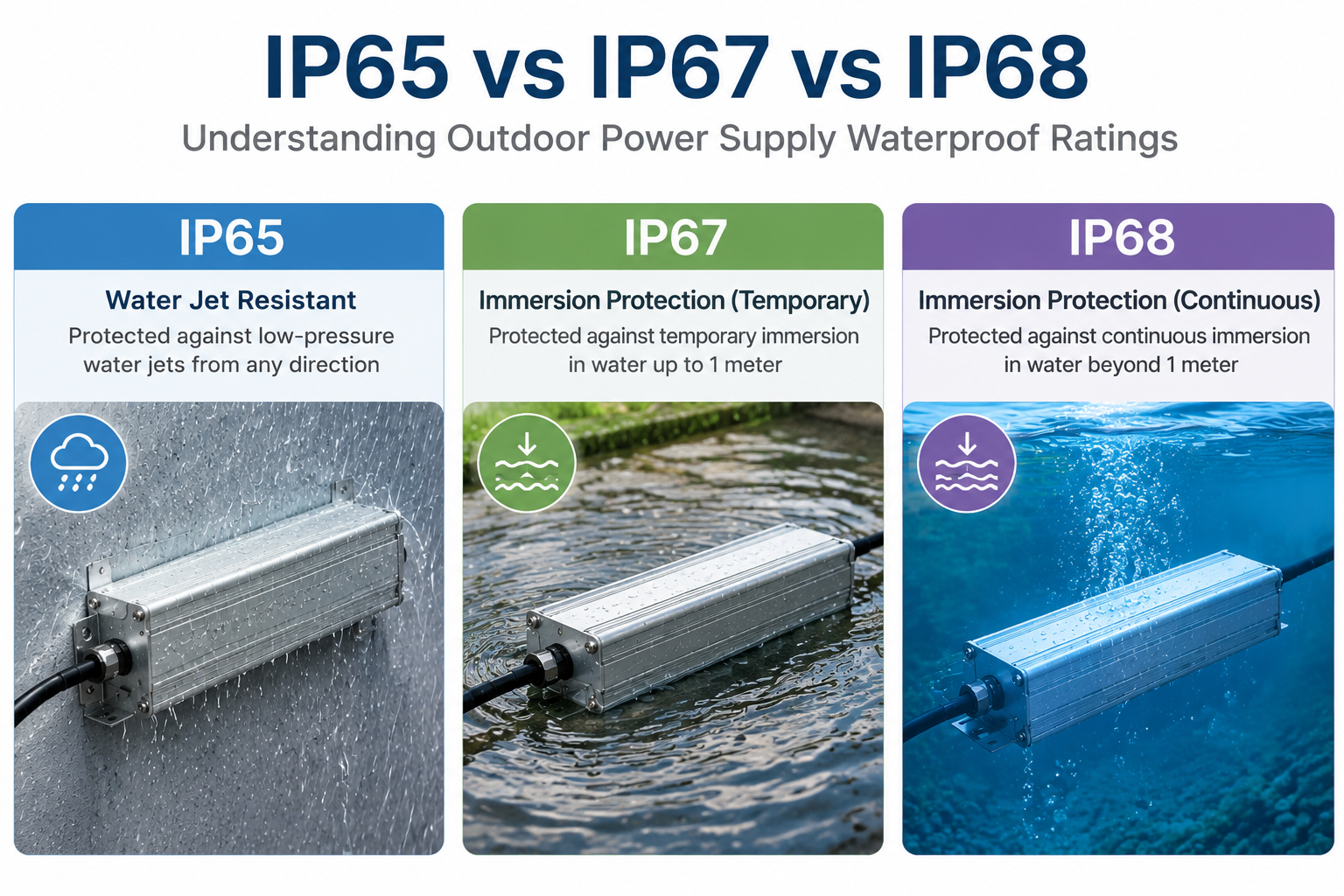
Ingress Protection (IP): Outdoor units require a minimum rating of IP65, meaning they are completely dust-tight and resistant to water jets, whereas indoor units typically carry an IP20 rating. The real-world implication is that outdoor enclosures must be hermetically sealed against driving rain, high humidity, and dust to prevent short circuits, while indoor units rely on ambient air venting.
Operating Temperature Range: Outdoor power supplies must reliably perform from -40°C to +70°C (-40°F to 158°F), compared to a standard indoor range of 0°C to 40°C (32°F to 104°F). The real-world implication is that outdoor components must tolerate extreme seasonal temperature swings and internal heat buildup without undergoing thermal runaway or premature degradation.
Surge Protection: Outdoor systems require a built-in surge rating of 4kV to 10kV, while indoor drivers typically top out at 1kV to 2kV. The real-world implication is that outdoor units must actively suppress high-voltage transient spikes from nearby lightning strikes and utility grid switching to protect the sensitive LED chips downstream.

For design teams, specifying the correct power supply is never a minor detail—it is the ultimate single point of failure for project longevity. Field diagnostics reveal a brutal reality: 80% of outdoor lighting system failures trace back to poor driver selection or flawed installation, not the LED fixtures themselves. To prevent these costly field callbacks, architects and engineers must evaluate the same piece of hardware through two distinctly different, yet interdependent, lenses:
Architects must look beyond the spec sheet: focusing on compact physical form factors that conceal within narrow architectural reveals, thermal dissipation profiles that prevent convective heat from damaging sensitive cladding materials, and clean aesthetic integration that keeps the hardware completely out of sight.
Engineers must drill into the physics: verifying exact electrical parameters—such as tight power factor limits and total harmonic distortion (THD)—while executing precise conductor sizing and voltage drop calculations, and ensuring absolute compliance with local wet-location mandates (such as UL Wet Location or IP-rated system boundaries).
While this guide won't turn every reader into a power supply design engineer, it establishes the technical guardrails needed to keep your project out of that 80% failure statistic. Ultimately, the power supply acts as the unsung gatekeeper of your entire lighting design—converting raw, unpredictable utility AC into the rock-solid, low-voltage DC required to keep your fixtures performing exactly as specified.
Selection & Sizing — The Decision Chain
Selection isn't design from scratch — it's a decision chain, one choice at a time. Each choice you make narrows down the hardware options, ensuring the final specification matches both electrical and environmental demands without over-engineering. Below, I break this decision chain into 5 practical steps to guide your selection.
Identify project type and fixture type: Determine the specific application, as facade illumination typically uses LED spotlights, landscape designs favor low-voltage tape lights, and roadway lighting requires high-mast luminaires—each demanding vastly different power delivery profiles.
Determine wiring configuration: Analyze how the fixtures are electrically connected, where a series circuit requires a constant current driver to maintain uniform brightness, and a parallel circuit demands a constant voltage driver to distribute power safely.
Choose the system voltage: Verify the nominal voltage (typically 12V, 24V, or 120–277V) directly from the fixture specification sheet, keeping in mind that lower voltage systems are significantly more sensitive to line loss and voltage drop over long cable runs.
Select the appropriate IP rating: Choose IP65 for general rain-exposed outdoor installations, IP67 for areas prone to temporary flooding or heavy washing, and IP68 for fixtures requiring continuous submersion, such as fountains, or direct soil burial.
Confirm regulatory compliance certifications: Verify that the power supply carries the necessary marks for your jurisdiction—such as UL Wet Location listing for North America, CE and ENEC marks for the European Union, or IEC/EN 61347 compliance as a global safety baseline.
The "80% Peak Load Rule" – Our Non‑Negotiable Safety Benchmark
To size a power supply reliably, running it at 100% rated capacity under continuous load is a critical mistake that guarantees overheating and rapid component failure. Through decades of engineering projects and rigorous field testing at Shenzhen Liangjiamei Lighting Co., Ltd., we have established a non-negotiable safety benchmark: always limit your continuous active load to a maximum of 80% of the power supply's rated capacity, leaving the remaining 20% strictly unused.
This rule is our most critical field-tested insight. For example, if your total fixture load calculated for a run is exactly 500W, you should never specify a 500W unit. Instead, divide your active wattage by 0.8 to find your target hardware spec—which in this case means specifying a power supply rated for at least 625W. This 20% headroom acts as a vital safety buffer. It effortlessly handles the massive, transient inrush currents drawn by LED drivers at the microsecond of startup, cushions the system against voltage spikes, and prevents thermal runaway when ambient temperatures spike during peak summer months.
Installation & Protection Addendum
You sized the power supply correctly. You picked the right voltage. And the lights still don't work evenly — 9 times out of 10, it's a wiring problem. The primary culprits are voltage drop, which starves downstream fixtures of necessary power, and incorrect cable selection, which leads to physical deterioration and moisture ingress under ground. This section covers what cable to use, how far you can run it, and how to protect it.
Cable Selection by Routing Method (Global + North American Options)
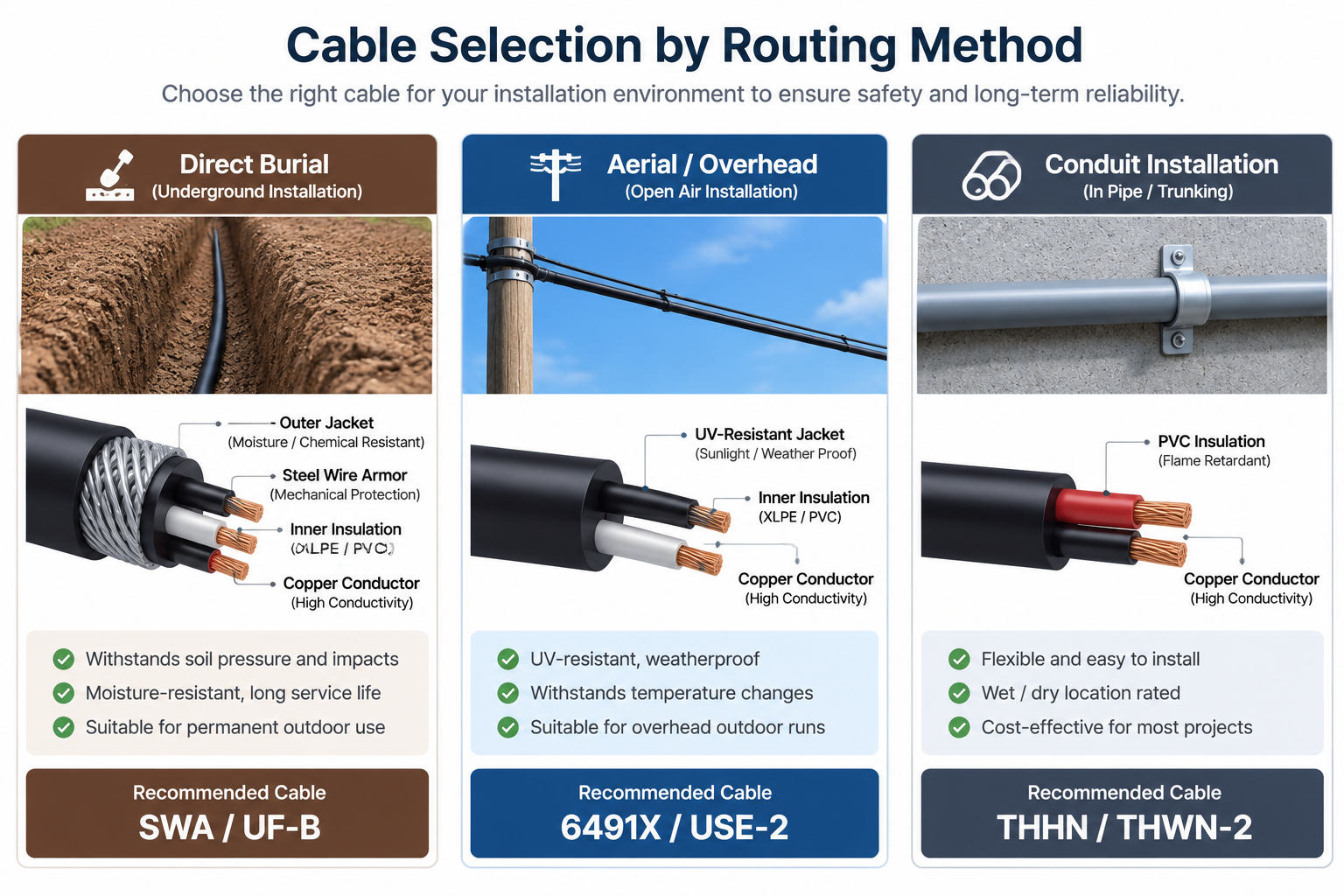
Specifying the wrong cable type for the physical environment guarantees water intrusion, insulation breakdown, or mechanical failure over time. Depending on your routing method, you must select a cable construction engineered to survive those specific stresses:
Direct burial: Steel Wire Armored (SWA) cable is the international standard, with mechanical armoring protecting conductors from soil pressure and accidental strikes. For North American projects, specify UF‑B cable (underground feeder) as the cost‑effective, code‑compliant alternative for direct earth burial.
Aerial installation: 6491X single-core with UV-resistant insulation (harmonized European standard) prevents ozone cracking and solar degradation. In North America, equivalents like USE‑2 or XLPE‑insulated conductors are commonly specified for exposed outdoor aerial runs.
Conduit installation: PVC-insulated single-core cable reduces friction for easy pulling through bends. For North American conduit systems, THHN/THWN-2 is the standard choice—its dual rating covers both dry and wet locations, making it ideal for damp underground conduits.
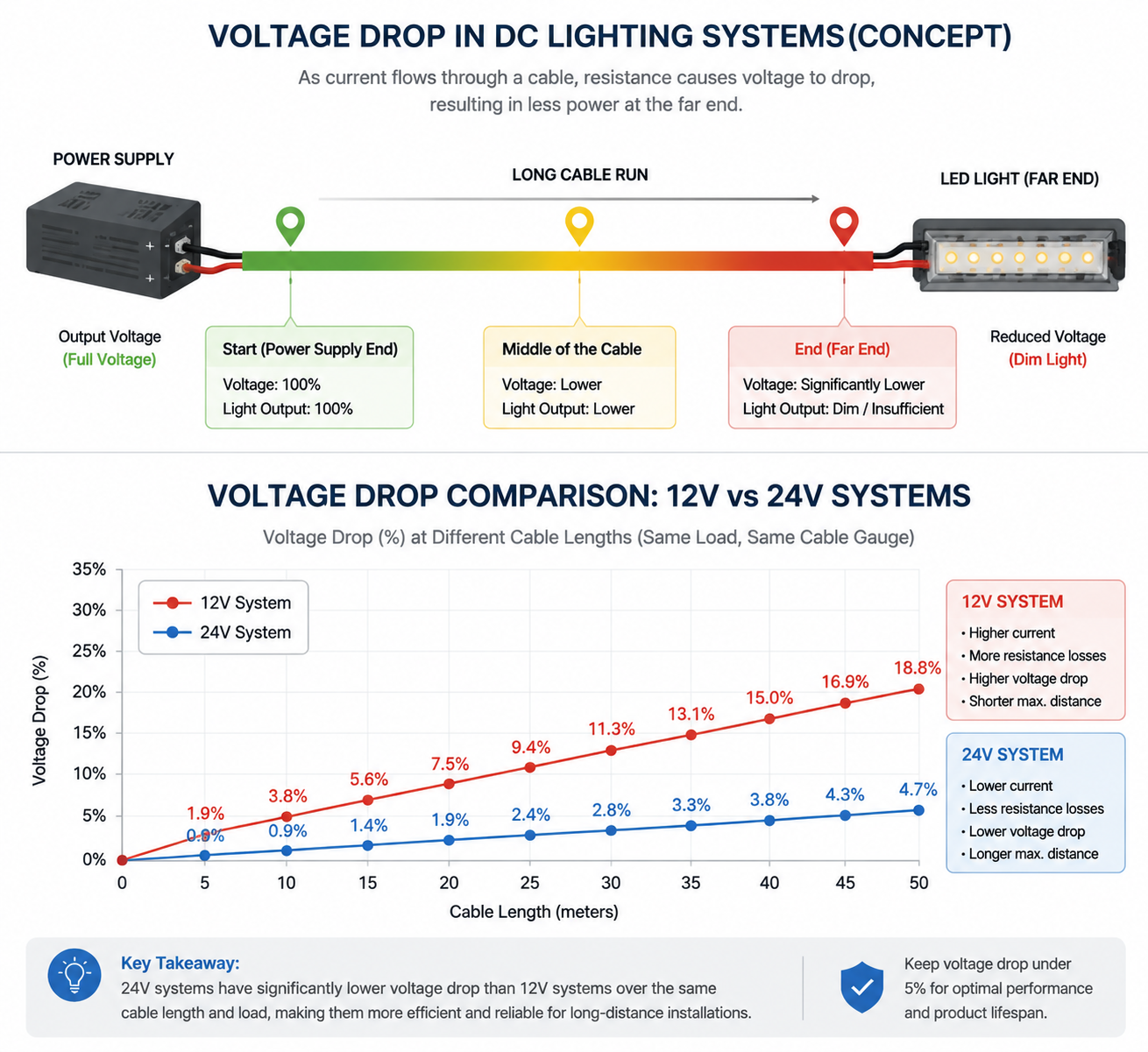
Managing Voltage Drop – Why 24V Beats 12V
The physics of voltage drop is simple: electrical cable is not a perfect conductor, but a resistor. As current flows through this resistance, a portion of the voltage is lost as heat, with the total drop increasing proportionally with longer distances, higher currents, and smaller wire gauges. To illustrate, consider a 100W load: a 220V system draws only ~0.45A of current, whereas a 24V system must draw ~4.2A to deliver the same wattage. Because voltage drop is directly proportional to current, the low-voltage 24V run experiences roughly ten times the voltage drop of the high-voltage run over the same wire. This power starvation causes visible dimming at the far end of the run, noticeable color shifting, or a complete failure of the terminal fixtures to ignite. To mitigate this, design teams should prioritize 24V systems over 12V configurations—since doubling the voltage cuts the current in half, reducing voltage drop by 75%—and specify larger conductor cross-sections (smaller AWG gauges) to lower cable resistance.
Grounding – Keep It Simple and Code‑Compliant
Designing an effective grounding system is a fundamental safety requirement for outdoor lighting installations, where damp soil and exposed metal poles escalate shock hazards. For standalone pole systems, the TT scheme—which isolates the local earth from the utility neutral—is widely preferred internationally for its fault-current containment. That said, always consult your local utility requirements and adopt the scheme mandated by your regional code (e.g., NEC Article 250 in North America, or local equivalents); for most practical outdoor projects, we recommend following the utility's standard practice rather than over-specifying a topology.
Physical Mounting – Keep It Cool and Shaded
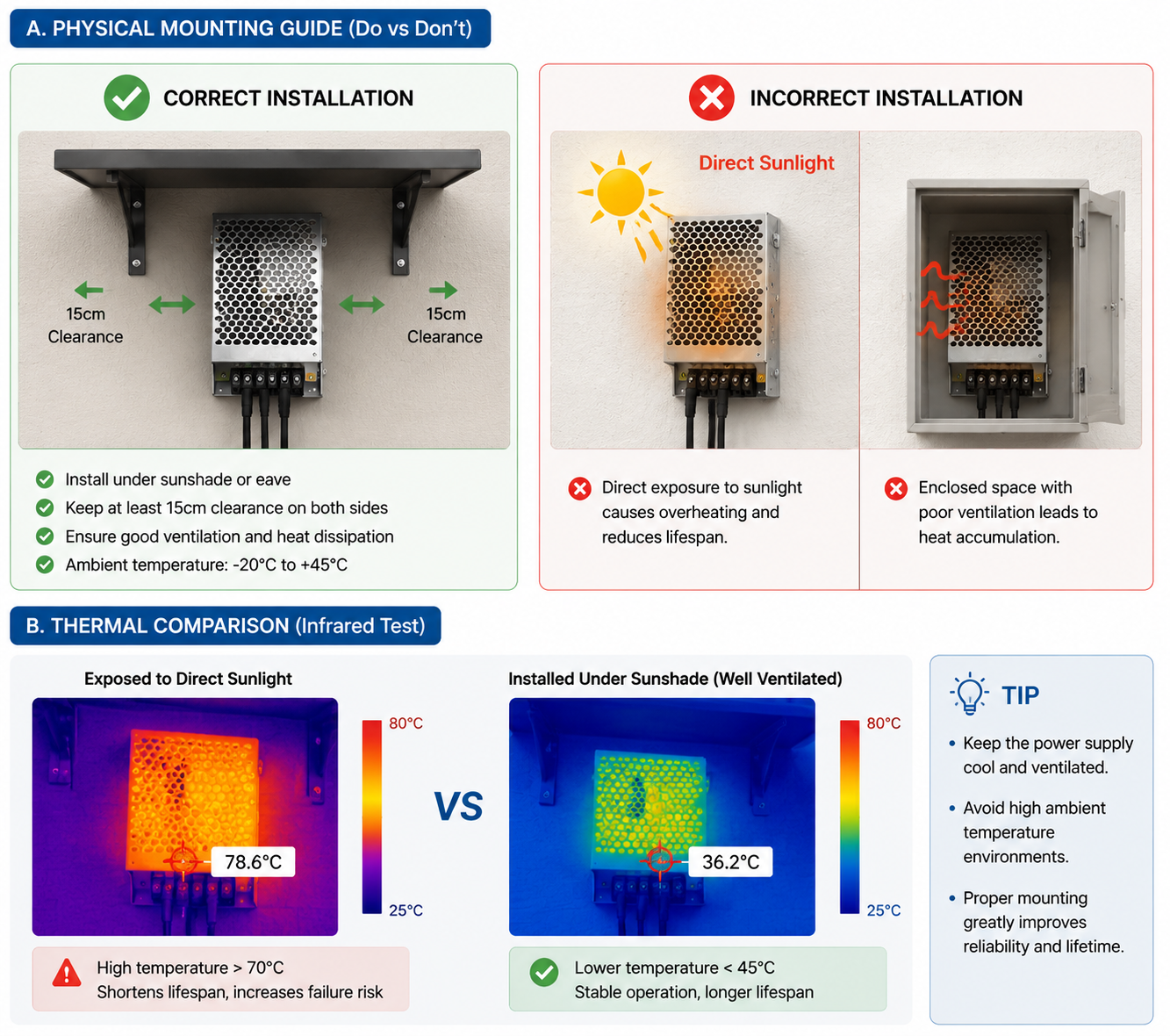
Where you physically mount the power supply directly dictates its operational lifespan, as poor placement leads to chronic thermal stress and rapid hardware failure. First, avoid direct sunlight at all costs: solar radiation can push the surface temperature of a metal power supply enclosure far beyond ambient air temperatures, accelerating the drying of internal electrolytic capacitors and cutting the unit's lifespan in half. Second, ensure adequate airflow around the chassis by maintaining at least 15 cm (6 inches) of free-air clearance on all sides; never seal a fanless power supply inside a tight, non-ventilated enclosure where heat is trapped.
Standards & Compliance
Compliance isn't a checkbox — it's the legal and insurance backbone of every project. Specifying or installing non-compliant outdoor power supplies carries severe professional and financial consequences, including failed municipal inspections, denied commercial insurance claims, and direct civil liability in the event of electrical fires or personal injury. This section does one thing — helps you quickly identify which standards apply to your project.
To navigate the complex regulatory landscape of exterior lighting, engineering teams must specify hardware that complies with the codes governing their specific geographical market and installation environment. The table below outlines the primary national and international standards that dictate the safety, electromagnetic compatibility, and physical performance of outdoor power supplies:
|
Standard Number |
Full Name |
Region/Application |
|
IEC/EN 61347 |
Lamp controlgear — Part 1: General and safety requirements |
Worldwide baseline for electrical safety of lighting controlgear. |
|
UL 8750 / UL 2108 |
Light Emitting Diode (LED) Equipment for Use in Lighting Products / Low Voltage Lighting Systems |
Essential North American safety standards for LED drivers and low-voltage systems. |
|
EN 55015 |
Limits and methods of measurement of radio disturbance characteristics of electrical lighting and similar equipment |
European standard governing electromagnetic interference (EMI) and radio frequency emissions. |
|
EN 61000-4-5 |
Electromagnetic compatibility (EMC) — Testing and measurement techniques — Surge immunity test |
European standard regulating the power supply's resilience to high-voltage transient surges. |
|
GB 50057 |
Code for design of protection of structures against lightning |
China national standard defining localized lightning protection and grounding design requirements. |
|
CSA C865.1:25 |
Light-emitting diode drivers — Methods of measurement (Binational standard with ANSI C82.16-2025) |
Canadian and U.S. unified standard defining performance and efficiency measurement protocols. |
For specific projects, consult a third-party certification body during the design phase to confirm the exact applicable standards.
Regional Compliance Quick Guide
Because safety regulations, electrical grids, and building codes vary drastically across borders, specifying the correct regional compliance path is critical for securing local project approval. When engineering your system, prioritize the following certification packages based on your project's physical location:
North America: Prioritize UL-listed (or CSA-certified) wet-location drivers and ensure strict adherence to National Electrical Code (NEC) Article 411 for low-voltage lighting systems.
Europe: Prioritize IEC/EN safety baselines, mandatory CE marking for market entry, and voluntary ENEC certification as a premium, third-party proof of product reliability.
China: Prioritize compliance with GB national standards and ensure the power supply carries the mandatory CCC (China Compulsory Certification) mark before installation.
Special Note on Lightning Protection Standards
Outdoor lighting systems are inherently exposed to lightning strikes and utility‑grid surges. A single induced overvoltage event can destroy your LED drivers in microseconds—and taking down an entire circuit often means costly repairs, especially when fixtures are buried underground or mounted on high poles. The labour and downtime far outweigh the hardware cost.
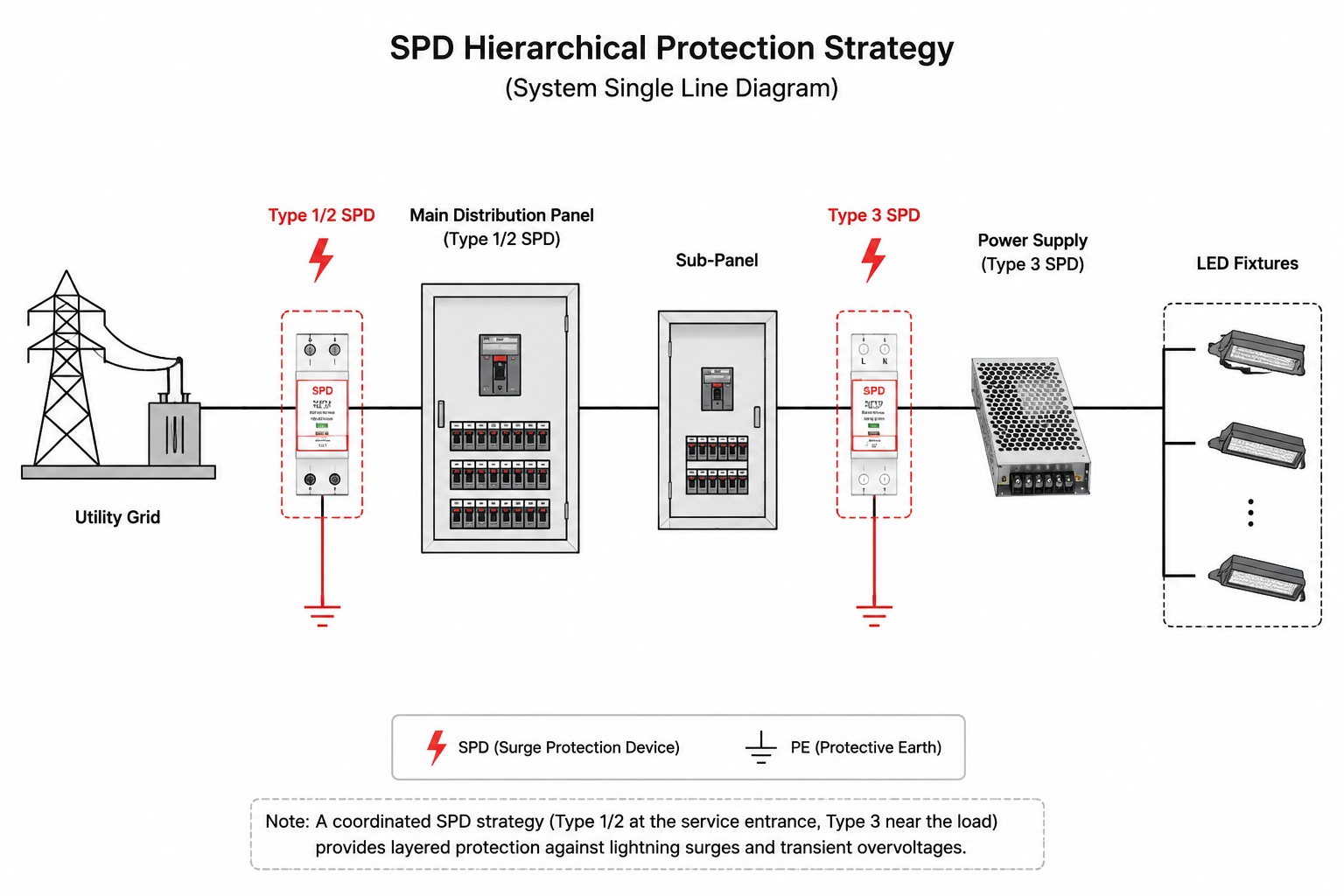
Internationally, lightning protection is typically governed by IEC 62305 (the global benchmark for surge protection), while North American projects often reference UL 1449 for SPDs, and European installations commonly require compliance with EN 61643‑11. Meeting these standards is the minimum we require—but we believe compliance alone doesn’t keep your lights burning through storm season. What really matters is real‑world reliability. That’s why we advocate a tiered protection strategy—proven across thousands of installations worldwide:
First line of defence: A heavy‑duty Type 1 or Type 2 SPD at the main AC distribution panel absorbs the brunt of direct lightning hits and high‑energy switching transients.
Second line of defence: A Type 3 SPD installed immediately upstream of each low‑voltage power supply or fixture housing clamps any residual overvoltage, protecting the sensitive LED chips inside.
This dual‑stage approach isn’t over‑engineering—it’s based on hard data from our own extensive field experience. Based on our internal field-return analysis covering over 2,000 outdoor installations globally, we've observed that in high‑lightning regions, a single SPD alone still correlates with a failure rate exceeding 30%; with a cascaded setup, that risk drops to below 5%. For you, this translates into tangible benefits:
Fewer call‑backs – lower maintenance costs and fewer client complaints.
Extended fixture life – minimising lumen depreciation and colour shift caused by voltage stress.
Smoother project handover – our solution comes with internationally recognised compliance documentation, helping you pass local inspections without hassle.
We don’t just hand you a generic checklist. We tailor the SPD selection and layout to your site’s specific lightning‑day frequency, grid characteristics, and local regulatory requirements. Just tell us your project location and power distribution scheme—we’ll handle the rest.
Summary
The path to a reliable exterior lighting installation relies on a rigorous decision chain: aligning project requirements to fixture types, choosing series or parallel wiring, selecting constant current or constant voltage topologies, calculating active wattage, and establishing critical parameters for IP ratings, surge immunity, and compliance. But hardware selection is only half the battle; success requires pairing those specifications with proper cable selection and precise voltage drop calculations to prevent field failures. One wrong power supply decision can compromise the entire lighting experience and lifespan of a project. Treat these electrical, physical, and regulatory requirements as a single, cohesive engineering task to ensure your design performs over the long term.
FAQs
Q1: How do I choose the right size outdoor lighting power supply?
The correct outdoor lighting power supply size depends on the total wattage of your LED fixtures, operating voltage, cable length, and installation environment. As a professional engineering practice, the power supply should not operate continuously at full capacity. A safety margin of approximately 20% is recommended, meaning the total LED load should generally stay below 80% of the power supply’s rated output. For example, a 500W lighting system should use a power supply rated at least 625W to ensure stable operation, thermal protection, and sufficient startup current capacity.
Q2: Is 12V or 24V better for outdoor LED lighting systems?
For most outdoor LED lighting applications, a 24V power supply is usually the better choice because it significantly reduces voltage drop over long cable distances. Since voltage drop increases with current, a 12V system requires twice the current of a 24V system for the same power output, resulting in greater energy loss and brightness variation. For landscape lighting, architectural facade lighting, and long-distance LED strip installations, 24V systems typically provide better efficiency, more consistent brightness, and easier cable management.
Q3: What IP rating should an outdoor LED power supply have?
The required IP rating depends on the installation environment and exposure level. For general outdoor lighting applications exposed to rain and dust, an IP65-rated power supply is typically recommended because it provides complete dust protection and resistance against water jets. Projects exposed to heavy water spray, temporary flooding, or harsh environments may require IP67 or IP68 protection. Selecting the correct IP rating helps prevent moisture damage, corrosion, short circuits, and premature power supply failure.
Q4: Can I install an indoor LED power supply outdoors?
An indoor LED power supply should not be installed in outdoor environments because it is not designed to withstand moisture, dust, temperature fluctuations, or electrical surges. Indoor models typically have lower IP protection ratings and limited environmental resistance, which makes them vulnerable to water ingress, corrosion, and insulation failure. Outdoor lighting projects require dedicated outdoor-rated power supplies with appropriate waterproof protection, operating temperature range, and surge resistance.
Q5: Why do outdoor LED lights become dimmer at the end of a long cable run?
Outdoor LED lights often become dimmer at the end of a long cable run because of voltage drop caused by cable resistance. When electrical current travels through a cable, part of the voltage is lost as heat, and the loss becomes greater with longer distances, higher current, and smaller cable sizes. To reduce voltage drop, engineers can increase the cable diameter, shorten the cable distance, install the power supply closer to the lighting load, or choose a 24V system instead of a 12V system.
About the Author – Who We Are and Why This Guide Matters
Since 2008, our team at Shenzhen Liangjiamei Lighting Co., Ltd. has been dedicated to exterior architectural illumination—designing and supplying wall washers, linear graze lights, projectors, and floodlights for building facades, bridges, and landscape environments across Asia, the Middle East, Europe, and the Americas. Over 17 years of hands-on project delivery, we've learned that the power supply is the single most critical factor determining whether a lighting system thrives or fails in the field.
We don't manufacture power supplies ourselves, but we've tested, validated, and debugged hundreds of them across real-world installations—from humid coastal zones to scorching desert climates. That field experience has given us a deep, practical understanding of what works and what doesn't. We wrote this guide to share that hard-won knowledge, so you can avoid the costly missteps we've seen too many times. If you need a second opinion on your power supply sizing or a lighting partner who understands both the fixtures and the power behind them, we're here to help.