Outdoor Lighting for Tropical Climates: Waterproofing and Drainage Guide
Most water damage in tropical outdoor lighting does not start inside the luminaire. It starts at a connector, a cable entry, a driver box or a recess that cannot drain. An IP68 label on the fitting will not protect a badly sealed joint or a flooded pit.
This guide walks you through a location-by-location waterproofing check, from the fixture to the drainage outlet, for projects in hot, humid regions with heavy seasonal rain, from Florida, the Gulf Coast and Hawaii to Southeast Asia.
Key takeaways
Check the whole installation: luminaire, cable, connector, driver enclosure, recess and drainage path.
Match each model's IP documentation to its real exposure at that location.
An IP rating is a lab classification, not approval of your installed system.
Re-inspect after paving, landscaping and final aiming, because each step can change water exposure.
Give every fixture an ID and keep it from delivery to handover.
Who this guide is for: lighting designers, landscape architects, MEP engineers, contractors and facility managers working on hotels, resorts, public realm and commercial facades in hot, humid climates, including the US Southeast, Hawaii, Puerto Rico, the Caribbean and Southeast Asia.
1. Build a model-by-model exposure schedule
List the exact luminaire, cable, connector and remote enclosure at each location. For each one, record the IP rating from its documentation and any conditions attached to it.
Track substitutions closely. A different cable diameter or connector can make an approved arrangement unsuitable.
|
Item |
What to record before installation |
|---|---|
|
Luminaire |
Model, revision, IP rating, mounting orientation, permitted exposure |
|
Field connection |
Connector model, compatible cable diameter, seals, tightening procedure, access |
|
Driver enclosure |
Enclosure model, gland arrangement, internal equipment, environmental limits |
|
Recess or pit |
Finished levels, expected water exposure, drainage route, service access |
What IP ratings do and do not tell you
IEC 60529 classifies how well an enclosure resists solids and water under defined test conditions. An IP code has two digits. The first (0–6) rates protection against solids and dust; the second (0–8) rates protection against water. So IP68 means dust-tight (6) plus continuous-immersion protection (8), while IPX8 states only the water rating. The water digits relevant to outdoor lighting are:
|
Rating |
Tested against |
Common tropical use |
|---|---|---|
|
IPX5 |
Water jets |
|
|
IPX6 |
Powerful water jets |
Facades and areas cleaned by pressure washing |
|
IPX7 |
Temporary immersion |
Locations that may briefly flood |
|
IPX8 |
Continuous immersion, under conditions stated by the manufacturer |
In-ground or submerged fittings, within stated depth and duration |
Two points matter on site. Immersion protection (IPX7/IPX8) does not automatically mean jet resistance (IPX5/IPX6); a fitting needs both markings for both claims. And IPX7 does not permit standing water for days. Always ask for the exact test conditions and installation instructions. For impact protection, which the IP code does not cover, see our guide to IK ratings for outdoor lighting.
For US and Canadian projects: inspectors usually look for a wet-location listing (for example UL, cUL or ETL) on outdoor luminaires. Line-voltage fixtures are evaluated to UL 1598 / CSA C22.2 No. 250.0, and low-voltage landscape systems to UL 1838. An IP rating is useful for comparing products, but it does not replace that listing. Ask for both documents when you specify.
2. Inspect cable entries before closing the assembly
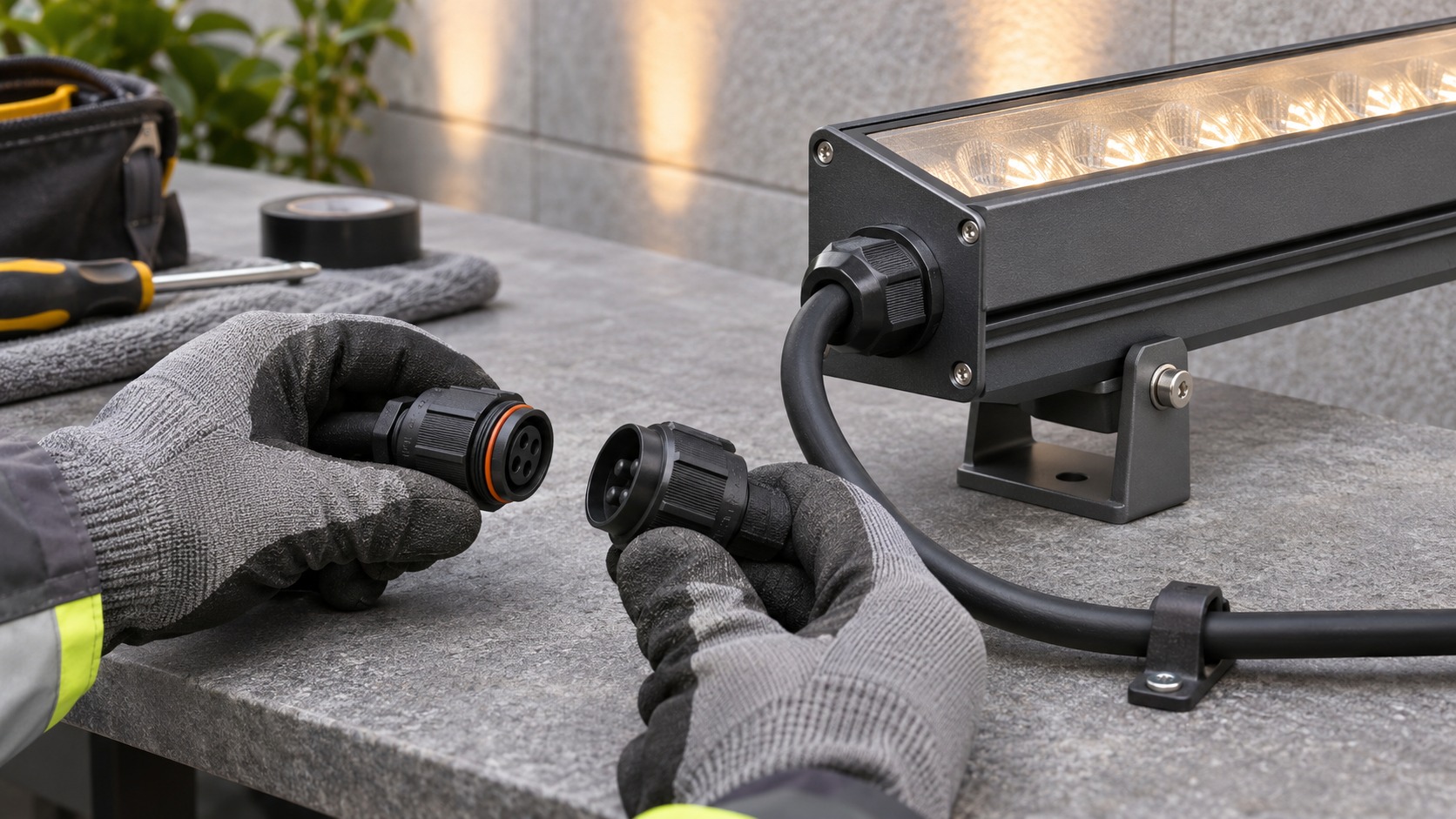
Cable entries are the most common route for water. Before you close the assembly:
Check the cable jacket for cuts or crushing.
Confirm the gland matches the actual cable diameter.
Inspect all required seals.
Follow the connector's preparation and tightening instructions.
Support the cable so aiming or maintenance does not pull on the entry.
Keep the connector accessible and within its rated exposure.
Take two photos with the same fixture ID: a wide shot showing the location and a close-up of the connection. A close-up alone cannot tell the maintenance team which circuit to check.
If a contractor proposes a different connector or sealant, get a technical decision before the change is repeated across the site.
3. Check driver boxes and how water reaches them
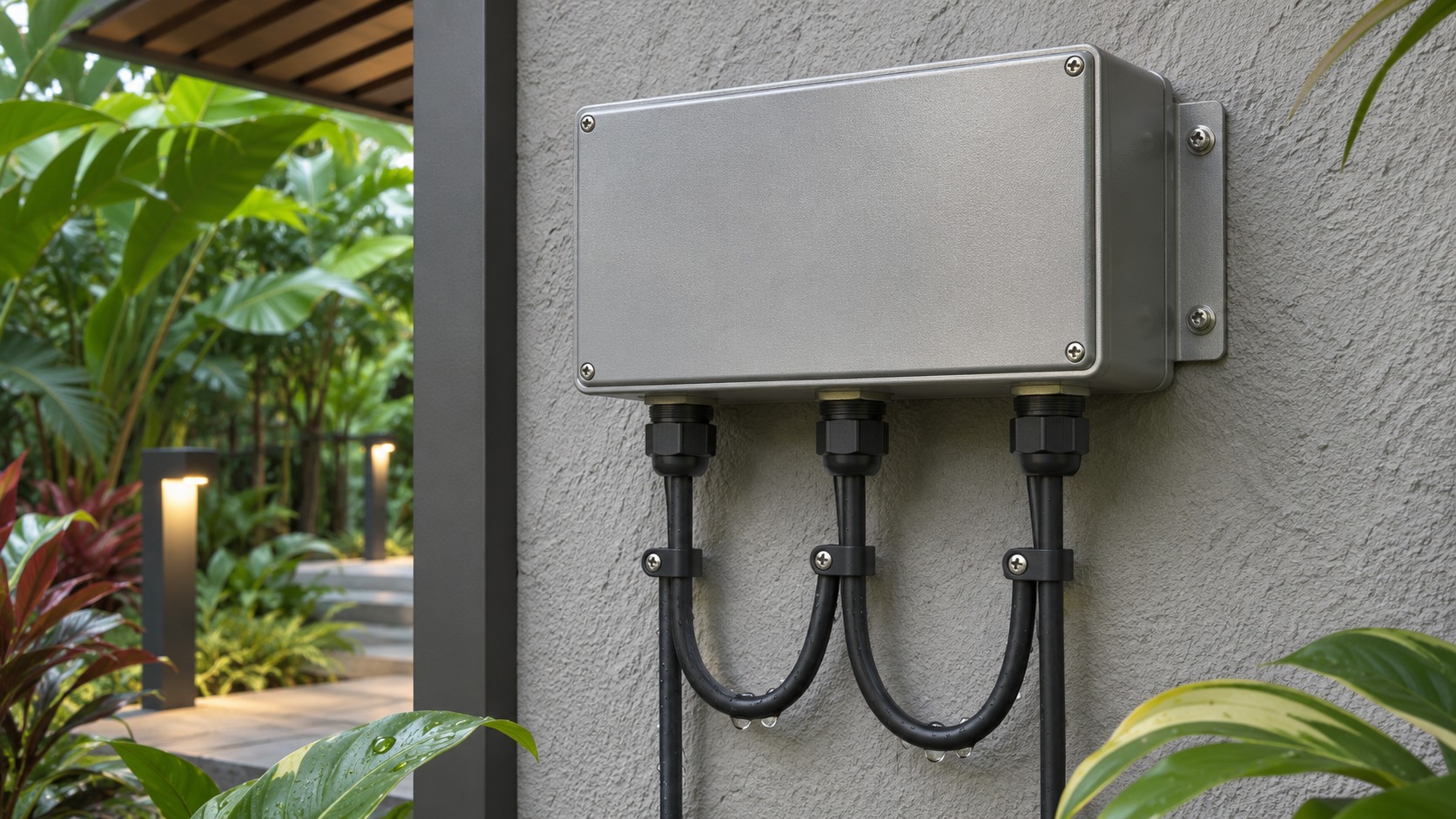
Trace how rainwater could reach the enclosure: runoff from higher surfaces, cable entry direction and likely flood levels. Then check:
Lid seals and closures on unused entries.
Mounting position against the enclosure instructions.
Drip loops, where specified, still in place after final cable routing.
Enough access for inspection and service.
Condensation or ingress? In high humidity, temperature swings can cause fogging inside an enclosure or behind a lens. Fogging alone does not prove a seal has failed. Record when it appears, whether it clears, the weather and any electrical symptoms, then ask the manufacturer for an approved fix. Do not drill drain holes or add vents without written approval, as this can void the IP rating and warranty. Sealing design and material choices also affect long-term reliability; see our guide to maximizing LED lifetime.
4. Verify in-ground light drainage after landscaping
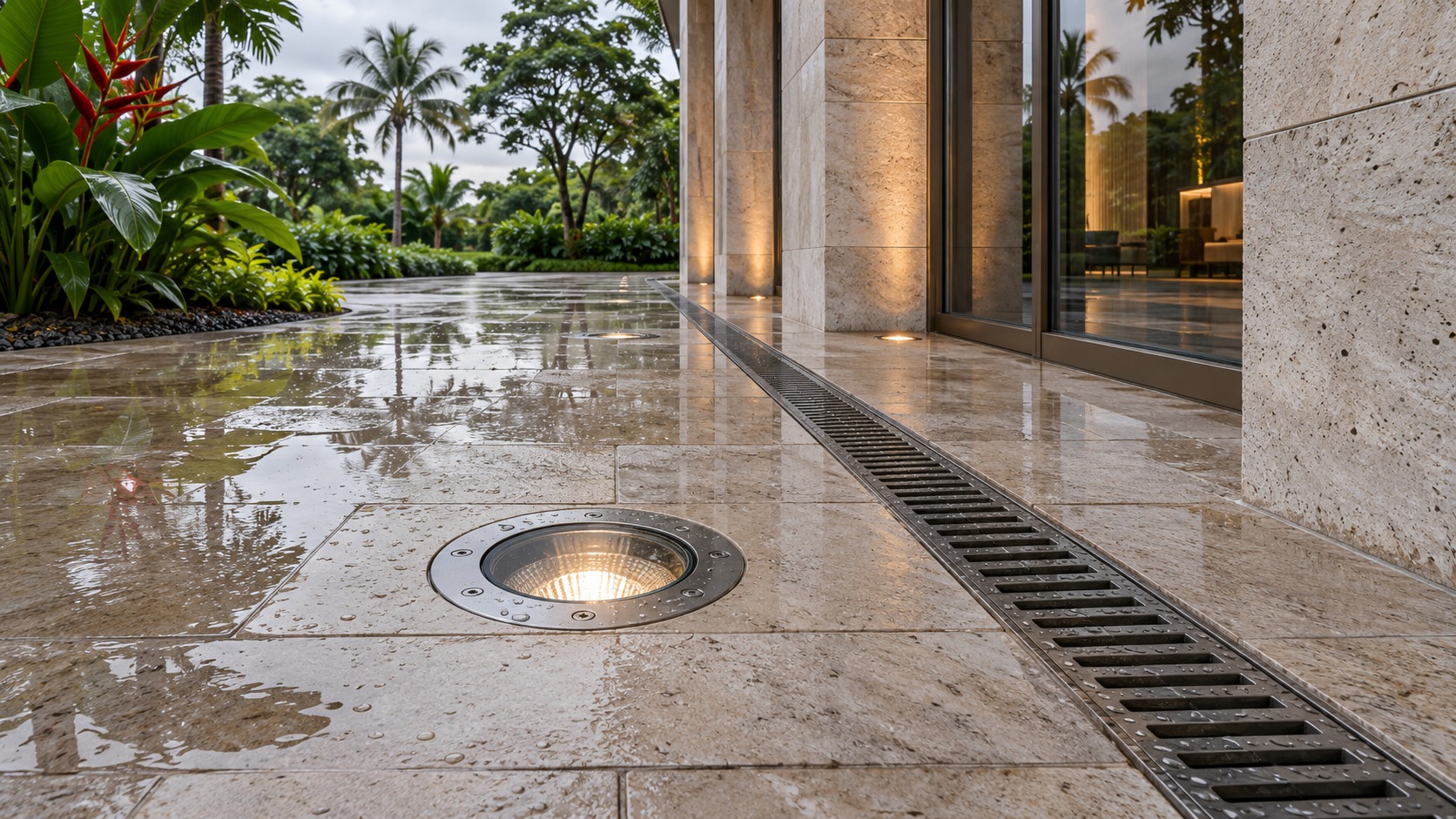
For in-ground and underground lights, drainage decides whether the fitting sits dry or in water. A layer of gravel is not proof of a working drain. Soil type, groundwater, compaction, irrigation and final paving levels all affect the result.
Ask the landscape or civil designer to confirm the intended drainage method for the site, then check:
|
Check |
What to look for |
|---|---|
|
Finished surface |
Does runoff flow toward the fitting, or is it diverted as designed? |
|
Recess and outlet |
Can water leave by the designed route? Is the outlet blocked or below the water table? |
|
Cable and connector |
Are connections accessible and within their rated exposure? |
|
After rain |
Record conditions, where water collects and how long it stays, against the agreed criteria |
There is no universal drain-down time or gravel depth. Compare what you see with the approved detail and the product limits, and recheck whenever paving, planting or irrigation changes.
If a location will stay flooded, do not treat it as a normal uplight position. Specify a product and full connection system documented for continuous immersion.
In hurricane-prone areas such as Florida, the Gulf Coast and Hawaii, include storm-surge and cloudburst flooding when you set the expected water level for each location.
Planning in-ground lights for a wet site? Send us your finished levels and drainage detail and we will recommend a suitable model and connection kit. View underground lights →
5. Keep site checks separate from lab IP testing
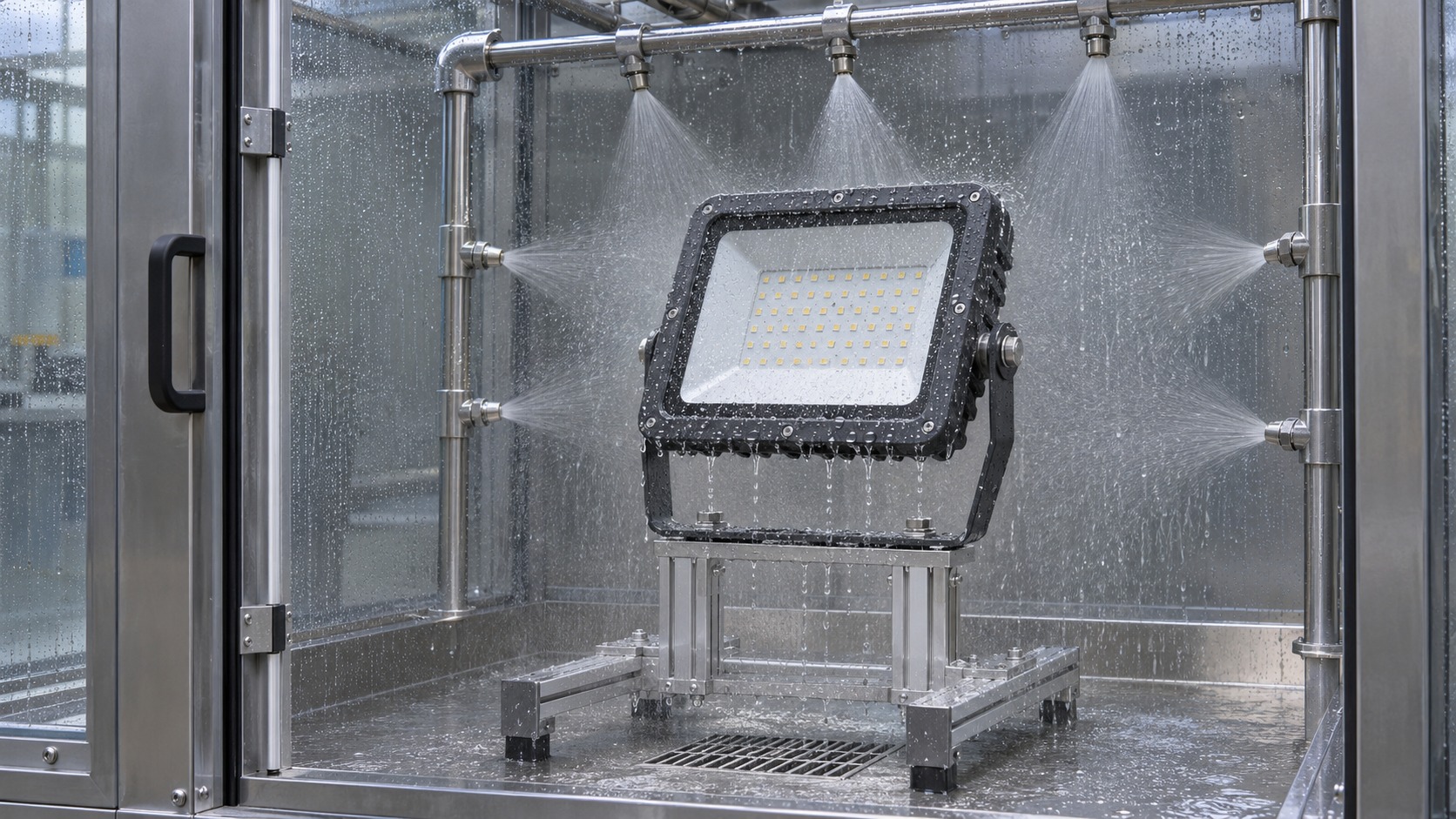
A hose test on site is not an IEC 60529 test. If you need a site water-exposure check, agree the method, equipment, acceptance criteria and electrical safety precautions with the responsible engineer and supplier first. Electrical testing and fault diagnosis should be done by qualified personnel.
If you suspect water ingress:
Isolate the affected circuit as appropriate.
Preserve evidence before any repair.
Record only what you see: water at a joint, moisture behind glass, a blocked outlet, a damaged cable.
Collect dated photos, the fixture ID, recent weather and inspection findings for the fault report.
Need help investigating an existing fault? Contact our engineering team with dated photos, the fixture ID and recent weather conditions.
6. Carry the same fixture IDs from delivery to handover
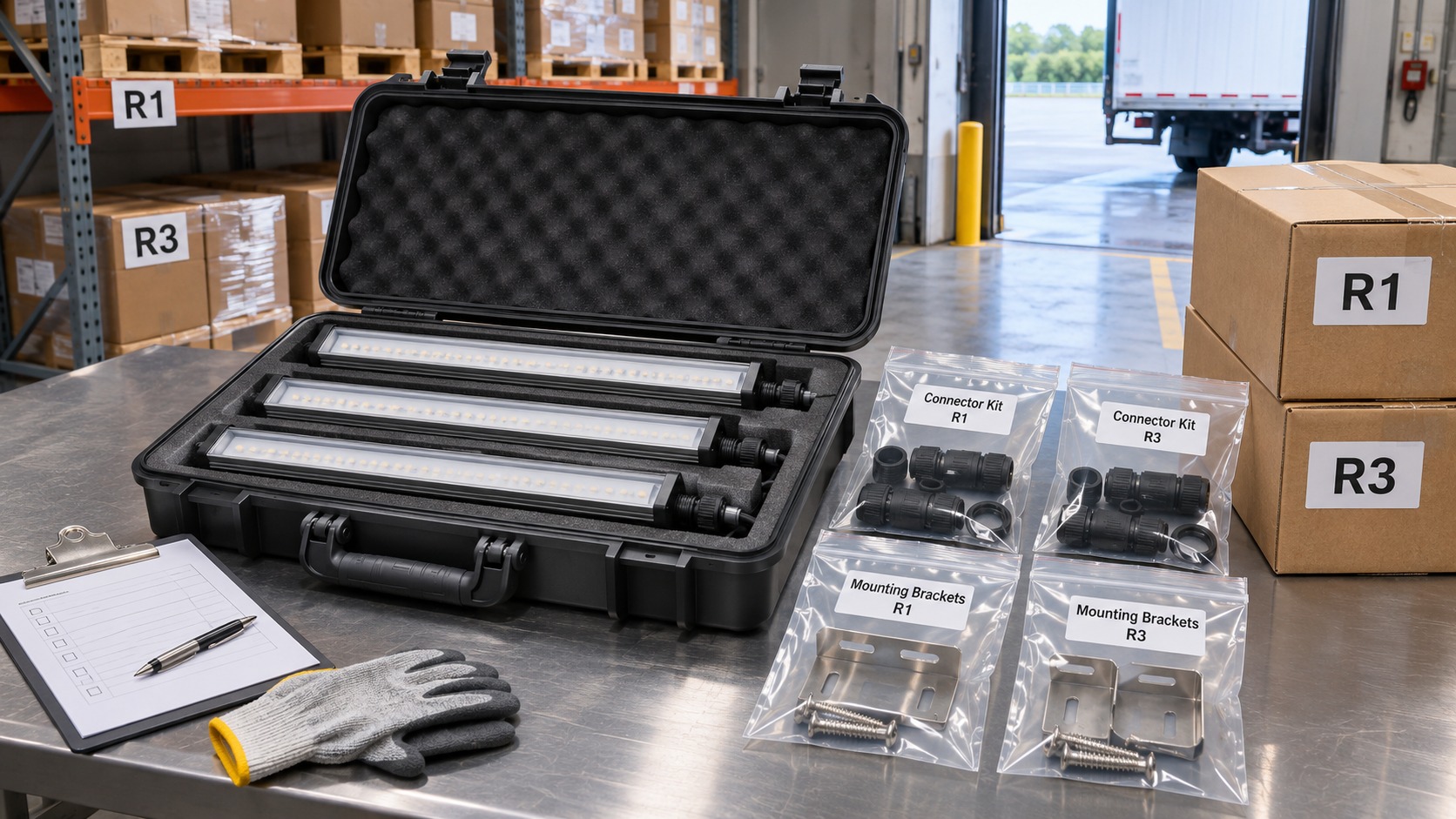
Waterproofing starts at goods receiving. Check for damaged or wet cartons, protected lenses and complete connector kits. Keep accessories dry and labeled, and record packing-list references, quantities and discrepancies before goods go to different floors or landscape zones.
Then inspect at each stage:
Before concealment: photograph the final connector and cable route.
After landscaping: check finished levels and the drainage path.
After aiming: recheck any cable or entry that moved.
At handover: keep open defects, owners, recheck evidence and drawing revisions.
After the agreed rain observation: close only items backed by an inspection record.
To assign reviewers and close records, use our waterproofing handover checklist.
Frequently asked questions
What IP rating do outdoor lights need in tropical climates?
It depends on the installation location. Facade and wall lights exposed to driving rain should be specified with an appropriate water-jet protection rating, such as IP65 or IP66, depending on the installation conditions and exposure level. In-ground lights in areas that can flood should be specified with a suitable immersion rating, such as IP67 or IP68, together with documented drainage and connectors. Confirm the final choice against the product's certification documents.
Can an IP-rated light still fail because of its installation?
Yes. A poorly sealed field connection, a damaged cable, an unsuitable location or a changed installation detail can let water in, even when the luminaire itself is correctly rated.
Does fogging inside a light mean the gasket has failed?
Not necessarily. Humidity and temperature changes can cause condensation. Record the conditions and have the assembly assessed before concluding the cause.
Should every underground light be IP68?
Choose protection and an installation method that match the real exposure. IP68 alone does not solve drainage, cable connections or limits on immersion depth and duration.
How do I stop water collecting around in-ground lights?
Confirm a working drainage route with the landscape or civil designer, check it again after paving and planting, and observe it after rain against agreed criteria.
Is an IP rating enough for outdoor lighting projects in Florida or Hawaii?
Not on its own. US projects typically need a wet-location listing (UL, cUL or ETL), and the installation still needs sealed connections and working drainage. Use the IP rating to choose the right level of water protection for each location.
Get a free tropical lighting installation review
Before you order, send LNJAMI your project details and our engineers will review the wet-location risks with you. Include:
Lighting layout and fixture schedule
Finished levels and drainage details
Proposed cable connections and driver locations
We will recommend suitable models and connection arrangements, send model-specific installation documents and flag any exposure conditions that need a decision. Samples are available, so you can check fit, sealing and light output before placing a project order.
What LNJAMI can supply for wet-location projects:
In-ground and underground lights for paths, plazas and pool surrounds
Underwater lights for fountains, pools and permanently submerged locations
Facade wall washers and floodlights for driving-rain exposure
Fixture selection and installation guidance for humid, rain-heavy sites
OEM / ODM customization for project-specific housings, optics and mounting
Request a free installation review or samples →
Related guides: Outdoor Lighting Waterproofing: A Pre-Handover Checklist · Choosing the Best IK Rating for Facade, Bridge, and Landscape Lighting
References
IEC 60529, Degrees of protection provided by enclosures (IP Code): BSI summary of BS EN 60529
UL Solutions: Landscape and outdoor lighting certification
UL Solutions: Understanding UL 1598, the Standard for Luminaires (5th edition)
UL Solutions: UL 1838 and UL 2108 for low-voltage lighting systems
National Hurricane Center: Storm surge overview
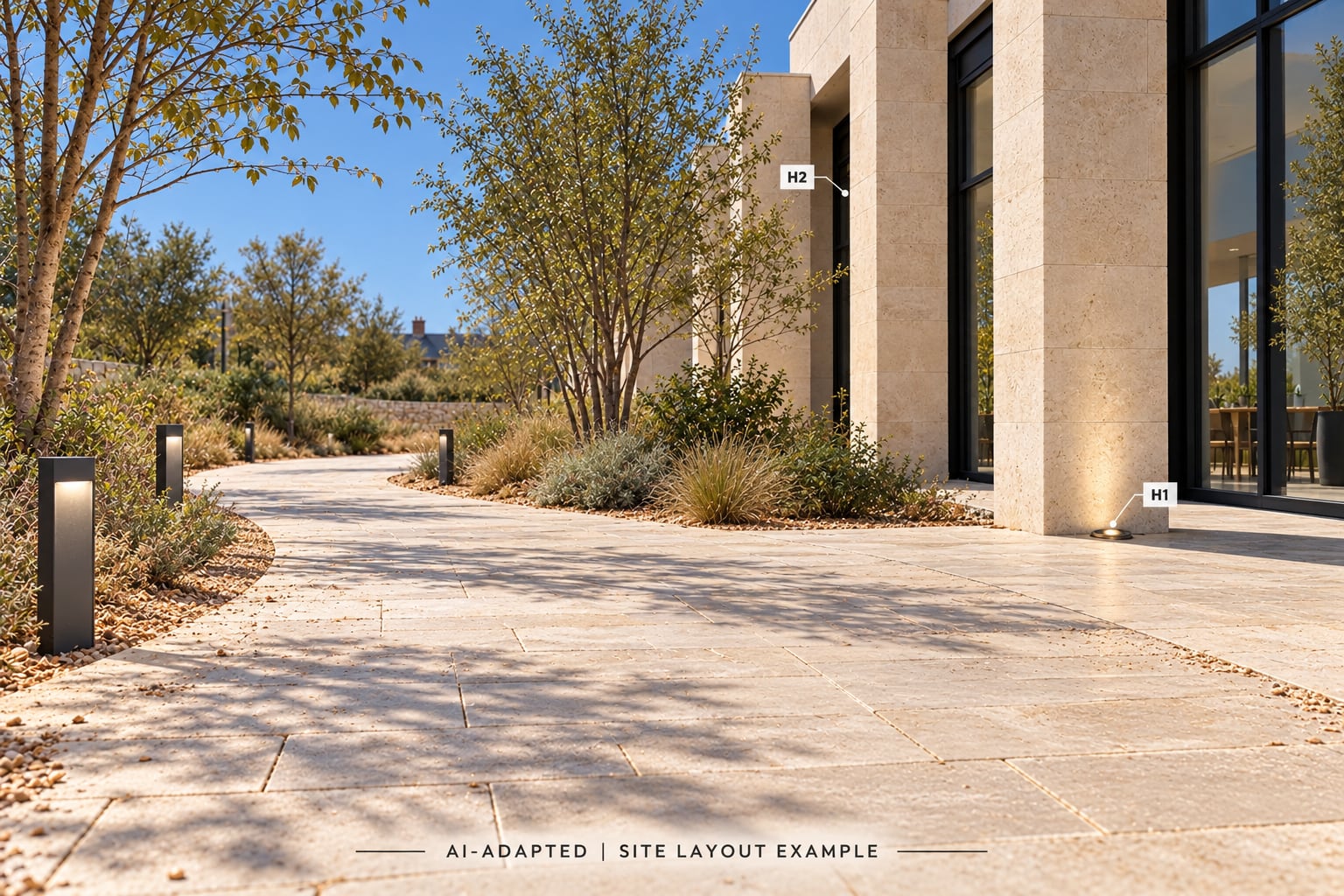
Image note: photos in this article are AI-adapted illustrations based on LNJAMI website images. They are not project records or test results.