LNJAMI · PROJECT PROCUREMENT & SITE PRACTICE
A newly lit facade can meet its design target while the calculation behind it assumes cleaning that nobody has arranged. Dust on optical surfaces and changes in light output over time then become an operating problem. The maintenance factor connects the lighting calculation to an expected maintenance condition.
For a project owner, the useful question is what supports the factor in the report. Ask which operating period, product data, environment and maintenance policy it represents. A number copied from another project may be convenient, but it cannot explain whether this facade will receive the attention assumed in its design.
Separate initial and maintained illuminance
Initial illuminance describes the calculated or measured light level for the initial condition. Maintained illuminance refers to the level associated with the design maintenance assumptions. Keep the calculation surface, operating scene and other comparison conditions consistent. A value measured on the pavement cannot be directly compared with a value calculated on the vertical facade.
In a simplified calculation, maintained illuminance equals initial illuminance multiplied by the maintenance factor. That factor is a planning allowance for specified light losses, not the electrical efficiency of the luminaire or the percentage of fixtures guaranteed to survive. The ERCO maintenance-factor glossary explains the link between depreciation, maintenance and design.
A single factor also cannot describe every visual change. One failed fixture may create a conspicuous dark patch while the facade average remains close to its target. Check local coverage and uniformity separately. For architectural work, surface appearance and viewing conditions still matter alongside the calculated illuminance.

Separate initial and maintained illuminance
Identify the assumptions behind the factor
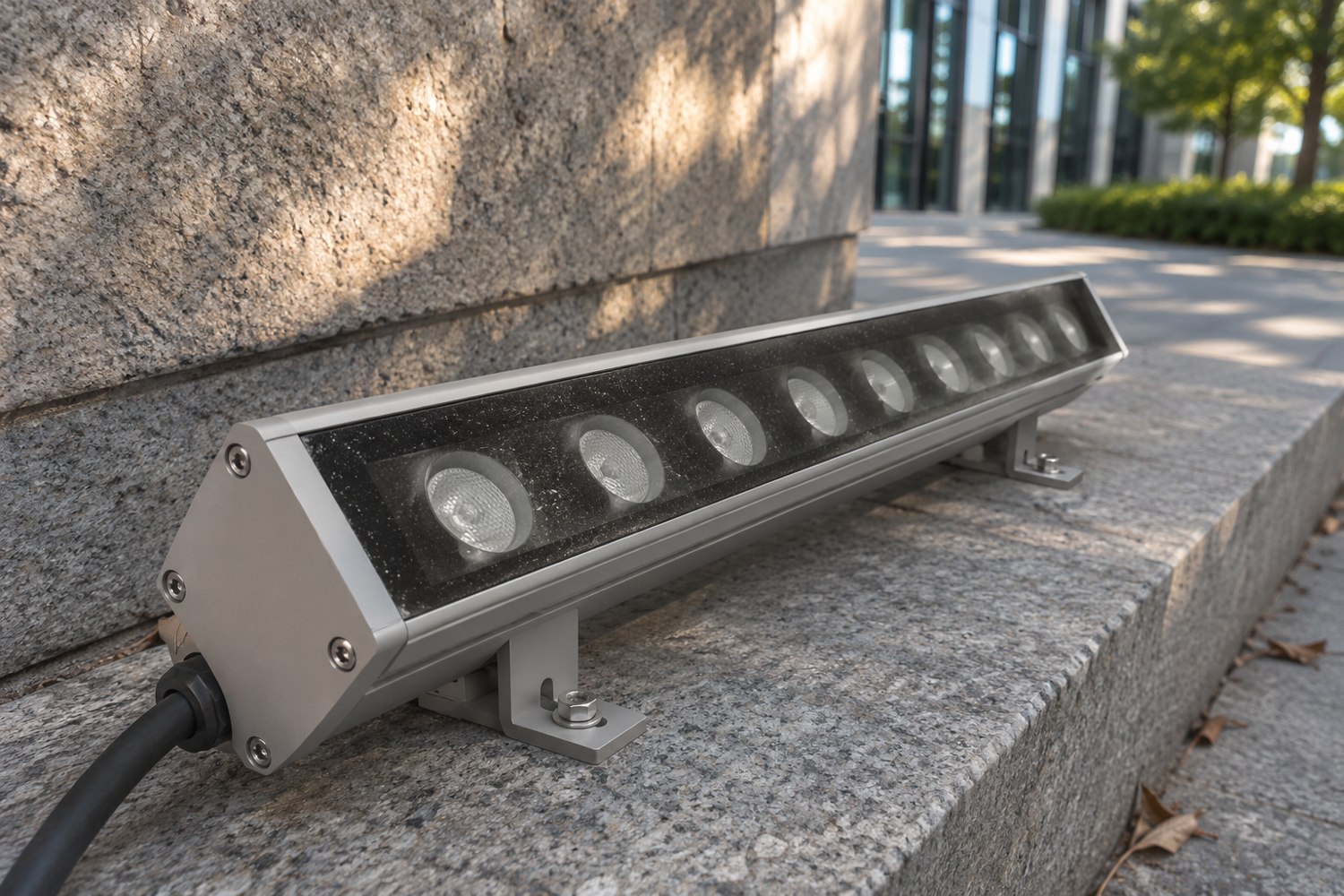
Separate the expected reduction in light output from the effect of dirt on the luminaire. The first needs relevant product data and operating conditions; the second depends on exposure and cleaning. A high ingress-protection rating does not prevent dust from settling on the outside of a glass cover. Nor does a lumen-maintenance statement describe every component in a complete lighting system.
Where the chosen method includes a survival factor, make its replacement assumption explicit. Prompt replacement of failed units is different from leaving them until a scheduled visit. Some methods also include a surface-related factor where appropriate. Do not copy an indoor room-surface factor into an open facade calculation without checking the method and its applicability.
The TRILUX LED guide describes the distinction between lumen maintenance, survival and luminaire soiling in maintenance-factor planning. Use such references to understand the components, then select the project method and obtain the data needed for that method. A generic table is not a substitute for identifying the actual luminaire and environment.
Identify the assumptions behind the factor
Work through a transparent calculation
Consider an illustrative calculation with an initial illuminance of 100 lx and an assumed maintenance factor of 0.80. The maintained value is 100 × 0.80 = 80 lx. These are teaching values only: 100 lx is not a recommended facade target and 0.80 is not a universal outdoor setting. The project designer must establish both from the relevant requirements and evidence.
Working backwards, an illustrative maintained target of 80 lx with the same factor would require a calculated initial value of 80 ÷ 0.80 = 100 lx. If the assumed factor changes to 0.70, the required initial value becomes about 114 lx. This sensitivity shows why the assumption affects the design; it does not justify increasing wattage before reviewing distribution, glare and operating scenes.
Check whether the photometric input or an output multiplier already accounts for a reduction. Applying the same allowance twice understates the calculated result. Record each adjustment and what it represents. If constant-light-output control is proposed, obtain the actual operating strategy and power implications instead of assuming that all light losses disappear.

Work through a transparent calculation
Connect cleaning assumptions to site access
A cleaning interval only supports the calculation if the owner can implement it. Check access to the glass or lens, the equipment required, working hours and any restrictions around occupied rooms or public routes. Record who carries out the work and how completion is logged. A concealed fixture may look neat while being difficult to reach without removing architectural panels.
Assess exposure at the actual mounting location. An upward-facing ledge beside a busy road can collect dirt differently from a sheltered vertical fitting. Sand, nearby construction, vegetation and local cleaning practices may matter more than the country name on the project brief. Keep these observations separate from unsupported numerical deductions about how much output will be lost.
Use the manufacturer’s maintenance instructions for cleaning methods and permitted products. Plan electrical isolation and access through qualified personnel and the site procedure. If access becomes impossible or the agreed cleaning frequency changes, return the assumption to the lighting designer for review rather than retaining an unsupported factor in the handover report.

Connect cleaning assumptions to site access
Check the calculation report before comparing products
Compare candidate luminaires within the same geometry, calculation surfaces, aiming and scene. Identify whether each result is initial or maintained and whether the maintenance assumptions are comparable. Otherwise, a higher number may simply reflect a different multiplier. Preserve the exact photometric file reference and software report revision alongside the comparison.
Review unwanted light in the appropriate operating condition as well as the intended facade illumination. For example, DIALux describes an obtrusive-light scene using a maintenance factor of 1. This illustrates why a reduced maintained-output assumption should not automatically be used for every check. Follow the method applicable to the project.
Keep the final selection tied to a documented basis, not to the most attractive rendered image. Our floodlight specification guide discusses distribution and selection; the maintenance-factor record should accompany those decisions without replacing them.

Check the calculation report before comparing products
Keep a maintenance-factor record
Store the approved assumptions with the calculation report and maintenance plan. The record should allow a later designer or facilities team to understand why the factor was chosen. Identify the product evidence, operating period, cleaning arrangement and replacement policy. Record missing information openly; a blank source reference should not be replaced with an invented test result.
Review the basis when the fixture, operating schedule, environment or maintenance practice changes materially. A later inspection can inform the next design review, but one photograph or an uncontrolled lux reading cannot establish a new maintenance factor on its own. Keep comparable measurements and the conditions under which they were obtained.
| Record | What to include |
|---|---|
| Design condition | Surface, scene, operating hours and assessment period |
| Product evidence | Exact variant, data source and applicable conditions |
| Maintenance plan | Exposure, access, cleaning and replacement assumptions |
| Calculation | Method, factor, separate adjustments and report revision |
| Review | Responsible party and changes requiring reassessment |

Keep a maintenance-factor record
Questions buyers ask
Can I use 0.80 for every outdoor project?
No. The value needs a basis in the selected method, product information, exposure and maintenance policy. Treat software defaults as inputs to review.
Does a long LED life mean no maintenance?
No. External optical surfaces can become dirty, and other components or connections may need attention. A lifetime declaration does not define the entire maintenance plan.
Will the factor predict dark patches?
A uniform factor does not locate individual failures or local obstructions. Check distribution and maintenance observations separately.
Discuss the project with LNJAMI
Send the relevant fixture schedule, drawings and project requirements to LNJAMI. Our team can discuss the product information needed for your outdoor lighting project.
Discuss your project
LNJAMI · Outdoor architectural LED lighting · Customisation