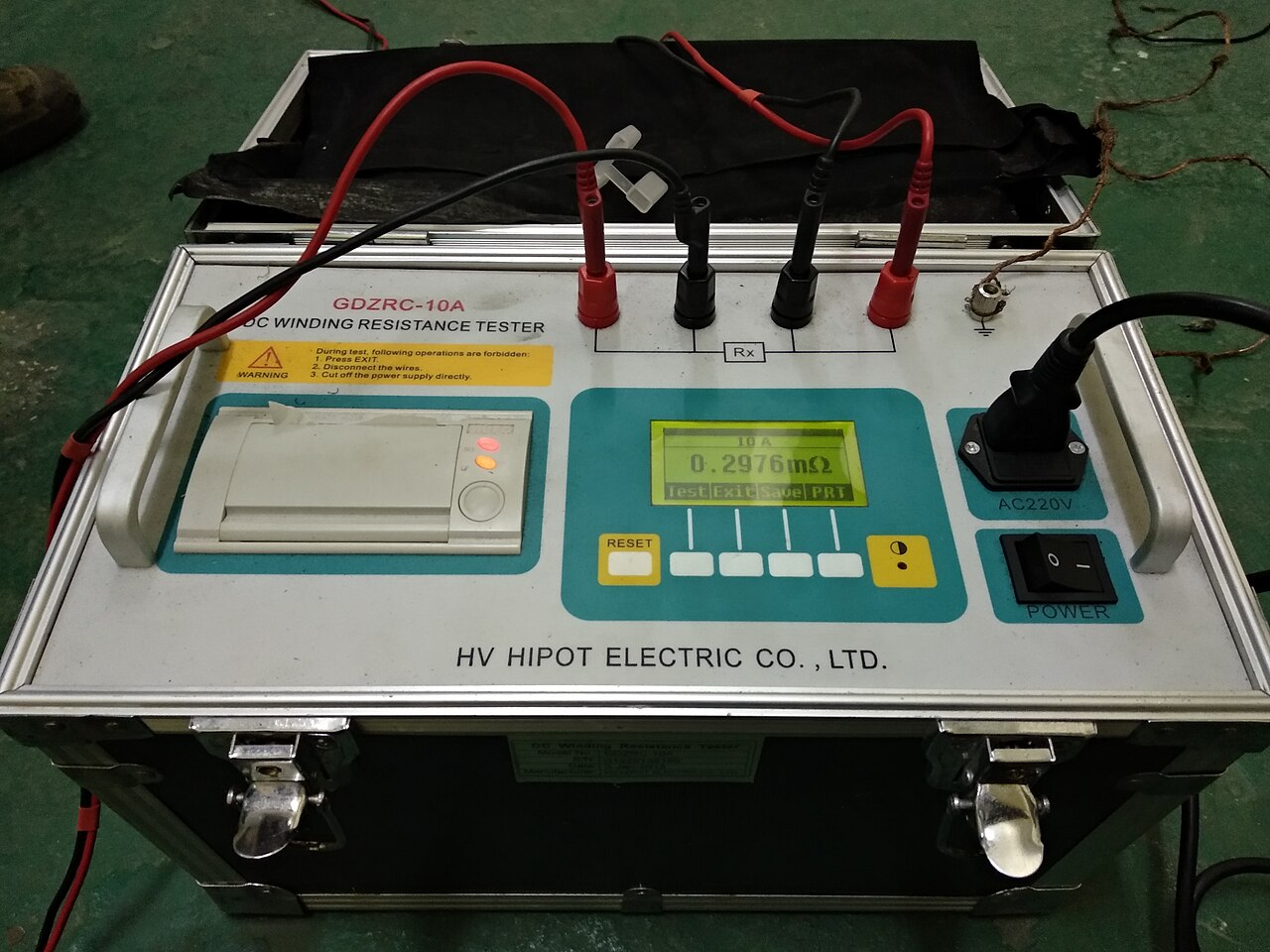
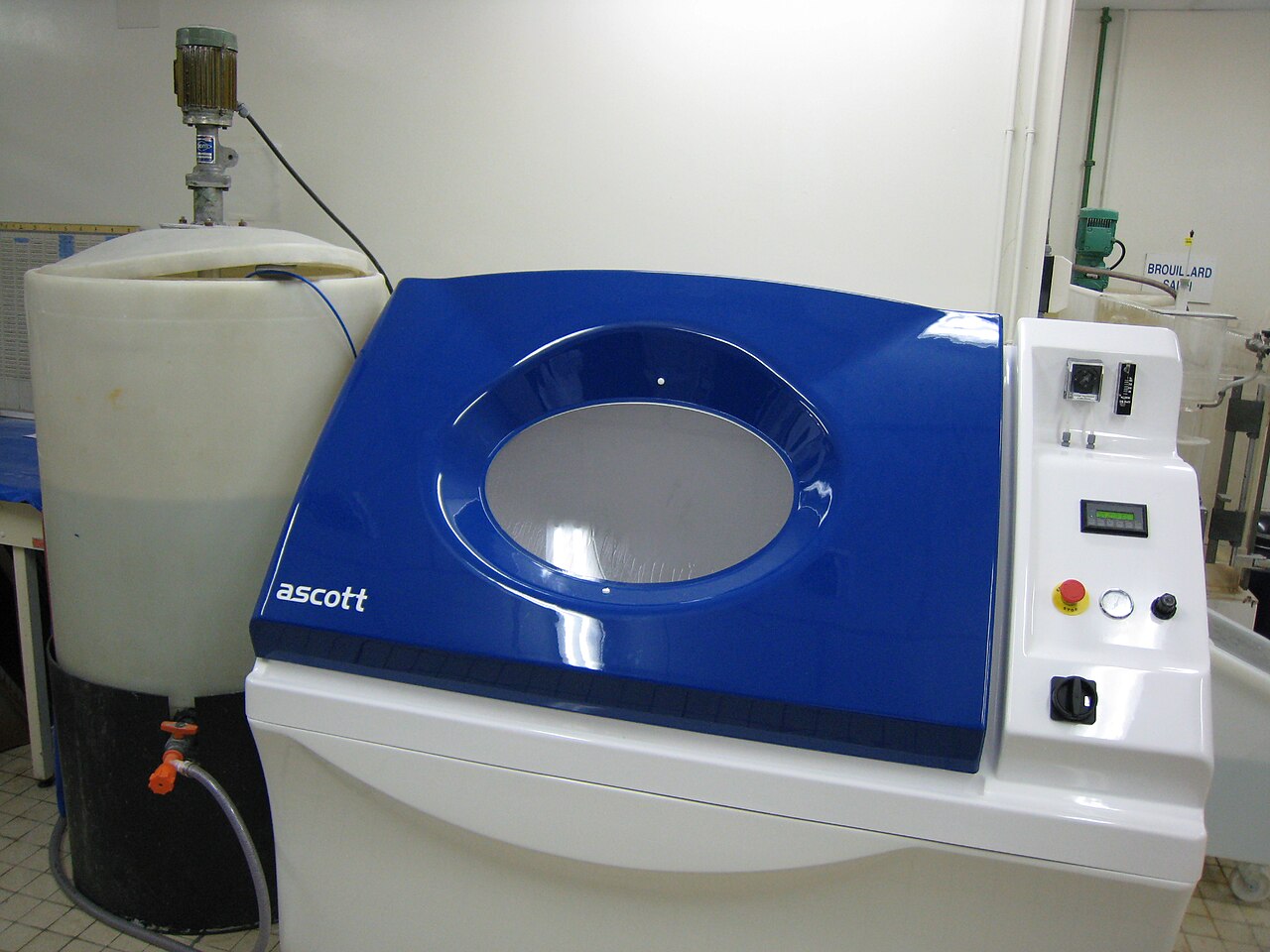
An IP rating printed on a datasheet is a test result, not a design intention. Behind every IP65, IP66, IP67 or IP68 claim there should be a specific test: water jets of a defined force, immersion at a defined depth, or hours in a chamber full of fine dust. This article explains how those tests are carried out under IEC 60529, what equipment is used, how a pass or fail is decided, and what an IP test report should contain.
This article is part of our guide to LED Light Fixture Testing.
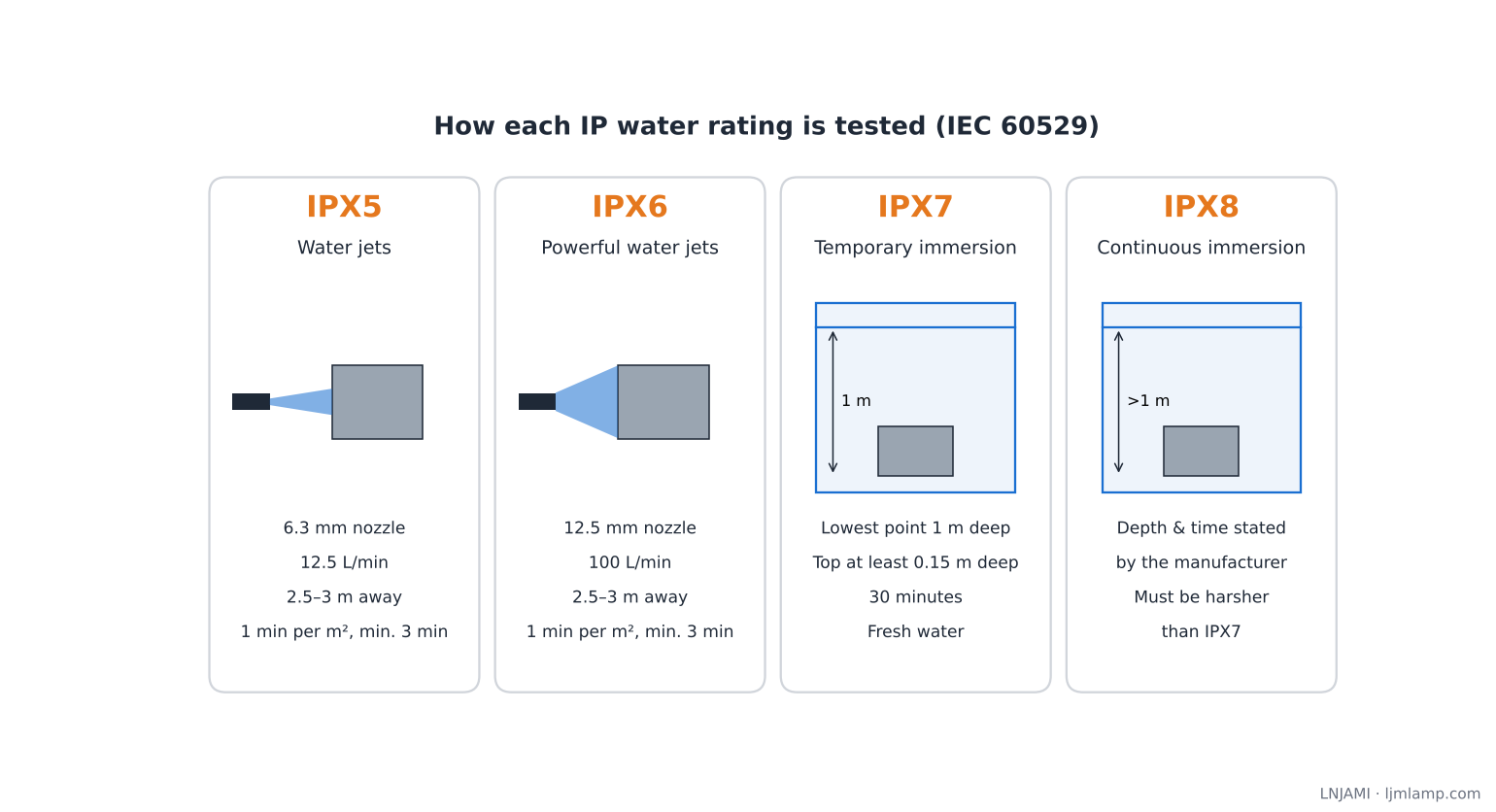
How each IP water rating is tested under IEC 60529: water jets for IPX5 and IPX6, immersion for IPX7 and IPX8.
What Is IP Testing?
IP stands for Ingress Protection. The test methods are defined in the international standard IEC 60529 (published in North America as ANSI/IEC 60529). An IP code has two digits, and each digit is earned through its own test:
|
Digit |
Protects against |
Levels most relevant to outdoor LED fixtures |
|---|---|---|
|
First digit (0–6) |
Solid objects and dust |
5 = dust-protected, 6 = dust-tight |
|
Second digit (0–9) |
Water |
5 = water jets, 6 = powerful water jets, 7 = temporary immersion, 8 = continuous immersion |
Each level has its own test method, so a fixture marked IP66/IP67 has passed two separate water tests. If you are still deciding which rating a project needs, or why fixtures let water in on site, see our article Why Outdoor LED Lights Fail from Water Ingress — and How to Prevent It.
The Test Equipment
|
Equipment |
Used for |
|---|---|
|
Hand-held jet nozzle (6.3 mm) with flow meter |
IPX5 water jet test |
|
Large jet nozzle (12.5 mm) with flow meter |
IPX6 powerful water jet test |
|
Immersion tank |
IPX7 temporary immersion test |
|
Immersion or pressure tank |
IPX8 continuous immersion at greater depth |
|
Dust chamber with circulating talcum powder |
IP5X and IP6X dust tests |
|
Vacuum pump and flow meter |
Drawing air through the enclosure in the dust-tight test |
|
Turntable or test stand |
Turning the fixture so every side is exposed |
How the Water Tests Are Done
|
Test |
Conditions (IEC 60529) |
|---|---|
|
IPX5 — water jets |
6.3 mm nozzle, 12.5 L/min, from 2.5–3 m, about 1 minute per m² of surface, at least 3 minutes |
|
IPX6 — powerful water jets |
12.5 mm nozzle, 100 L/min, from 2.5–3 m, about 1 minute per m² of surface, at least 3 minutes |
|
IPX7 — temporary immersion |
Lowest point 1 m below the surface, top at least 0.15 m below, for 30 minutes |
|
IPX8 — continuous immersion |
Conditions agreed between the manufacturer and the user, and more severe than IPX7 |
IPX7 vs IPX8: why the IPX8 conditions matter
IPX7 has one fixed test. IPX8 does not: the depth and duration are agreed for the product, so two fixtures can both be marked IPX8 and still have been tested very differently.
|
Rating |
Example of test conditions |
|---|---|
|
IPX7 |
1 m immersion depth, 30 minutes (fixed by the standard) |
|
IPX8 |
Agreed for the product, for example 2 m for 60 minutes |
The 2 m / 60 minute figure is only an example, not a requirement for all IPX8 products. When a project needs IPX8, ask for the exact depth and duration the fixture was tested to, and check that they match the real installation — a fountain, a pool or a submerged facade detail.
1. Prepare the fixture as installed. It is fully assembled, with the gasket, lens and cable gland tightened as they would be on site, and the cable led out the normal way.
2. Match the temperatures. The water should be close to the fixture's temperature. A hot fixture plunged into cold water contracts its internal air and can draw water in, so this is controlled.
3. Apply the water. For IPX5 and IPX6 the jet is aimed at the fixture from every practical direction for the required time. For IPX7 and IPX8 the fixture is lowered into the tank to the required depth.
4. Dry and open. The outside is wiped dry so no outside water falls in, then the fixture is opened and inspected.
How the Dust Tests Are Done
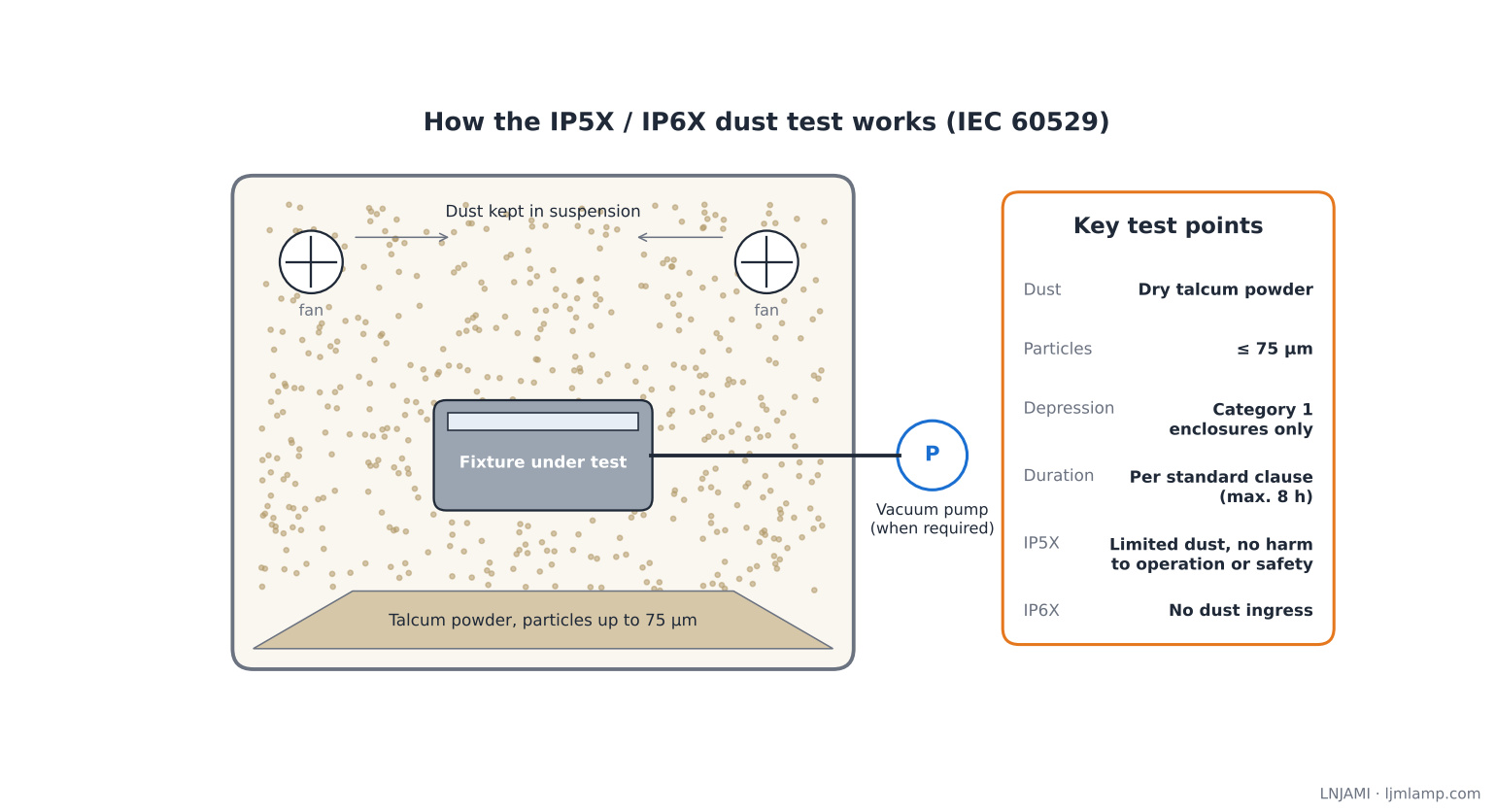
How the IP5X and IP6X dust test works.
IP5X and IP6X are tested with essentially the same equipment: a dust chamber in which dry talcum powder (particles up to 75 µm) is kept in suspension by circulating air. What changes is how the test is set up and how the result is judged.
1. The enclosure category is decided first. IEC 60529 distinguishes between enclosures whose normal operating cycle causes a pressure difference between inside and outside — such as a fixture that heats up and cools down — and enclosures where this does not happen.
2. Depression is applied only where the standard calls for it. For the first category, a vacuum pump draws air out of the enclosure so that air and dust are pulled through any gap. The standard sets limits on the pressure difference and on the volume of air drawn through, together with a maximum test duration of 8 hours. For the second category, the test is run without depression for the specified time.
3. The fixture is opened and inspected. For IP5X (dust-protected), some dust may enter, but not in an amount or location that interferes with satisfactory operation or impairs safety. For IP6X (dust-tight), no dust ingress is permitted.
Because the set-up depends on the enclosure category, the exact duration and extraction parameters should always be taken from the applicable clauses of the standard and stated in the test report.
How a Pass or Fail Is Decided
Three different layers of requirements can apply, and it is important not to mix them up:
|
Level |
Who sets it |
What it covers |
|---|---|---|
|
IEC 60529 acceptance conditions |
The IP standard itself |
Whether any water or dust that enters stays within the limits the standard sets for that rating, assessed by inspecting the enclosure after the test |
|
Product safety standard |
The standard for the product type, e.g. IEC 60598-1 for luminaires |
Additional safety checks after the ingress test, such as insulation resistance and electric strength, to confirm the fixture is still safe |
|
Project or manufacturer acceptance criteria |
The specifier, the buyer or the manufacturer |
Stricter internal rules — for example, no visible water inside the LED or driver compartment — written into a specification or quality plan |
The IEC 60529 rating on its own does not mean "no water at all". If a project needs a stricter rule, it should be written into the specification as an acceptance criterion, so the supplier and the test laboratory both check against it.
What an IP Test Report Includes
|
Item in the report |
What it tells you |
|---|---|
|
Standard and rating tested |
e.g. IEC 60529, IPX6 and IPX7 |
|
Sample description |
The exact model, configuration and cable entry tested |
|
Test conditions |
Nozzle size, flow rate, distance and duration — or depth and time for immersion |
|
Inspection result |
Whether any water or dust was found inside, with photos |
|
Post-test checks |
Insulation / dielectric check and function check |
|
Laboratory name and report number |
Where and when the test was carried out |
What IP Testing Does Not Tell You
• IP ratings are not cumulative beyond IPX6. An IPX7 fixture is not automatically tested for powerful jets; look for a dual rating such as IP66/IP67 if both are needed.
• The test is done on a new sample. Gaskets and seals age, and fixtures "breathe" as they heat and cool. Long-term sealing is checked with thermal cycling and damp heat testing.
• Installation still matters. A tested fixture can still leak through a poorly made cable joint or an undrained in-ground housing.
IP Protection for Your Project
If your project requires a specific IP rating, our team can help review the required protection level, fixture structure, sealing design and installation conditions. For projects requiring formal verification, testing can be arranged according to the applicable requirements.
FAQ
Does IP67 include IP66?
Not automatically. The two ratings use different tests, so a fixture that must resist both jets and immersion should be marked IP66/IP67.
How long is an IPX7 test?
30 minutes, with the lowest point of the fixture 1 m below the water surface.
Who decides the IPX8 test conditions?
They are agreed between the manufacturer and the user, and must be more severe than IPX7. Always ask for the exact depth and duration.
Does an IP rating mean no water can get inside?
Not necessarily. IEC 60529 sets acceptance conditions for each rating. A stricter "no water inside" rule is a project or manufacturer requirement and should be written into the specification.
Is an IP rating on a datasheet enough?
No. Ask whether the fixture was actually tested to that rating, under which standard, and for the test report.
Not Sure Which Tests Your Fixtures Need?
Tell us where and how the fixtures will be installed. Contact us for a free project consultation.
Back to the full guide: LED Light Fixture Testing: The Equipment and Reports That Prove Quality