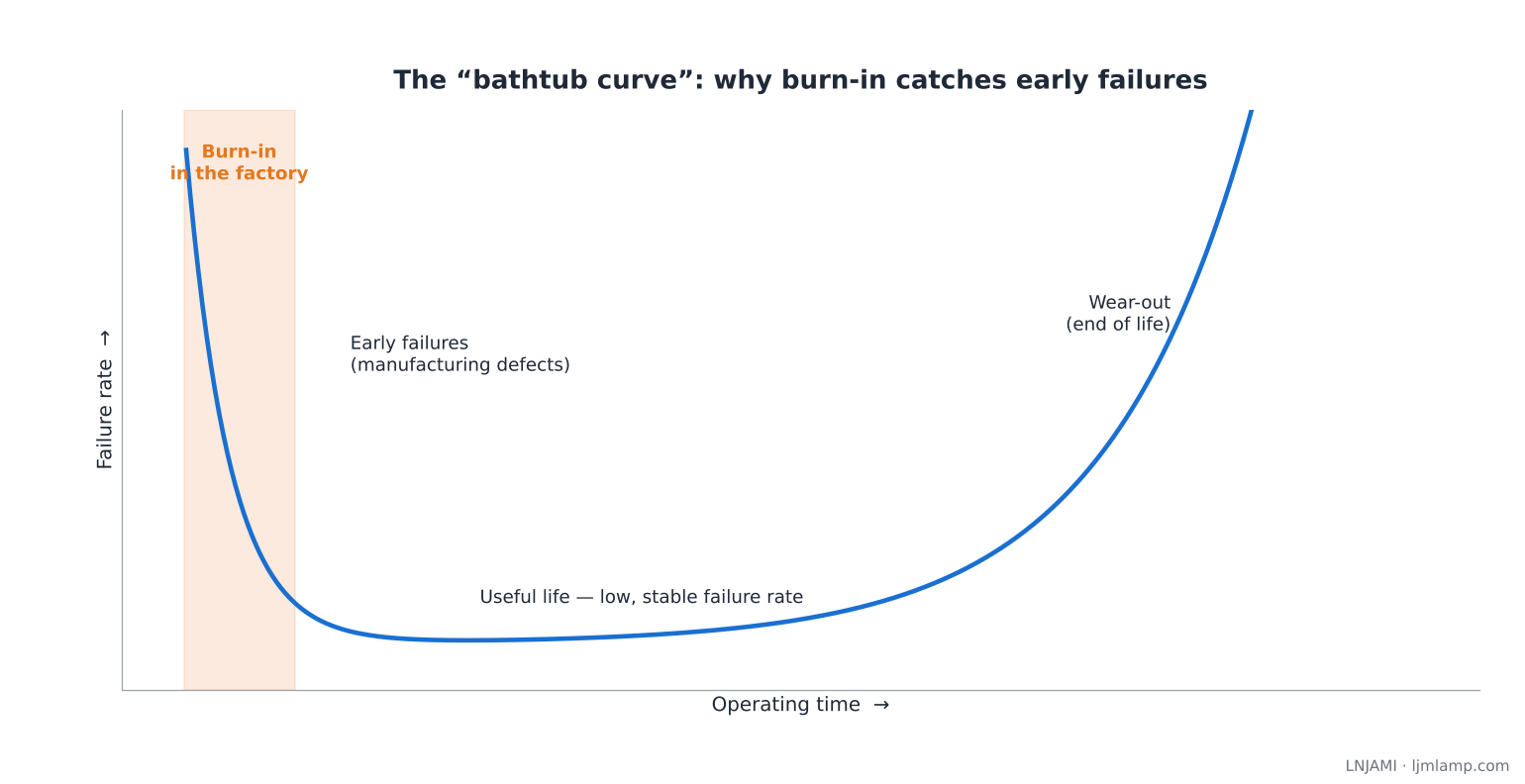
An outdoor fixture lives through a small "weather cycle" every day. It heats up when it turns on at night, cools down at dawn, and faces summer heat, winter frost and humid air in between. Over time, these swings can loosen seals, crack solder joints and leave condensation inside the lens. Thermal cycling and damp heat tests apply these stresses in a controlled, accelerated way, so weak points show up in the lab before installation. They reveal potential failure modes under specific conditions — they do not directly predict how many years a fixture will last in service.
This article is part of our guide to LED Light Fixture Testing.
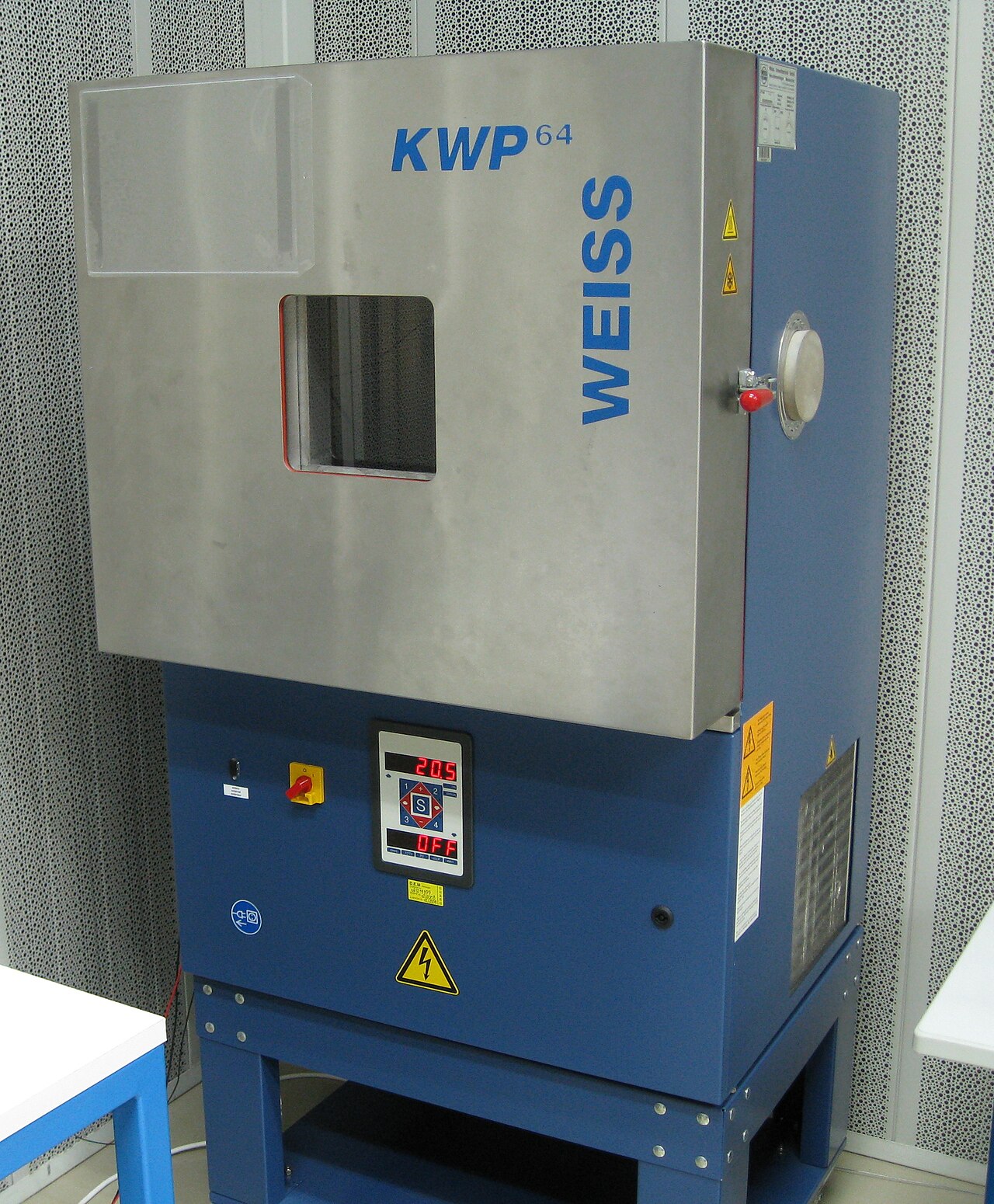
A climatic test chamber, the type of equipment used for temperature cycling and humidity testing.
Photo: Climatic test chamber by Cjp24, CC BY-SA 3.0, via Wikimedia Commons.
What Is a Thermal Cycling Test?
In a thermal cycling test, the fixture is placed in a climatic chamber that moves repeatedly between a low and a high temperature. Each move from cold to hot and back is one cycle. The fixture may be switched on and off during the test to add its own heating.
The common reference standard is IEC 60068-2-14 (change of temperature). Some tests use two chambers and move the fixture quickly between them for a harsher thermal shock.
What Is a Damp Heat Test?
A damp heat test exposes the fixture to high temperature and high humidity together.
• Steady damp heat (IEC 60068-2-78) holds constant temperature and high humidity for a set period.
• Cyclic damp heat (IEC 60068-2-30) cycles the temperature while humidity stays high. As the temperature drops, moisture condenses on and inside the fixture, which is exactly what happens outdoors.
Test Conditions Are Set by the Standard and the Project
There is no single set of conditions for every fixture. The temperature range, humidity, dwell times, ramp rate and number of cycles are chosen from the applicable standard, the product's rating and the project specification. The chart below shows example profiles only, to illustrate how the tests work:
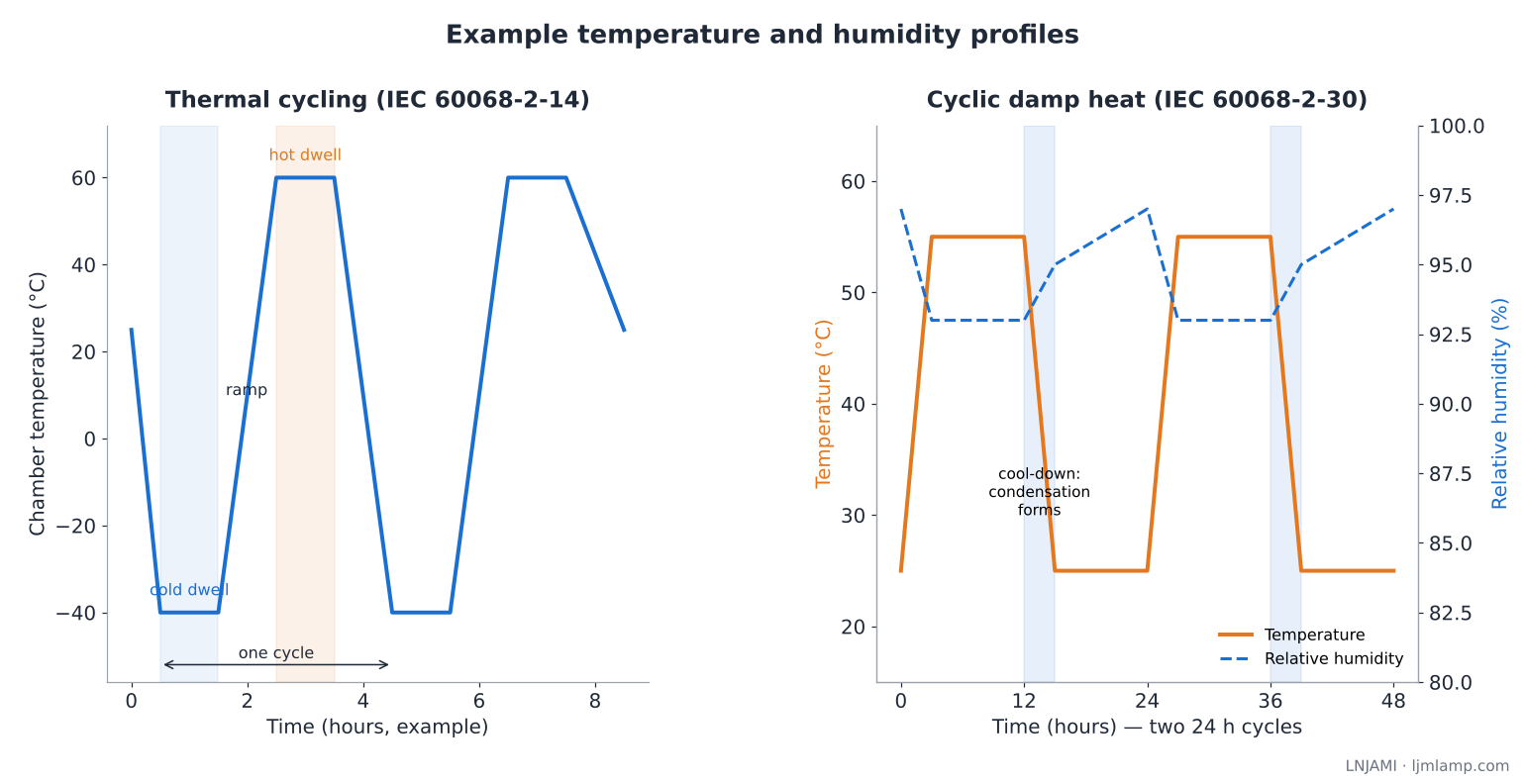
Example profiles only. Left: a thermal cycling profile between −40 °C and +60 °C. Right: a cyclic damp heat profile with an upper temperature of 55 °C and high humidity.
|
Parameter |
Example value |
Set by |
|---|---|---|
|
Low / high temperature (thermal cycling) |
−40 °C / +60 °C |
Product rating, site climate, specification |
|
Upper temperature (cyclic damp heat) |
40 °C or 55 °C |
Test variant chosen under IEC 60068-2-30 |
|
Relative humidity (damp heat) |
Around 93% or higher |
Applicable standard |
|
Number of cycles / duration |
Agreed per project |
Specification or quality plan |
|
Fixture powered during test |
Yes or no |
Test plan |
What Failures Do These Tests Expose?
|
Failure |
Why it happens |
What you would see on site |
|---|---|---|
|
Seal failure |
Gaskets and silicone harden or shrink with repeated expansion |
Water or fog inside the lens |
|
Condensation |
Humid air is drawn in as the fixture cools ("breathing") |
Misty lens, water droplets, corrosion inside |
|
Solder joint cracks |
Different materials expand at different rates |
Flickering or dead LED sections |
|
Lens or optic damage |
Thermal stress on plastic or glass |
Cracked or yellowed lens, light pattern changes |
|
Driver failure |
Heat and moisture attack electronic parts |
Fixture fails to start or shuts off |
|
Adhesive failure |
Glue softens or loses grip |
Loose optics or detached parts |
How to Read the Results
A useful report states:
• The standard and test profile — temperature range, humidity, dwell times and ramp rate.
• The number of cycles or total hours.
• Whether the fixture was powered during the test.
• The checks before and after testing — does it light up normally, is there water inside, has the light output or color changed, does it still pass an insulation or waterproof check?
A fixture that only "survived" is not enough. It should still work and still be sealed after the test.
Which Projects Need It Most?
• Cold climates with freeze–thaw cycles, such as the northern US and Canada
• Hot, humid regions such as the Gulf Coast and Florida
• In-ground, underwater and fountain fixtures
• Facade fixtures in direct sun that heat up strongly during the day
Our Temperature and Humidity Testing Service
LNJAMI runs high/low temperature, thermal shock and damp-heat tests on our fixtures. We can test at temperatures from −40 °C to +100 °C, which covers cold-climate projects in the northern US and Canada as well as hot, humid regions. Tell us the standard and conditions your specification requires — temperature range, humidity, number of cycles — and we will confirm the test plan before testing and share the results for your project.
FAQ
Can thermal cycling tell me how many years a fixture will last?
No. It shows whether a fixture has weak points under the tested conditions. Service life depends on the real climate, installation and maintenance.
Is thermal cycling the same as thermal testing of the LED temperature?
No. Thermal cycling tests the whole fixture's durability under temperature swings. Measuring the LED and driver temperature during operation is a separate test of heat dissipation.
Why does fog appear inside some outdoor fixtures?
Usually the seal is not tight enough, or humid air is drawn in as the fixture cools. Damp heat and thermal cycling tests expose this before installation.
Can a fixture pass an IP test and still fail thermal cycling?
Yes. A seal can be watertight when new but harden or loosen after many temperature cycles. That is why the two tests complement each other.
Working in a Harsh Climate?
Tell us your site's temperature range and conditions and we will recommend suitable tests. Contact us for a free project consultation.
Back to the full guide: LED Light Fixture Testing: The Equipment and Reports That Prove Quality