Outdoor fixtures are connected to long cable runs that act like antennas for lightning and grid disturbances. A single surge can destroy a driver or a row of LEDs, and a breakdown in insulation can make a metal housing dangerous to touch. Surge and hipot tests check both risks before a fixture is installed. This article explains what each test is, how it is done, and how to read the results correctly.
This article is part of our guide to LED Light Fixture Testing.
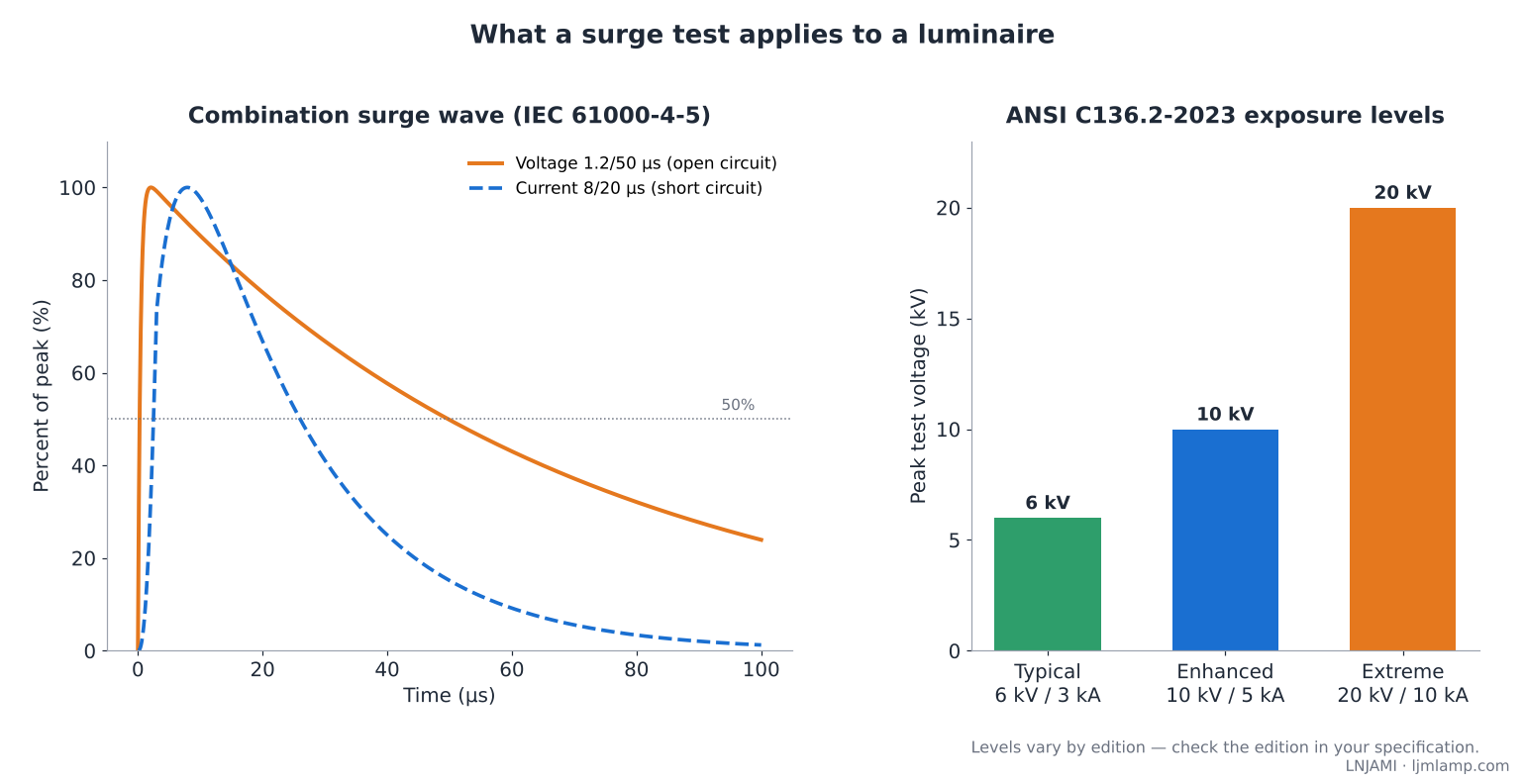
Left: the standard combination surge wave. Right: the exposure levels defined in ANSI C136.2-2023 — always check the edition named in your project specification.
What Is a Surge Test?
A surge test uses a surge generator to send short, high-energy voltage pulses into the fixture's power input. The pulses simulate what happens when lightning strikes nearby, or when large equipment switches on and off on the same supply.
The common test method is IEC 61000-4-5, which uses a standard "combination wave" (1.2/50 µs voltage, 8/20 µs current). For roadway and area lighting in North America, ANSI C136.2 defines surge test levels for luminaires.
Surge Levels in ANSI C136.2
ANSI C136.2 has been revised several times, and the names and values of its exposure levels depend on the edition. In ANSI C136.2-2023, the levels are:
|
Exposure level (ANSI C136.2-2023) |
Peak voltage / current |
Typical application |
|---|---|---|
|
Typical |
6 kV / 3 kA |
Building exteriors and entrances |
|
Enhanced |
10 kV / 5 kA |
Parking lots, garages, tunnels |
|
Extreme |
20 kV / 10 kA |
Roadways, stadiums, airports |
Before quoting or comparing surge levels, confirm which edition of the standard the project specification refers to, and check that the test report names the same edition and level.
Differential Mode vs Common Mode
• Differential mode (line to line / line to neutral): the surge appears between the power wires.
• Common mode (line to ground): the surge appears between the power wires and the earth or housing. Outdoor fixtures on metal poles and structures often face this type.
A complete surge rating states the level for each mode, the standard and the waveform used.
Driver Surge Rating vs Fixture Surge Test
These are two different things, and they are often confused:
|
|
Driver surge rating |
Complete fixture surge test |
|---|---|---|
|
What is tested |
The LED driver on its own |
The finished fixture: driver, wiring, LED board, housing and any surge protective device (SPD) |
|
Where it comes from |
The driver manufacturer's datasheet |
A test on the assembled fixture |
|
What it shows |
How much surge the driver itself withstands |
How the whole fixture performs as installed |
A fixture can use a driver with a good surge rating and still fail at a lower level — for example because of internal wiring, the earthing path through the housing, or poor coordination with an added SPD. When a project specifies a surge level, ask for the result of the complete fixture, not only the driver datasheet.
What Is a Hipot Test?
Hipot stands for "high potential". It is also called a dielectric strength or withstand voltage test. A hipot tester applies a high AC or DC voltage, well above normal operating voltage, between the live parts and the accessible parts of the fixture. If the insulation is sound, only a tiny leakage current flows. If there is a weak point, the insulation breaks down and the fixture fails.
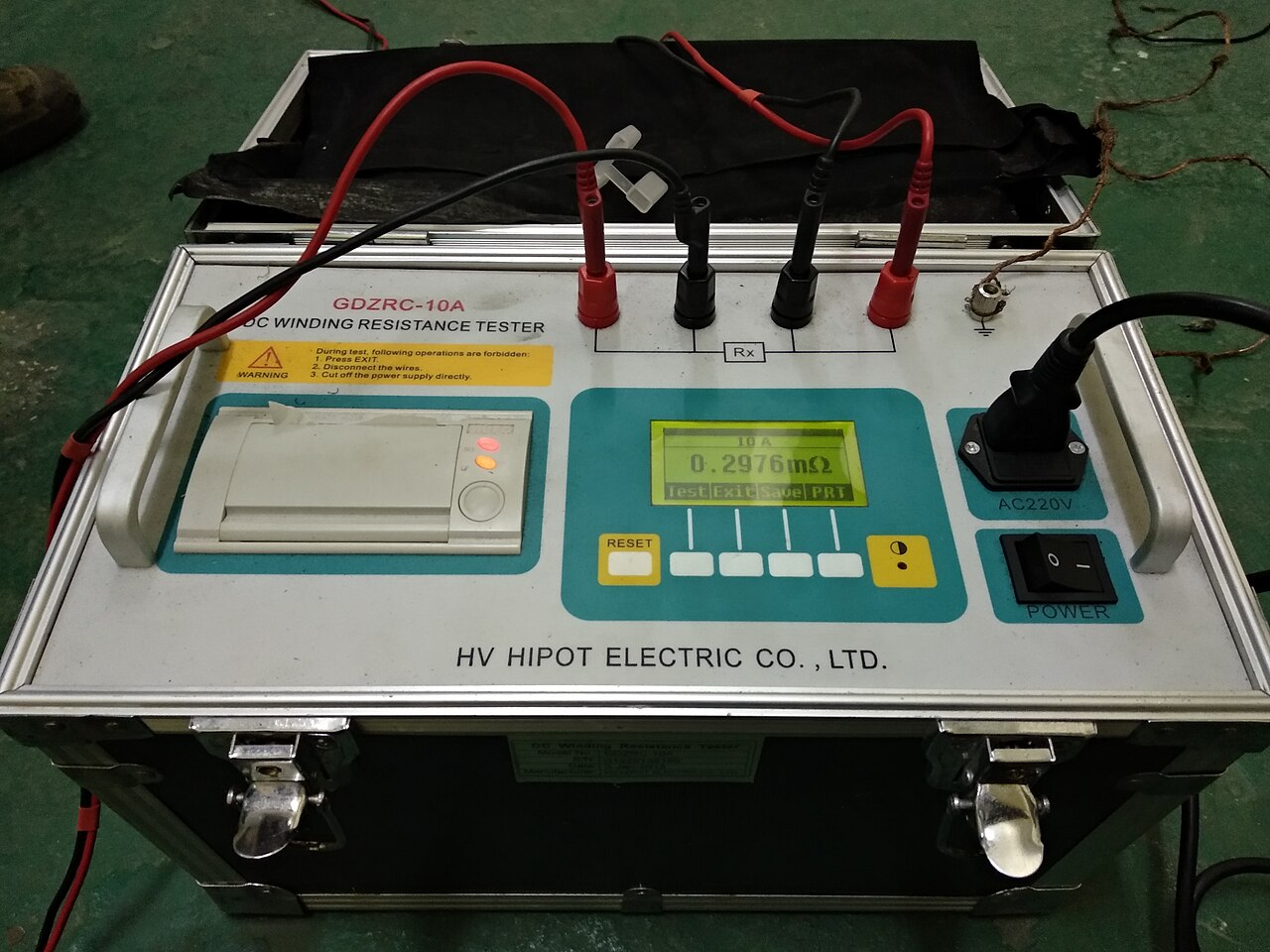
A hipot (dielectric strength) tester.
Photo: Hipot tester by Dr Lotus Black, CC BY-SA 4.0, via Wikimedia Commons.
How Hipot Test Conditions Are Set
There is no single hipot voltage or duration that applies to every LED fixture. The test conditions depend on:
• The luminaire class — for example Class I (protective earth) or Class II (double or reinforced insulation).
• The insulation type being tested — basic, supplementary or reinforced insulation.
• The rated voltage of the fixture.
• The applicable standard — for example IEC 60598-1 for luminaires, or UL 1598 / UL 8750 in North America.
• The type of test — a longer type test during certification, or a shorter routine test on every production unit.
A meaningful hipot record therefore states the standard, the voltage applied, the duration, the points tested and the leakage current limit — not just "passed".
What Hipot Testing Catches
• Damaged or pinched wire insulation
• Too little spacing between live parts and the housing
• Moisture or dirt that creates a leakage path
• Assembly mistakes, such as a sharp edge cutting a cable
It is often combined with ground continuity and insulation resistance checks.
Which Projects Need Higher Surge Protection?
|
Typical site |
Surge exposure |
|---|---|
|
Indoor or covered areas close to the panel |
Lower |
|
Building facades and landscape lighting |
Medium to high |
|
Poles, bridges, rooftops, open areas, lightning-prone regions |
High — consider an added SPD |
Your electrical engineer or the project specification should set the required level.
What to Ask Your Supplier
• What is the surge level of the complete fixture, in kV, for both differential and common mode?
• Which standard and edition was it tested to?
• Is the protection in the driver, or is a separate SPD included?
• Is every production fixture hipot tested, and at what voltage and duration?
• If certification such as UL or ETL is required, which exact model is listed, and what is the certificate or file number?
Surge and Electrical Safety Testing for Your Project
If your project requires a specific surge level or electrical safety verification, testing can be arranged according to the applicable requirements.
FAQ
Is a surge protective device always needed?
Not always. For high-exposure sites such as poles, bridges and rooftops in lightning-prone areas, an added SPD is a common safeguard.
Is the driver's surge rating the same as the fixture's?
No. The driver rating applies to the driver alone. The fixture's surge performance should be confirmed by testing the complete fixture.
Does a high surge rating protect against a direct lightning strike?
No. Surge protection handles induced and grid surges. A direct strike needs a building lightning protection system.
What is the difference between hipot and insulation resistance tests?
Hipot checks whether insulation withstands high voltage without breaking down. Insulation resistance measures how well it resists leakage at a test voltage. Both are useful.
Lighting a Lightning-Prone Site?
Tell us about your site and power supply and we will help you review the protection your project needs. Contact us for a free project consultation.
Back to the full guide: LED Light Fixture Testing: The Equipment and Reports That Prove Quality