Salt air is one of the fastest ways to destroy an outdoor fixture. Screws seize, brackets rust, coatings blister and water finds its way in through the corrosion. A salt spray test exposes a fixture's materials and finish to a controlled, highly corrosive salt fog, so their resistance can be compared in weeks rather than years. This article explains what the test is, how it is done, what a report contains and what the results can — and cannot — tell you.
This article is part of our guide to LED Light Fixture Testing.
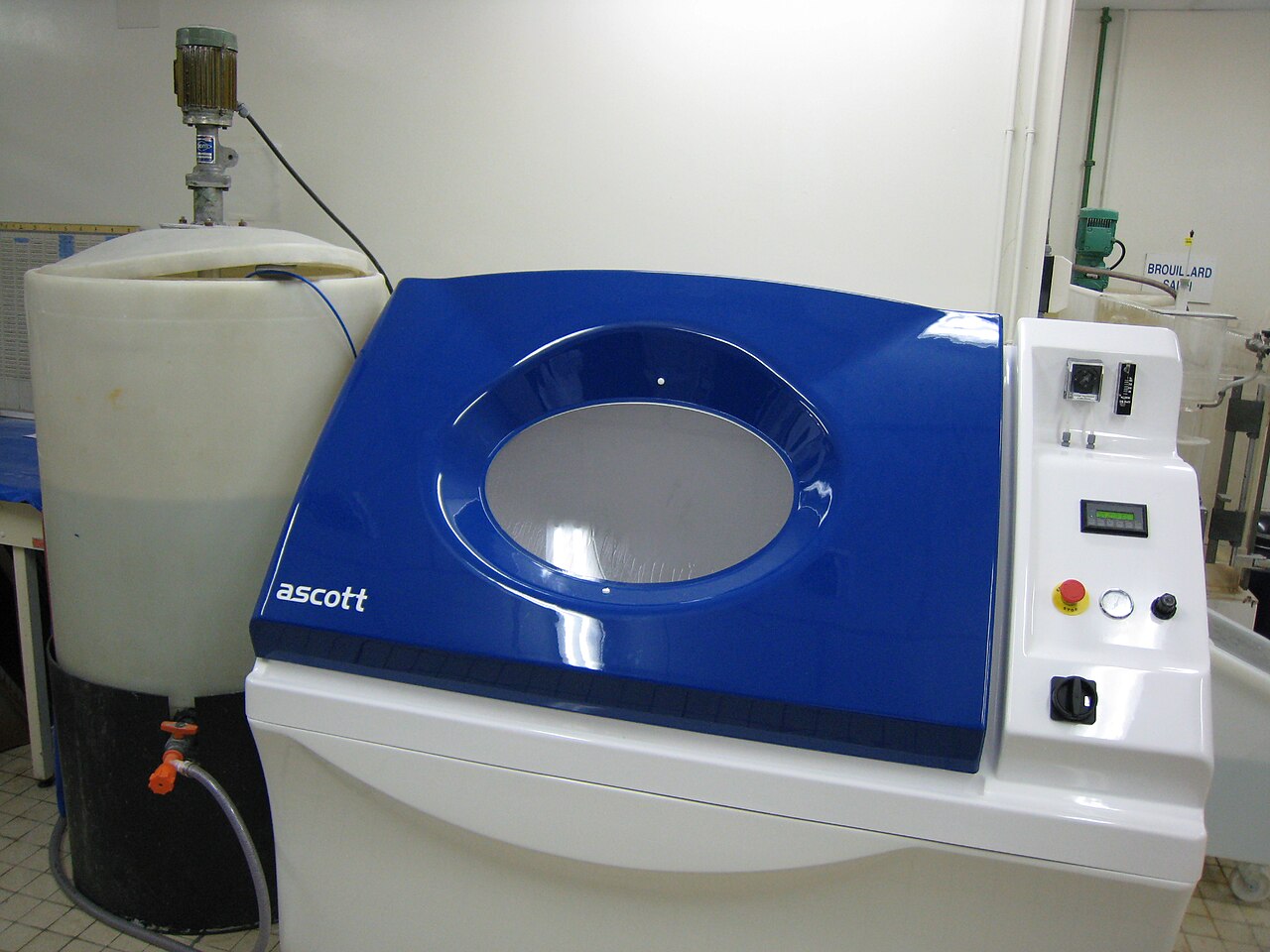
A neutral salt spray (salt fog) test chamber.
Photo: Salt spray chamber by Cjp24, CC BY-SA 3.0, via Wikimedia Commons.
What Is a Salt Spray Test?
A salt spray test (also called a salt fog test) is an accelerated corrosion test. Fixtures or parts are placed in a sealed chamber filled with a continuous, fine mist of salt water at a controlled temperature. After a set number of hours, they are inspected for rust, blistering, peeling and other corrosion.
Its purpose is comparison and quality control: it shows quickly whether a housing, coating or fastener resists salt better or worse than another, and whether a product meets the salt spray hours written into a project specification.
How Does It Work?
The most widely used method in North America is ASTM B117, the neutral salt spray test. Related methods include ISO 9227 (neutral salt spray, NSS) and IEC 60068-2-11 (Test Ka). They are based on the same principle — a neutral salt fog at a controlled temperature — but they are separate standards with their own details for apparatus, test conditions and evaluation. Results are only directly comparable when the same standard, conditions and duration are used, so a report should always name the standard it was run to.
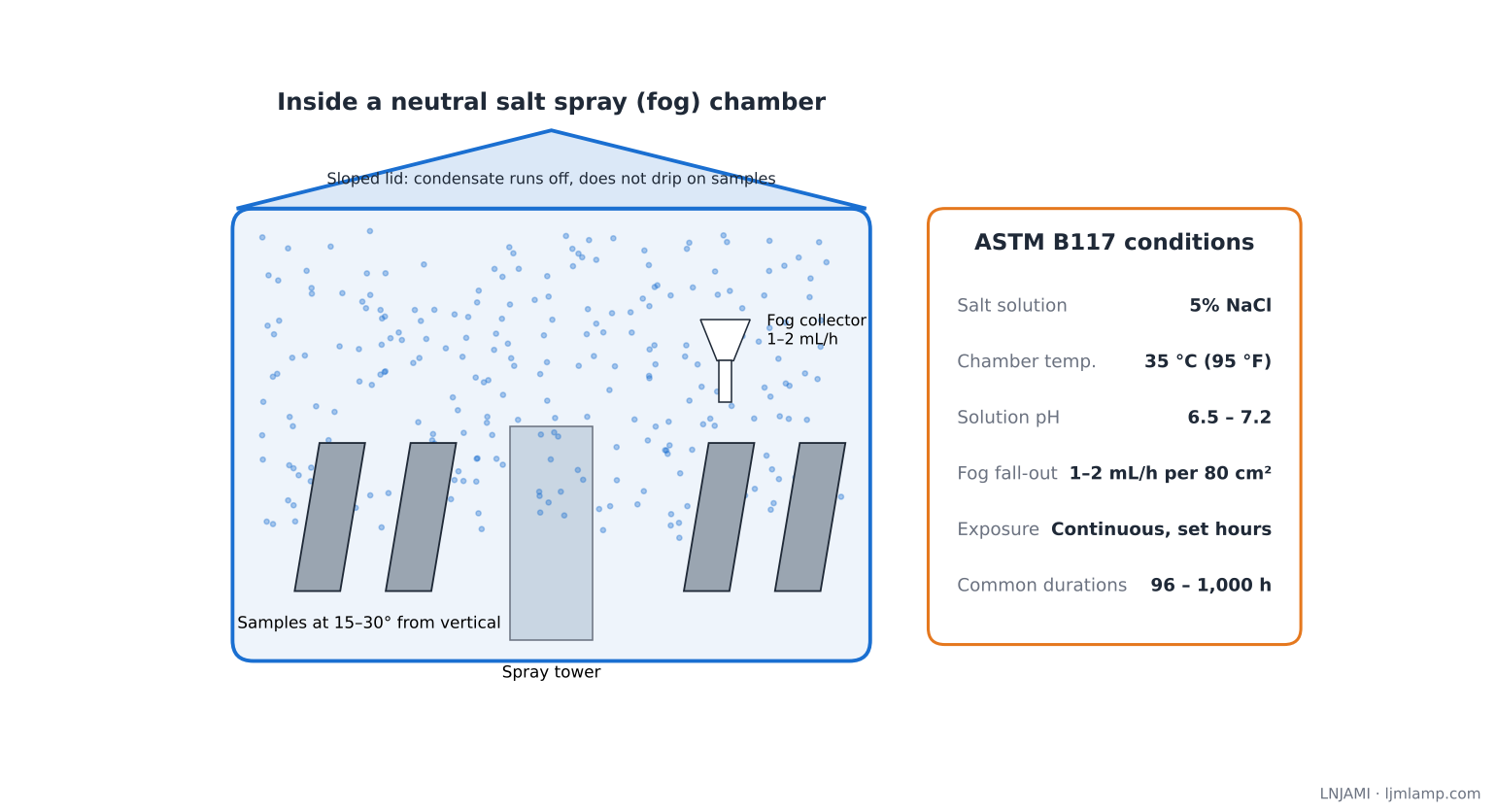
How a neutral salt spray chamber works, with typical ASTM B117 conditions.
|
Condition |
Typical value (ASTM B117) |
|---|---|
|
Salt solution |
5% sodium chloride in water |
|
Chamber temperature |
35 °C (95 °F) |
|
Solution pH |
About 6.5 to 7.2 (neutral) |
|
Exposure |
Continuous mist for the agreed number of hours |
1. Preparation. Samples are cleaned, labeled and photographed. On coated panels, a line is often scratched through the coating to see how corrosion spreads underneath.
2. Loading. Samples are placed on racks at a slight angle so the salt fog settles evenly, without touching each other.
3. Exposure. The chamber runs continuously for the agreed duration, such as 240, 500 or 1,000 hours.
4. Inspection. Samples are rinsed, dried and compared with the "before" photos. Complete fixtures can also be powered on to check they still work.
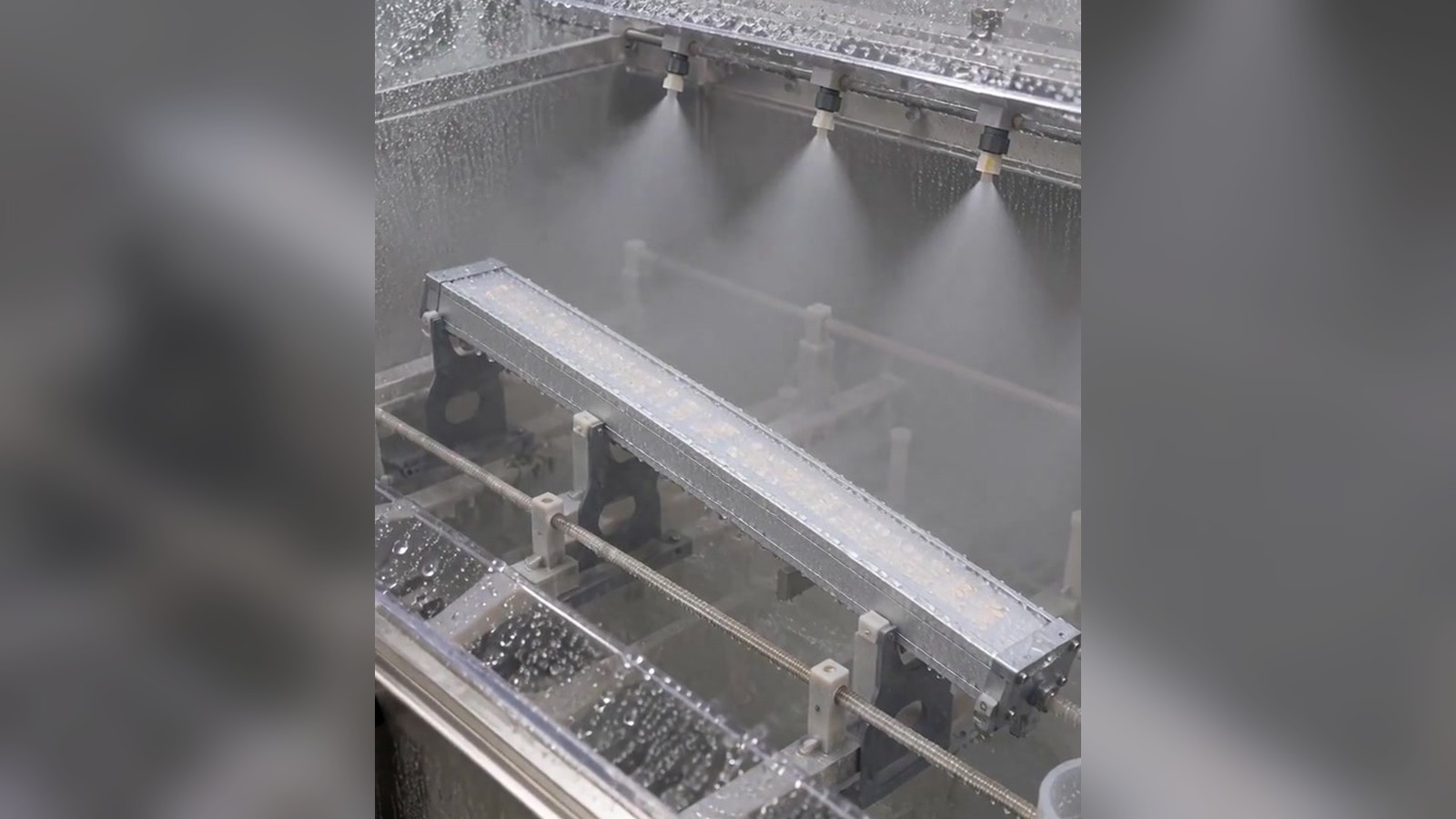
Illustration (AI-generated): an LED linear fixture under test in a salt spray chamber.
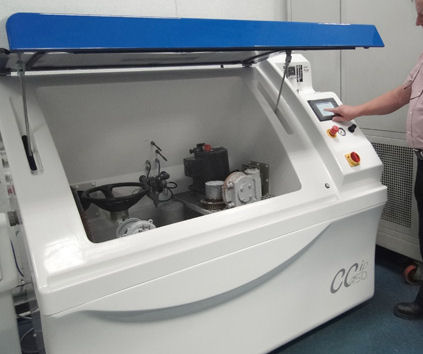
Samples inside a salt spray chamber during a test.
Photo: Salt Spray Chamber by Ascott Analytical, CC BY-SA 4.0, via Wikimedia Commons.
What Can Be Tested on an LED Fixture?
• Housing and coating — aluminum die-casting and powder coating, or stainless steel.
• Hardware — screws, brackets, hinges and mounting accessories, often the first parts to rust.
• Seals and cable glands — whether corrosion opens a path for water.
• Lens frames and joints — where two materials meet, which can cause galvanic corrosion.
• Complete fixtures — to check that the product still works and stays sealed after exposure.
What the Results Look Like
The photo below shows a typical comparison after 1,000 hours: fasteners with two different surface treatments, side by side. One finish stays almost clean; the other is covered in red rust. This is exactly how salt spray testing is used — to see which material or finish holds up better before it is used on site.
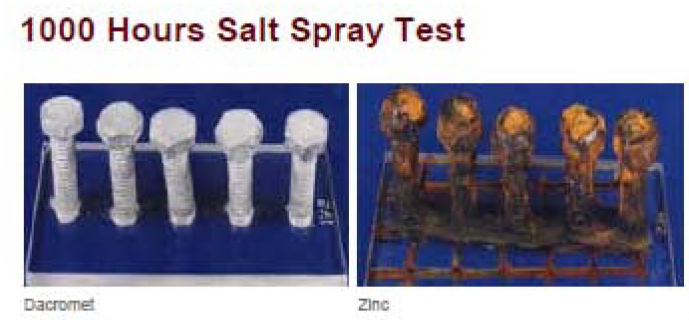
Fasteners with two different surface treatments after a 1,000-hour salt spray test.
Photo: Dacro1000 by Ottomon2020, CC BY-SA 4.0, via Wikimedia Commons.
What a Salt Spray Report Includes
|
Item in the report |
What it tells you |
|---|---|
|
Test standard |
Which method was used, e.g. ASTM B117 or ISO 9227 |
|
Test conditions and hours |
How severe the exposure was |
|
Samples tested |
Complete fixture, housing, hardware or coated panel |
|
Before and after photos |
The visible condition of coating, screws and brackets |
|
Evaluation |
Red rust, white rust, blistering, coating loss from the scribe |
|
Function check (if fixtures) |
Whether the fixture still lights up and stays sealed |
|
Laboratory name and report number |
Where and when the test was carried out |
How to Read Salt Spray Results
Hours are a comparison, not a lifespan. A 500-hour result does not mean the fixture lasts 500 days or 5 years on the coast. Real corrosion depends on humidity, rain, sun, temperature and how often the fixture is washed. Salt spray hours are best used to compare materials and finishes against each other, or against a project specification.
When you review a report, check that it covers the exact product and finish you are buying, that the standard and hours match your specification, and that the pass criteria — for example, no red rust and no blistering — are clearly stated.
When Does Your Project Need It?
• Coastal buildings, piers, marinas and seafront promenades
• Bridges and roads where de-icing salt is used
• Swimming pools, water features and fountains
• Industrial sites with chemical exposure
For these sites, material choice matters as much as the coating. 316 stainless steel housings and hardware resist salt far better than standard materials, and are often specified for marine and underwater lighting.
Salt Spray Testing for Your Project
If your project needs salt spray testing, we can provide it and supply the test report.
FAQ
How many salt spray hours do I need?
It depends on your specification and site. Coastal and marine projects usually specify longer durations.
Are ASTM B117 and ISO 9227 results the same?
Not automatically. The methods are similar, but each has its own requirements, so compare results only when they were run to the same standard and conditions.
Does powder coating pass salt spray tests?
A good pretreatment and powder coating can perform well, but results depend on the process. Ask to see test results rather than assuming.
Is stainless steel always better?
Not every grade. 316 stainless steel resists salt much better than 304, which is why it is preferred for marine and underwater use.
Lighting a Coastal Project?
Tell us where the fixtures will be installed and we will suggest materials and tests that suit the site. Contact us for a free project consultation.
Back to the full guide: LED Light Fixture Testing: The Equipment and Reports That Prove Quality