To estimate facade lighting power consumption, multiply the system’s total input power in kilowatts by its operating hours. Multiply the resulting kilowatt-hours by your local electricity rate to estimate the energy charge.
A quick example: a 2.52 kW system operating six hours per night uses 453.6 kWh over 30 days. At an assumed rate of USD 0.15/kWh, the monthly energy charge is USD 68.04.
This guide shows how to build that estimate from a fixture schedule for a hotel, office building or commercial facade. The figures are illustrative, not a quotation or a measured LNJAMI project. The scope is exterior architectural lighting; indoor lighting, air conditioning and other building services are excluded.
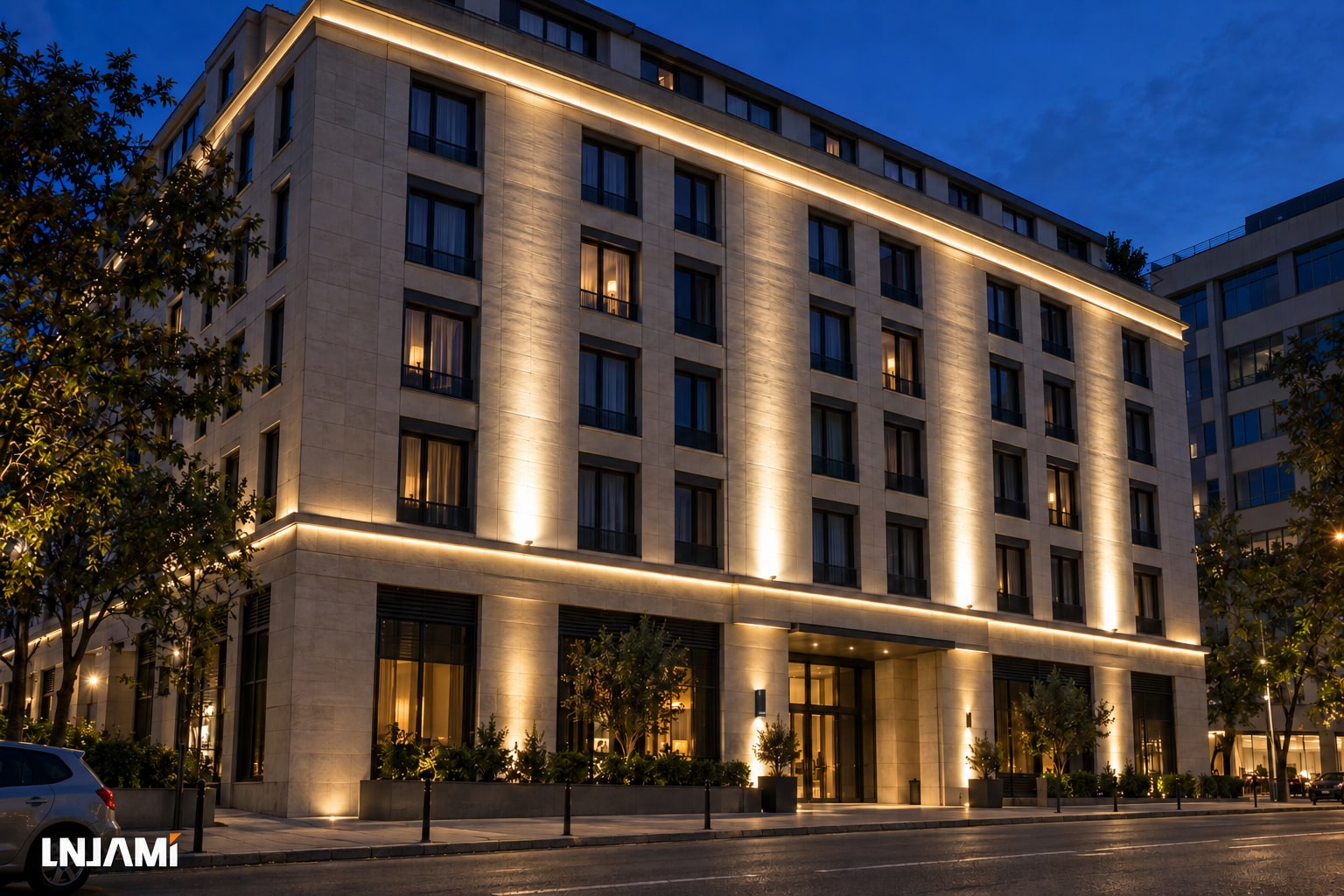
Facade lighting can combine linear accents and wall washing. AI-generated illustration; not an actual LNJAMI project or the building used in the calculation.
Start with four project inputs
A reliable electricity estimate starts with the equipment and its operating schedule, not the building’s appearance. Two similar facades can use different amounts of electricity because their fixture quantities, input power and running hours differ.
| Input | What to record |
|---|---|
| Fixture quantity | Count each model separately. For products rated per metre, record installed length. |
| Input power | Use watts per complete fixture or watts per metre, and check whether external power-supply losses are included. |
| Operating schedule | Record hours per night, operating days and any separate lighting zones or scenes. |
| Electricity rate | Use the applicable rate per kWh from the project’s electricity contract or bill. |
Keep the units consistent. A product specified at 12 W/m over 50 metres has a listed load of 600 W. A fixture specified at 12 W each needs a fixture count instead. If the schedule mixes metres and units, calculate each group separately before adding the totals.
Watts describe power at a particular moment. Kilowatt-hours describe electricity used over time: 1,000 W equals 1 kW, and a steady 1 kW load running for one hour uses 1 kWh. See the EIA explanation of electricity measurement.
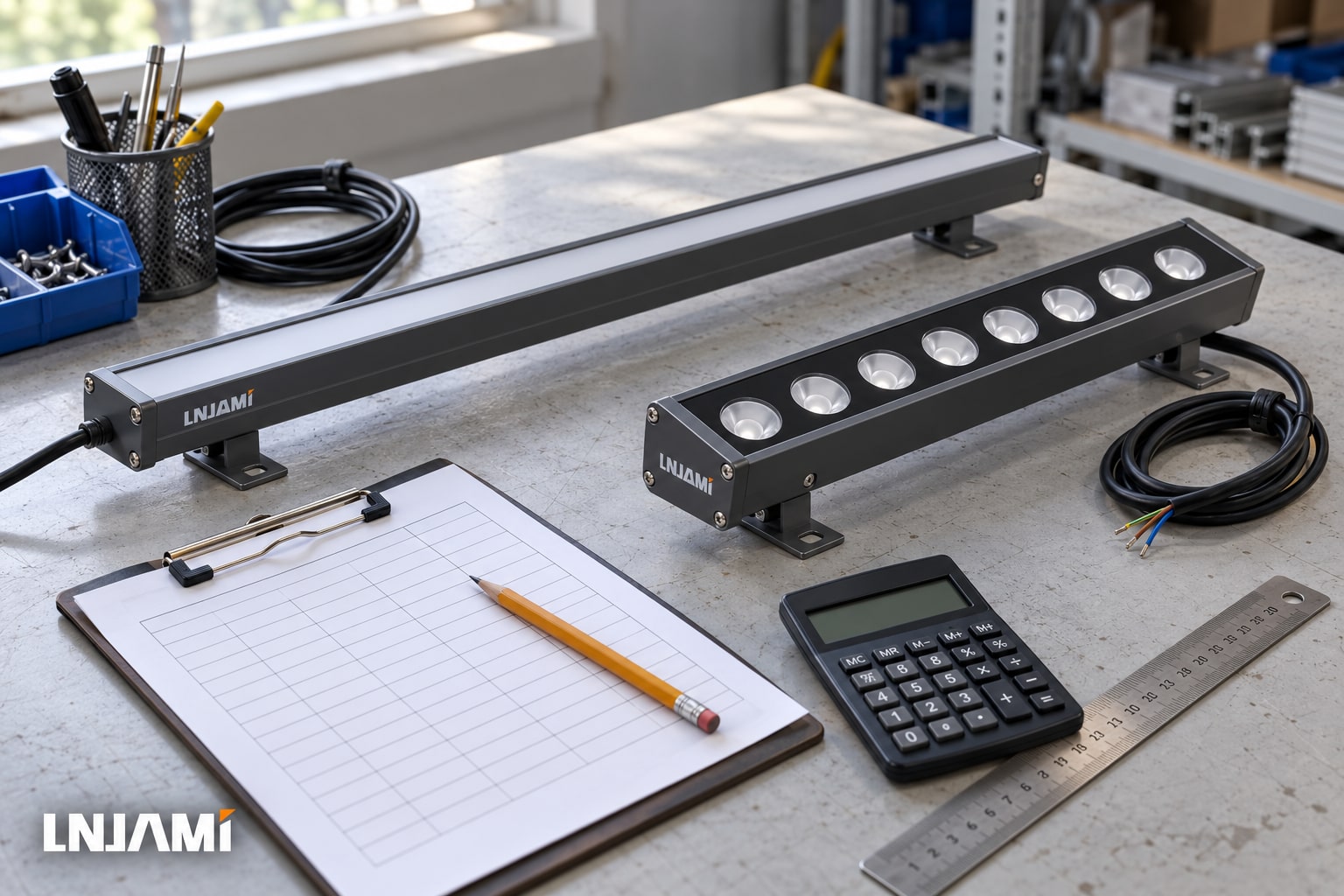
Check each fixture type, quantity and power-rating basis before calculating the total. AI-generated sample-planning illustration with LNJAMI branding; not an actual product specification or factory photograph.
Calculate the power drawn from the supply
For each fixture group, multiply quantity by input wattage. Add the groups to obtain the total power for that operating scene. Include the associated drivers and power supplies once, then account for controllers and other equipment within your chosen system boundary.
Total fixture input power (W)
= sum of [quantity × input watts per fixture]
A low-voltage LED fixture’s listed wattage may describe the DC load rather than the power drawn from the AC supply. If an external supply feeds a 900 W DC load and its efficiency at that operating point is assumed to be 90%, its AC input is approximately 900 ÷ 0.90 = 1,000 W. This is a calculation example, not a specification for a particular supply.
Use the actual power-supply data at the relevant load and input voltage. If the fixture figure already includes its driver, do not add the same loss again. A measurement at the dedicated lighting-system input can include drivers, controllers and downstream cable losses together; keep unrelated building loads outside that measurement.
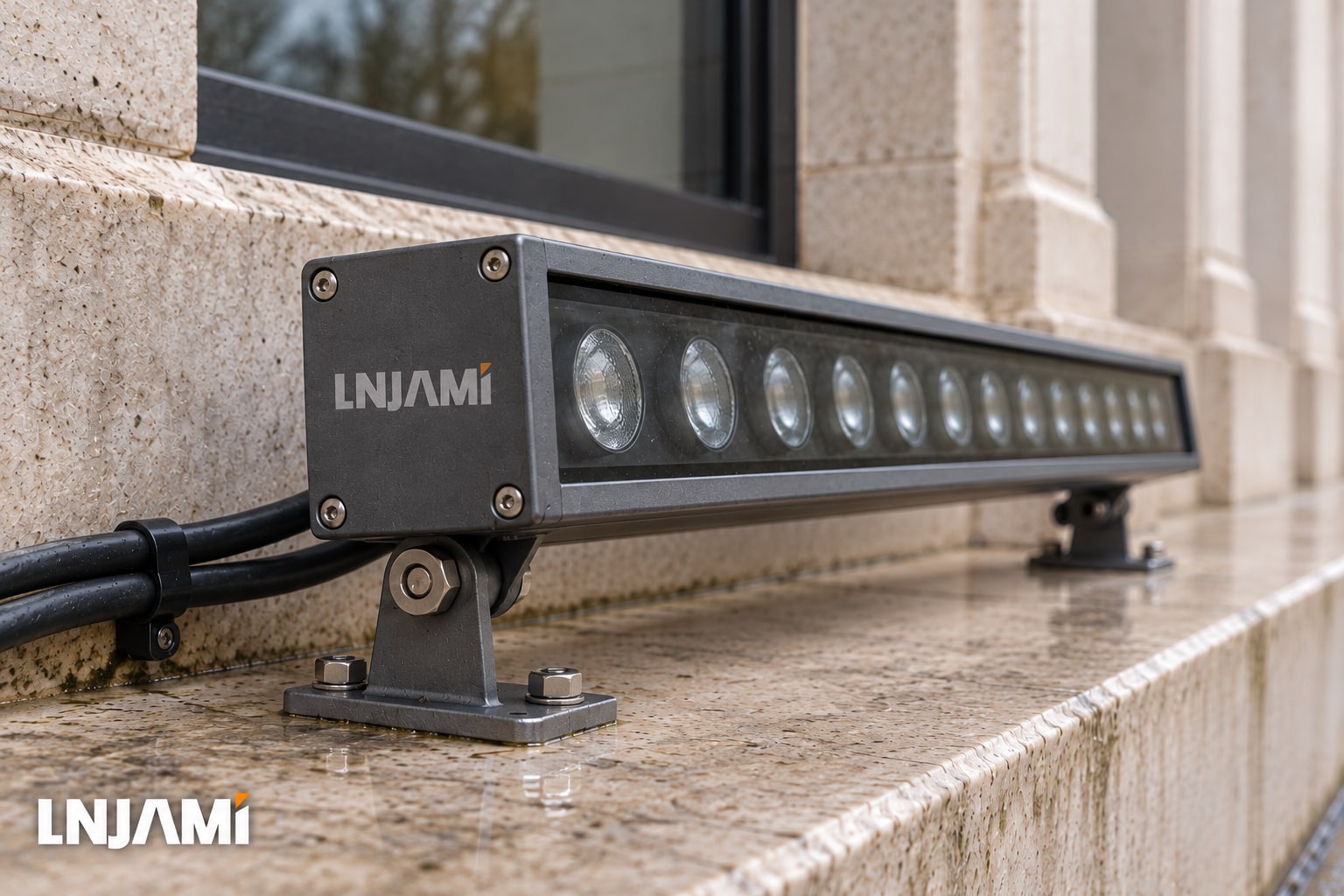
Identify the complete luminaire and its power-supply arrangement before building the load schedule. AI-generated generic installation illustration; not a specific LNJAMI model.
A power supply’s rated output capacity is not its constant electricity use. For example, a 300 W label does not mean the supply always draws 300 W. Capacity selection and energy estimation are separate tasks. For equipment selection, read our outdoor lighting power-supply guide and check the selected manufacturer’s specifications.
Work out the monthly electricity cost
Consider an illustrative facade with 100 linear lights and 20 wall washers. For this example, each listed wattage is an allocated AC input value that already includes the associated driver or power-supply loss. Separate control equipment and cable losses are omitted from this simplified estimate.
| Fixture group | Quantity | Input per fixture | Group input |
|---|---|---|---|
| Linear facade lights | 100 | 18 W | 1,800 W |
| LED wall washers | 20 | 36 W | 720 W |
| Total | 120 | 2,520 W |
Assume that all fixtures run at the stated input power for six hours every night, for 30 days. Use an illustrative electricity rate of USD 0.15/kWh. This rate is not a current tariff for any country; replace it with the rate that applies to your project.
Convert watts to kilowatts: 2,520 ÷ 1,000 = 2.52 kW.
Calculate daily energy: 2.52 × 6 = 15.12 kWh.
Calculate monthly energy: 15.12 × 30 = 453.6 kWh.
Apply the electricity rate: 453.6 × 0.15 = USD 68.04.
Input power: 2.52 kW · Monthly energy: 453.6 kWh · Monthly energy charge: USD 68.04
Monthly energy (kWh) = input power (W) ÷ 1,000 × hours per day × operating days
Energy charge = energy (kWh) × rate per kWh
This is the energy charge, not necessarily the entire utility bill. Fixed charges, demand charges and taxes may also apply. With time-of-use pricing, calculate the energy used in each tariff period and apply that period’s rate. If different zones have different schedules, calculate each zone separately and add the results.
Estimate your own electricity cost
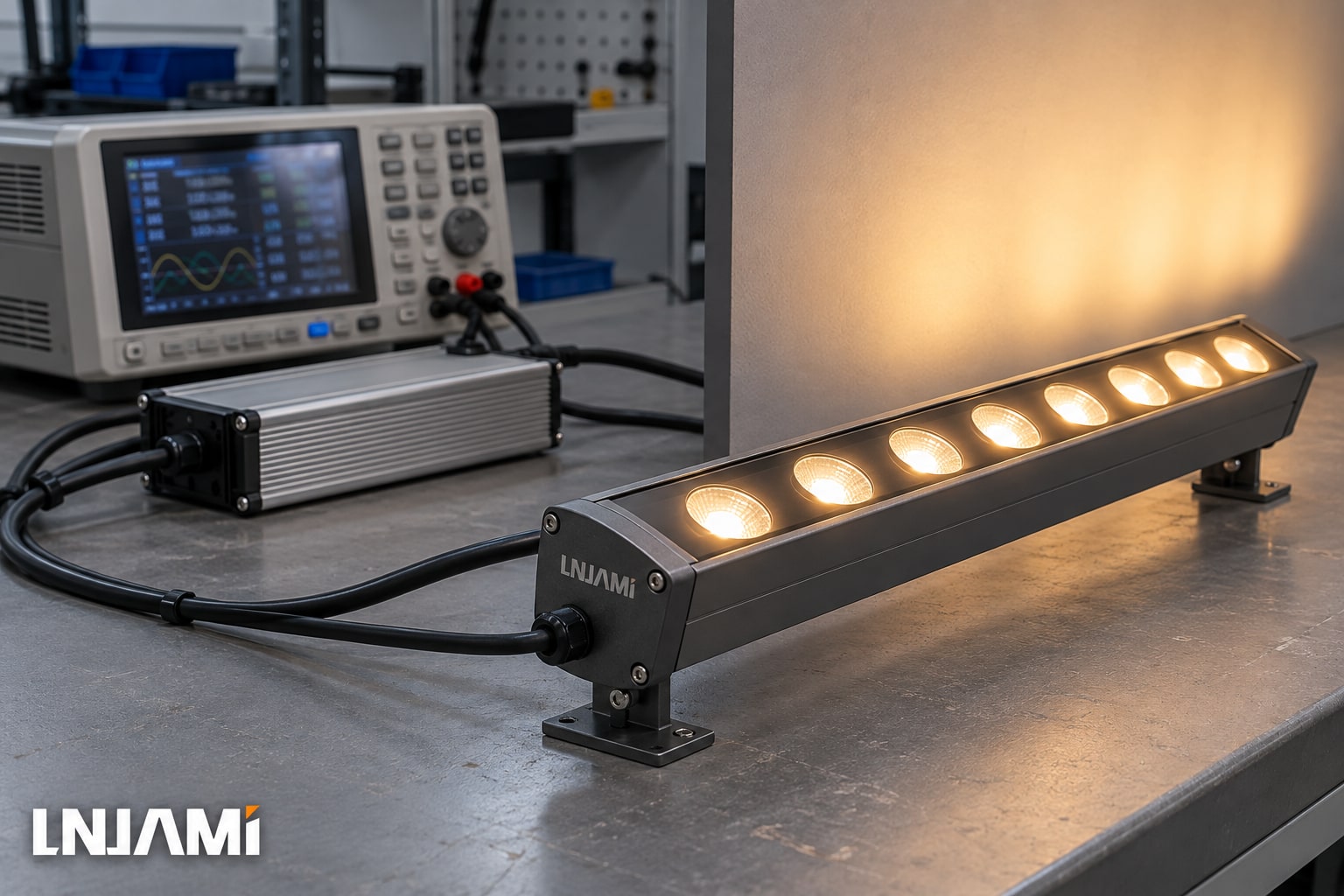
Use verified input-power data for the operating scene you want to estimate. AI-generated measurement-bench illustration with a branded luminaire; the image is not a test record, wiring guide or proof of measured performance.
Use the total AC input power for one operating scene, the daily hours, the number of operating days and your energy rate. Use one currency consistently. The formula estimates energy charges only; it does not select fixtures or size power supplies.
Worked example: 2,520 W ÷ 1,000 × 6 hours/day × 30 days = 453.6 kWh per month.
453.6 kWh × USD 0.15/kWh = USD 68.04 per month.
Replace these example values with your project data. For multiple scenes or time-of-use rates, calculate each period separately.
Reduce running costs with a clear operating plan
Set the decorative lighting hours
Start by identifying when the facade needs its full decorative scene. A schedule can reduce unnecessary late-night operation while preserving required entrance, access and safety lighting on appropriate circuits. Check the agreed operating requirements before changing any schedule.
For the same 2.52 kW example, reducing daily operation from six to four hours changes monthly energy from 453.6 to 302.4 kWh. At the assumed rate, the charge falls from USD 68.04 to USD 45.36: a saving of USD 22.68, or 33.3%. This comparison assumes unchanged power while the lights are on.
6 hours per night453.6 kWh
4 hours per night302.4 kWh
Separate zones and verify dimmed scenes
Roofline accents, wall washing and entrance lighting do not always need the same schedule. Estimate each zone using its own input power and operating time. For dimmed or RGBW scenes, use measured scene power or verified manufacturer data rather than treating the control percentage as a power percentage.
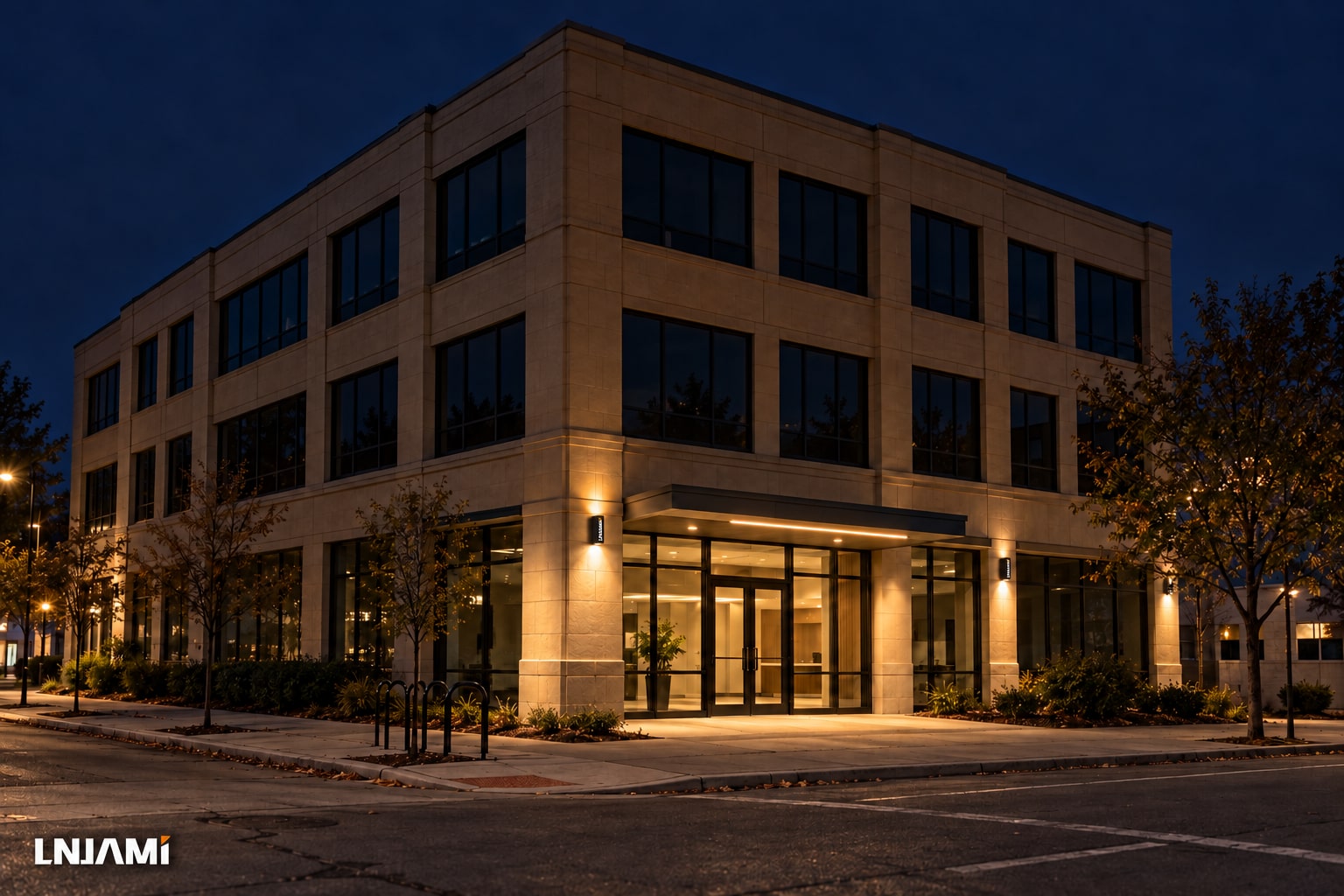
An illustrative late-evening scene retains entrance lighting while much of the upper facade remains dark. AI-generated image; it does not demonstrate measured energy savings.
Check the lighting effect before reducing wattage
Lower wattage alone does not prove that a design meets the brief. Review beam distribution, fixture spacing, aiming and the required visual effect together. Compare options under equivalent lighting requirements, then calculate the running cost of the complete proposed system.
Common questions about facade lighting electricity use
Does a 50% dimming setting mean 50% electricity use?
Not necessarily. The control setting, light output and electrical input are different quantities, and their relationship depends on the controller and driver. Use measured watts for the scene or an applicable input-power curve. Lutron’s control-topology guidance explains how dimming curves can differ.
Can I estimate consumption from facade area alone?
Area can help with an early design discussion, but it does not establish the installed load. A narrow outline, a fully washed wall and an animated pixel facade can have very different equipment schedules. Use a fixture schedule and operating plan for a project-specific estimate.
Should controllers and standby power be included?
Yes, if they fall within the system you are estimating. Calculate them over their actual powered hours, which may be longer than the facade’s lit hours. For example, an assumed 20 W controller powered continuously for 30 days uses 14.4 kWh. Do not add it again if a whole-system measurement already includes it.
Is this also the project installation cost?
No. Electricity is one operating expense. Fixture purchases, controls, cabling, installation, access equipment and maintenance belong in separate budget lines. For a discussion focused on individual floodlights, see Do Flood Lights Use a Lot of Electricity?.
Build an estimate for your facade lighting project
Begin with the fixture list, confirm the AC input power, apply the operating schedule and use the correct electricity rate. Keep assumptions visible so the estimate can be updated when the design, scene settings or tariff changes.
Planning lighting for a hotel, office building or commercial facade? Share your facade drawings or fixture schedule, project location and planned operating hours with LNJAMI. These details help our team discuss fixture selection, control arrangements and the inputs needed for an electricity estimate.
Discuss your facade lighting project
Explore LED linear facade lights