Tree Ring Lights vs. Spotlights: Which Is Better for Uplighting Trees?
Short answer: neither is better in every case. Tree ring lights provide light from several directions with one fixture and suit trees seen from all sides, palms and tight spaces; spotlights reach high canopies and suit trees seen mainly from one direction. The result depends mostly on beam angle, mounting distance and the fixture’s light distribution, and large feature trees often use both.
Ask which fixture is "better" for uplighting a tree and the honest answer is that it depends less on the type of fixture than on its optics and where it is placed. A well-aimed spotlight can make a trunk look sculpted; a poorly specified ring can leave a bright band at the base and a dark canopy. The reverse is also true.
This article compares the two approaches with that in mind: what each one does, which optical factors actually decide the result, how tree type changes the choice, and what installing a ring on an existing tree involves. For background on ring fixtures, see our complete guide to LED circular tree lights.
1. What Each Fixture Actually Does
A spotlight sends a directional beam from one point. It is usually placed some distance from the trunk, in the ground or on a stake, and aimed up into the tree. Lighting a tree from several viewing directions normally takes two or three spotlights placed around it.
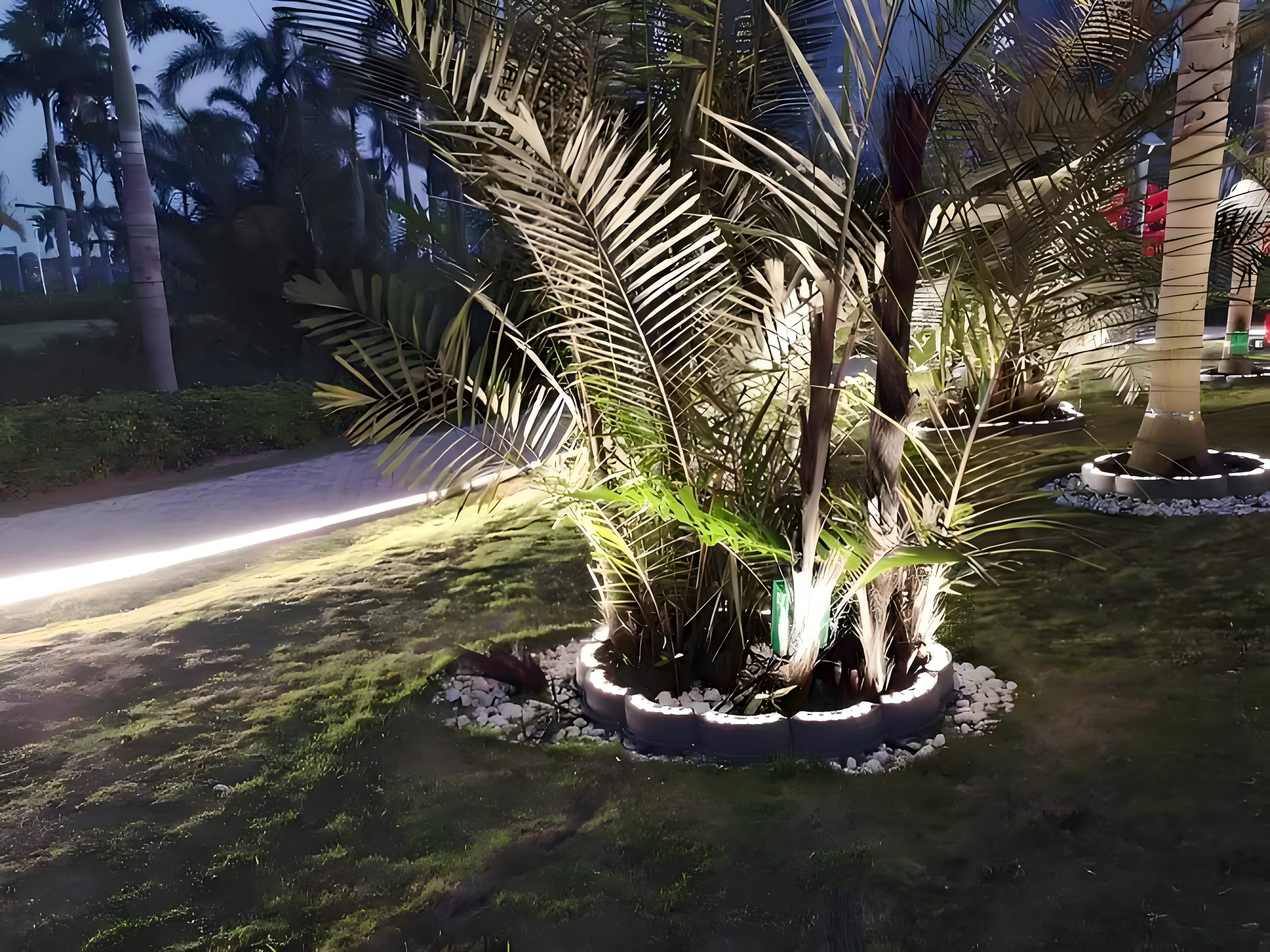
A tree ring light distributes light sources around the trunk, providing illumination from multiple directions with a single fixture. This can create a more consistent all-round effect than a single spotlight, although the actual uniformity depends on beam angle, LED orientation, mounting distance, trunk shape and fixture optics. Branches and foliage also block light, so the canopy rarely receives as even a result as the trunk.
In other words, a ring guarantees where the light sources are, not how evenly the tree is lit.
2. Beam Angle and Mounting Distance: What Actually Determines the Result?
Beam angle
Narrow beams are generally better for throwing light a long way and for picking out a specific part of a tree, such as a tall trunk or the upper canopy. Wide beams cover more area but spread the light, so less of it reaches high branches.
A quick way to see the effect is the approximate width of the beam at a given distance:
Beam width ≈ 2 × distance × tan(beam angle ÷ 2)
At 5 m from the fixture, a 15° beam is about 1.3 m wide, while a 40° beam is about 3.6 m wide. The 15° beam puts much more light on a smaller area; the 40° beam covers a broad canopy but less brightly. Beam angle is normally measured to the point where intensity falls to half of the peak, so light continues to fade beyond these edges rather than stopping sharply.
Mounting distance
For a spotlight, distance from the tree changes both the area covered and the angle at which light meets the bark. Close to the trunk and aimed steeply upward, it grazes the bark and emphasizes texture but lights less of the canopy. Further back, it covers more of the tree with a gentler angle on the trunk.
For a ring light, the distance between the LEDs and the trunk plays the same role. When the LEDs sit close to the bark, light runs almost parallel to the trunk. Further out, the beams from neighboring LEDs overlap more before reaching the trunk and land higher up. The ring's inner diameter compared with the trunk diameter therefore affects the look as well as the fit; our guide on how to size an LED tree ring light explains how to calculate it.
Light distribution
Wattage and lumens alone do not tell you how a fixture will light a tree. Two fixtures with the same output can produce very different results depending on their optics. Ask for the photometric data (polar curves or IES files), run a lighting simulation for important trees, and test a sample on site at night. LNJAMI can provide IES files for the fixtures used in your project.
3. Side-by-Side Comparison
|
Factor |
Tree ring light |
Spotlights |
|---|---|---|
|
Light directions |
Multiple directions from one fixture around the trunk |
One direction per fixture; several units for all-round coverage |
|
Uniformity |
Can be more consistent all round; depends on optics, LED orientation and distance to the trunk |
Depends on number of units, aiming and beam overlap |
|
Reach into tall canopies |
Mainly trunk and lower to middle canopy, depending on optics |
Narrow beams from a distance can reach high canopies |
|
Effect on texture |
Multiple light directions can reveal bark texture from different viewing angles, depending on fixture optics and beam distribution. |
Directional beams can create stronger shadows and texture contrast, especially when aimed from an offset position. |
|
Fit to the tree |
Inner diameter must match the trunk and allow for growth |
Not limited by trunk size |
|
Adjustment after installation |
Limited; the ring position is fixed by the trunk |
Easy to re-aim or move |
|
Space needed |
Only the area around the trunk |
Space at a distance from the tree |
|
Daytime appearance |
A ring at the base of the tree |
Small fixtures in the ground or on stakes |
4. Tree Type Matters: Palms, Broadleaf Trees and Feature Trees
|
Tree type |
Approach worth considering first |
Why |
|---|---|---|
|
Palm trees |
Tree ring lights |
Straight trunks make it easier to achieve a continuous effect from a surrounding ring |
|
Large oaks and other broad trees |
Ring lights and spotlights combined |
The trunk and the wide canopy may need light from different positions and directions |
|
Small ornamental trees |
Either |
Depends on canopy shape and the main viewing direction |
|
Trees with exposed roots or a large root flare |
Spotlights |
Root shape can make it hard to seat a ring around the base |
This table is a starting point for fixture selection, not a substitute for a lighting design of the actual site.
Bark also changes the outcome. Smooth, light-colored bark such as plane or birch reflects a lot of light and can show hot spots if a fixture is too close. Dark, deeply furrowed bark absorbs more light but shows texture well, especially when light arrives at a low angle.
5. Installing a Ring Light on an Existing Tree
Spotlights can be added around a mature tree without touching it. A ring has to go around the trunk, which raises a few practical points.
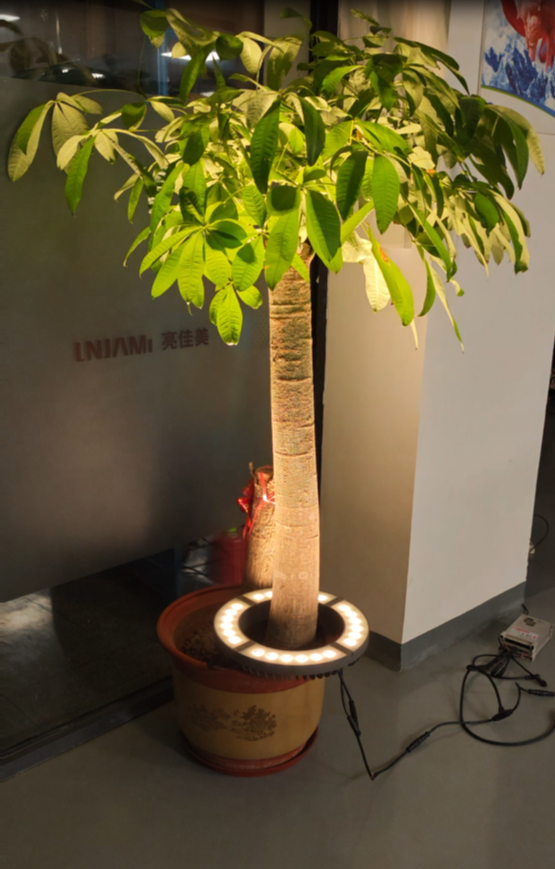
- Split rings. A one-piece ring can only be placed when the tree is planted. Around an existing trunk, use a split (clamshell) or segmented ring that opens and closes around the tree without anything being lifted over it.
- Room to grow. Size the inner diameter from the trunk diameter plus a clearance on each side, chosen for the species and its growth rate. Adjustable or segmented rings can be enlarged later instead of replaced.
- No damage to the bark. The ring must not press on the trunk, and it should not be fixed with screws or nails into the tree or with straps tightened around it. Support it from the ground or from adjustable, non-constricting brackets.
- Drainage. Tree pits and planters are often low points. Check where water goes after rain or irrigation, especially for recessed rings, and provide drainage underneath if water can collect.
- Cable entry. Seal cable entries with suitably rated glands, avoid placing them at the lowest point of the fixture, and make joints in an accessible junction box rather than buried in the soil.
- Access for maintenance. Make sure the ring can be opened, cleaned and checked without removing it completely, and leave spare cable so it can be repositioned as the tree grows.
6. Using Both on One Tree
On large feature trees the two approaches complement each other. A ring at the base lights the trunk from several sides, while one or two narrow-beam spotlights placed further away reach the upper canopy. Each fixture does the part it is suited to, and the combined result is easier to balance than trying to make one type cover the whole tree.
Spotlights on their own remain a sensible choice for trees seen mainly from one direction, very tall trees where light has to be thrown a long way, and temporary or frequently changing layouts.
7. Glare and Light Spill
Glare and unwanted light spill are important issues to check during installation. The risk depends on fixture position, beam direction, shielding and the surrounding viewing environment.
- Ring lights: look for internal baffles or shielding so the LEDs are not directly visible from normal eye height, and check that no light escapes sideways across paths.
- Spotlights: use glare cowls or honeycomb louvers, aim away from paths, seats and windows, and avoid beams much wider than the tree.
- Both: walk the site at night after installation, look from every approach, and adjust before handover.
Before deciding, it helps to know how tall the tree is, where people will see it from, how much space there is around it and what the ground is like at the base. Those four facts usually point clearly toward a ring, spotlights or a combination.
FAQ
Do tree ring lights or spotlights show bark texture better?
Either can. Directional spotlights aimed from an offset position can create strong shadows and texture contrast. Ring lights light the bark from several directions, which can reveal texture from more viewing angles, depending on the optics and how close the LEDs sit to the trunk. Bark type matters too: deep, dark bark shows texture more readily than smooth, light bark.
How many spotlights does it take to light a tree evenly?
For a tree seen mainly from one direction, one or two may be enough. For a tree seen from all sides, two or three placed around it are common, with their beams overlapping on the trunk. The right number depends on tree size, beam angle and where people stand, so confirm it with a night test on site.
What beam angle is best for uplighting a tall tree?
There is no single correct angle. Narrow beams reach high canopies from a distance but cover less width; wide beams cover broad canopies but put less light at height. Use beam width ≈ 2 × distance × tan(beam angle ÷ 2) as a first check, then confirm with IES data, a lighting simulation or a sample on site.
Can tree ring lights and spotlights be used on the same tree?
Yes, and on large feature trees it is often the most balanced solution: the ring lights the trunk from several sides, while narrow-beam spotlights placed further away light the upper canopy. Balance the two on site at night so the base does not overpower the canopy.
For the bigger picture, see our complete guide to LED circular tree lights and our article on LED tree ring lights for Christmas and holiday displays.
Not sure which approach suits your trees? Send us site photos and tree sizes for a free project consultation →