Facade Lighting Replacement: How to Match LED Color and Beam
(Publish this heading as the H1.) LNJAMI · Project technical notes · Outdoor architectural lighting
Facade lighting replacement looks simple until the new fixture is switched on. One failed luminaire is swapped, the light returns, yet its patch on the wall looks cooler, sharper or brighter than the bays beside it. The replacement may even carry the same wattage and color temperature on its label.
Those two numbers leave the important questions open. A reliable facade light replacement starts with the installation that is operating today: record the original product, check the replacement's mechanical and electrical interfaces, then compare a sample beside the neighboring fixtures. For contractors, distributors and facility teams ordering replacement wall washer lights, that is a safer basis for a repeat order than the closest-looking product photo.
In this guide: identify the installed fixture · matching LED color temperature · LED beam angle replacement · mounting and electrical checks · on-site sample comparison (with a worked example) · one fixture or a section · documentation for maintenance · FAQ
Identify the installed fixture before choosing a replacement
Photograph the label, the complete fixture and its mounting arrangement. Look for the original order, the approved luminaire schedule, the optical code and any later substitutions. One product family name can cover several generations of LEDs, lenses and drivers.
If the label is unreadable, send the supplier dimensions and installation photos. Keep the identification provisional until the configuration is confirmed.
Then define what "matching" means at this location. A continuous pale wall is a harder visual task than separate objects in a landscape. Mark the viewing positions and the section being judged. Ask the owner or lighting designer to agree which differences would be unacceptable before the batch order is placed.
Matching LED color temperature: why two 3000K fixtures can look different
Correlated color temperature (CCT) does not uniquely define a white LED's color. Two sources with the same CCT can sit at different chromaticity positions — one slightly greener, one slightly pinker. Tridonic's optical design guidance explains this and the use of color coordinates and SDCM (MacAdam ellipse) tolerances. Ask for the target and tolerance of the proposed version, not only the CCT printed on a quote.
A tight initial tolerance is useful information about new products. It does not guarantee a match to aged fixtures. The existing luminaires may have shifted in output or color, and covers, dirt and wall finishes all affect the comparison. ERCO's LED information treats color tolerance and lumen maintenance as separate characteristics; keep that distinction when reviewing evidence.
What to request for a white-light match:
- CCT plus color coordinates (x, y) or tint information
- The stated SDCM tolerance and the conditions it was measured under
- The exact product version and LED revision being offered
For a color-changing (RGBW) fixture, first confirm which white mode is being compared. A dedicated white channel and a mixed-color white scene are different configurations. Do not readdress fixtures or rewrite the control program to hide an unidentified product mismatch.
LED beam angle replacement: match the light on the wall, not the watts
Equal wattage says nothing about light distribution. Two wall washers labeled with the same beam angle can still produce different edges, spill and bright spots. Request the IES or LDT file for the exact variant, and keep lenses, accessories and mounting details identical to the proposed supply. Then compare the result on the wall at the distances that matter to the project.
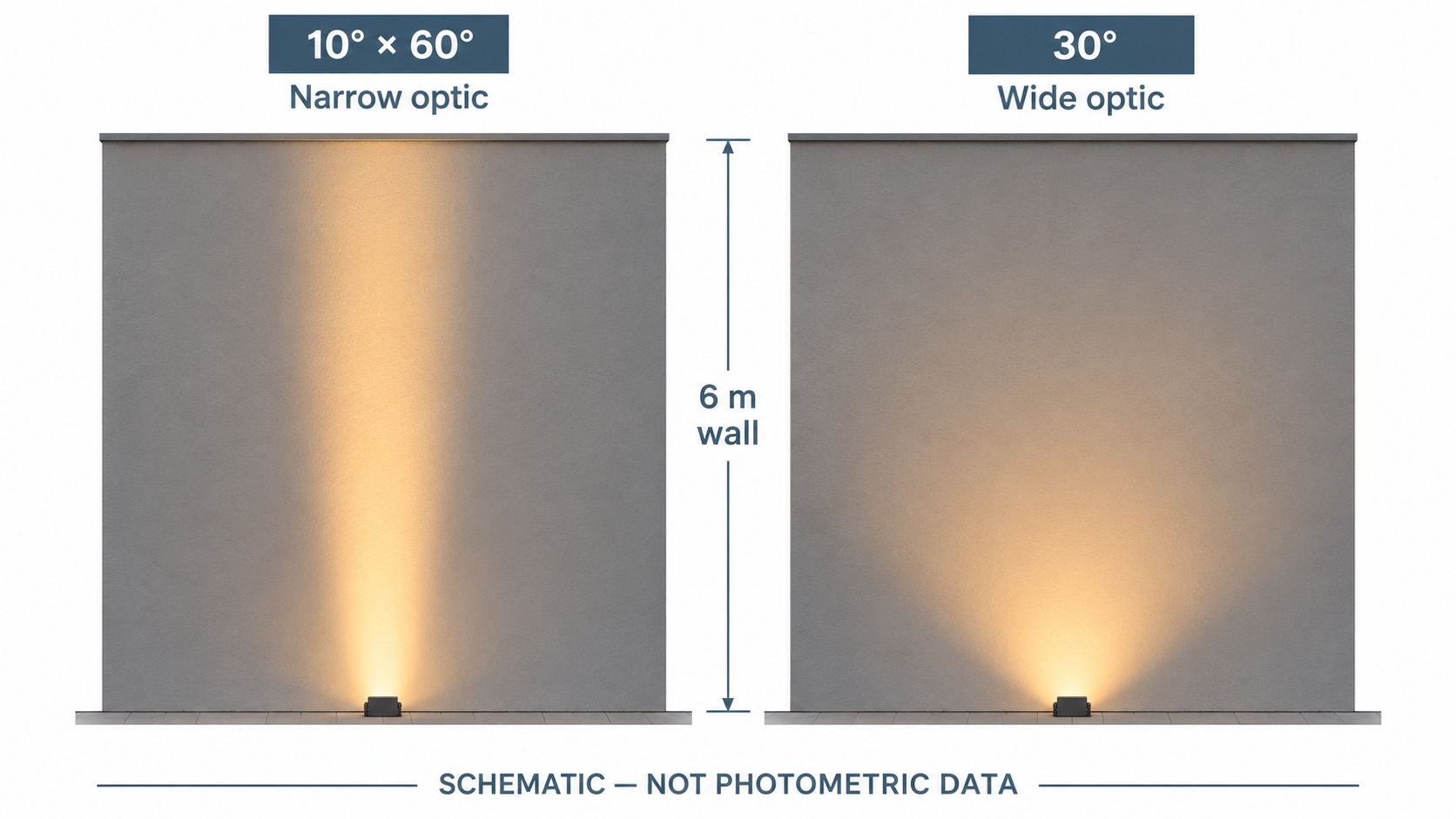
If the mismatch is mainly brightness, a supported output adjustment may help, within product limits and the project's lighting requirements. Dimming will not correct a tint difference or a differently shaped beam. Agree a setting only after checking both appearance and required performance.
Check mounting and electrical compatibility separately
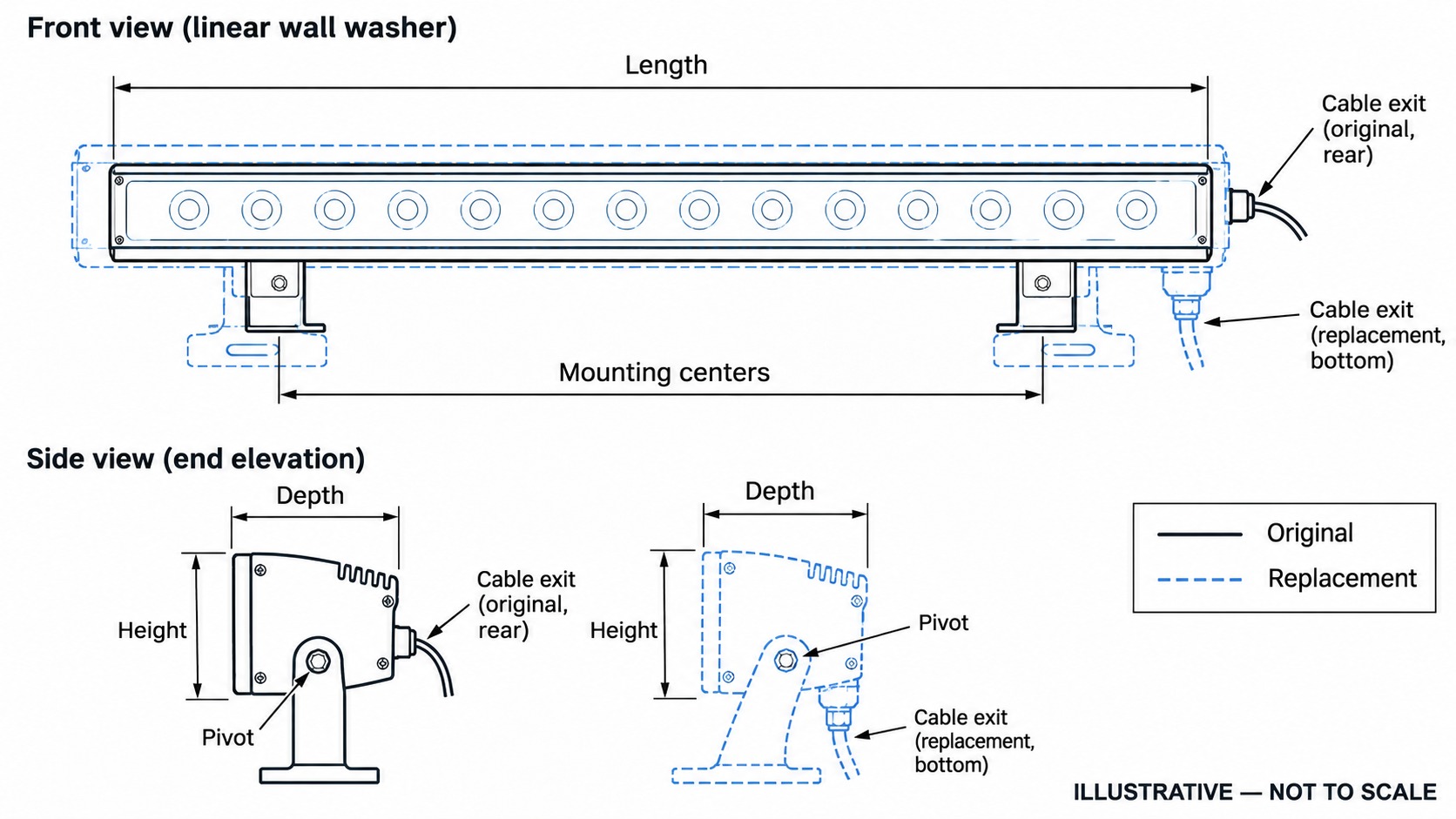
Check mounting centers, bracket envelope, tilt range and cable exit against the available space. A smaller housing can still be awkward to service; a larger bracket can block the intended aiming position. Ask the supplier to review the original detail and state what changes, if any, the candidate needs.
Electrical compatibility needs its own review by the responsible technical team. Confirm supply type and rating, driver arrangement, connector and pin assignment, control protocol (e.g. DMX512, DALI, 0–10V) and any product-specific limits. Similar-looking connectors do not prove interchangeability. Keep open items open until they are resolved, and resolve them before a sample is connected to the live system.
|
Requirement |
Evidence to request |
What a simple label misses |
|---|---|---|
|
Color |
CCT, color coordinates, target and SDCM tolerance for the offered version |
How the neighboring fixtures look today |
|
Beam and output |
IES/LDT for the exact lens and assembly; a working sample |
Beam shape and distribution across the wall |
|
Mounting and access |
Dimensions, bracket detail, cable exit, access space |
Whether the fixture can be aimed and serviced in place |
|
Electrical and control |
Confirmed supply/driver, connector pinout, control compatibility |
Whether the full connection and control chain works |
Compare a sample beside the existing installation
Use a representative bay with the real wall material and mounting position. Record the location, output setting, aiming, viewing positions and conditions. Let both fixtures reach the operating state their instructions require before comparing. If you take photos, lock exposure and white balance, and keep written observations alongside them.
A bench comparison can catch product differences before site access is booked. It cannot reproduce every installed condition. If a sample looks right on a test wall but wrong on the building, check mounting geometry, wall finish and surrounding light before changing the specification again.
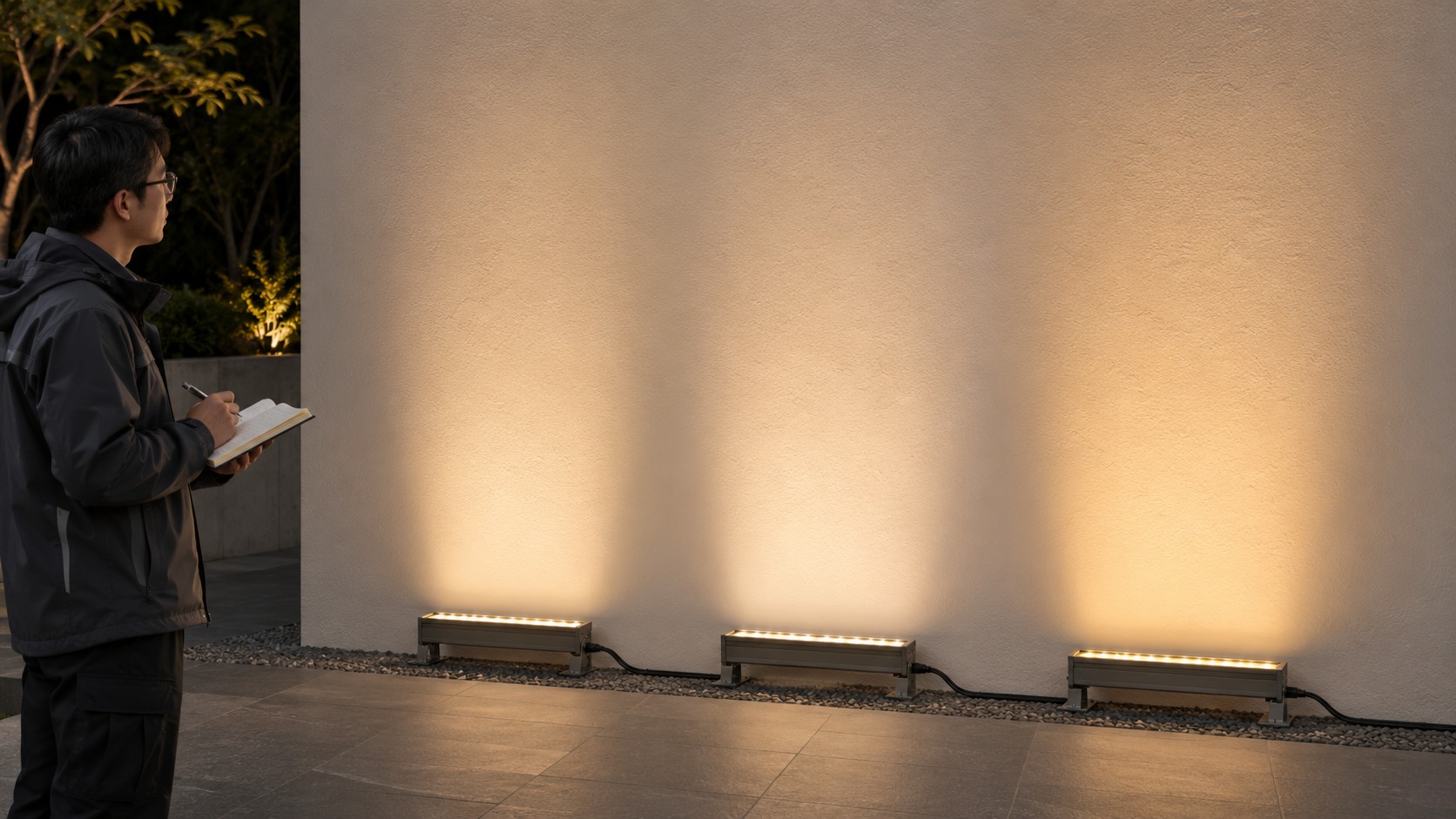
Worked example: a 3000K replacement that looks "off"
Hypothetical example — the situation and observations below are invented to show the decision logic. They are not results from an LNJAMI project.
An office facade uses 3000K linear wall washers. The replacement is also labeled 3000K. At the site comparison, the team records:
|
Observation |
Possible cause |
Next check |
Do not conclude yet |
|---|---|---|---|
|
New fixture looks slightly greener |
Different chromaticity at the same CCT, or aged neighbors have shifted |
Compare color coordinates and SDCM data; view both on the same surface |
"The LED is defective" |
|
Wall brightness is about the same |
Output is close enough |
Note the setting used |
— |
|
Beam edge is sharper than the original |
Different lens or optic version |
Compare IES/LDT files for both optical codes |
"Wrong beam angle was supplied" |
|
Bracket sits slightly off the old position |
Different mounting centers or pivot point |
Measure aiming angle against the original detail |
"The fixture doesn't fit" |
Three observations point to three separate checks: chromaticity, photometric distribution and mounting angle. Correct the aiming first, since it is cheapest and can change how the edge reads. Then decide whether the remaining tint and edge difference is acceptable from the agreed viewing positions. Only after that should anyone reject the product or change the order.
Record the finding, the correction and the recheck result together, so the next buyer can see why the decision was made.
Replace one fixture or a whole section?
If a single sample is acceptable beside the retained fixtures, a one-for-one swap may be practical. If the difference stays visible across a continuous wall, ask the project team whether a defined section should be updated together. Use an architectural boundary — a bay, a pier, a separate elevation — to set the extent, rather than product age or a percentage.
Document the approved replacement for architectural lighting maintenance
Save the accepted model and revision, optical code, color data, driver arrangement and any agreed output setting. Link them to the physical location and the comparison photos. A future buyer should be able to tell the approved replacement apart from the original product and from any rejected candidate.
Ask the supplier how later product changes will be communicated, and which parts can realistically be held as spares. The right quantity depends on the installed base, access constraints, lead time and product-change risk; a fixed spare percentage is rarely the full answer. Spares also need proper storage and a recorded identity — they are not a permanent guarantee of a visual match.
Facade lighting replacement FAQ
Why do two 3000K LED lights look different?
CCT is only one description of white light. Chromaticity, aging, optics and the wall surface can all differ. Request the actual configuration and compare a sample under recorded conditions.
Does a low SDCM value guarantee a color match?
No. Read it with its color target, product version and measurement conditions. It describes a tolerance for new products, not the current color of aged neighboring fixtures.
Will the same wattage and beam angle give the same effect?
They are useful filters, but they do not define the full distribution. Review the exact IES/LDT data, accessories and mounting, then compare the light on the wall.
Can I replace a facade light with a different brand?
Often, but cross-brand fit is never automatic. Mounting, connectors, driver and control protocol must each be confirmed, and the visual result checked with a site sample.
What if the original facade light is discontinued?
Ask for the closest documented alternative and a list of what has changed. Review mechanical and electrical compatibility before a site sample, and agree any acceptable difference or replacement extent with the project team.
How many spare wall washer lights should we keep?
It depends on the installed base, access, lead time and the risk of product changes. Record the identity of each spare and store it properly.
Need replacement wall washer lights? Send LNJAMI the installed details
If you are planning a facade lighting replacement, LNJAMI's project team can help you with:
- Identifying a replacement model for the installed fixture, from the label, original model or photos
- Checking mounting compatibility — dimensions, bracket, aiming range and cable exit against your existing detail
- Supplying photometric data (IES/LDT) for the exact version offered, not a family average
- Confirming color and electrical parameters — CCT, color coordinates and tolerance, supply, driver and control protocol
- Arranging a sample for an on-site comparison, where the project needs one
To get started, send:
- A label photo or the original model number
- Quantity needed
- Clear photos of the fixture, its mounting and the lit wall
- Key dimensions and supply/control details
- The result you need to preserve (e.g. "match bays 3–7 on the north elevation")
We will tell you what can be confirmed from documents, what needs a sample, and where a difference may remain. Cross-brand fit, color matching and the scope of any replacement are confirmed before a batch order — not assumed.
[Button: Start a replacement enquiry →] (link to the LNJAMI project enquiry page)