How to Read a Salt Spray Test Report for Coastal Outdoor Lighting
Quick answer: A salt spray test report only proves something about the exact specimen that was tested, under the stated method and acceptance criteria. Before you approve one for a coastal lighting project, confirm that the tested panel or part matches the fixture, finish and mounting hardware you are actually buying — and never convert test hours into years of service.
A quotation for coastal lighting says "salt spray tested." The attached report looks substantial — but the sample photo shows a flat coated panel, while the quote covers a complete fixture, mounting bracket and fasteners. This guide shows you how to connect the two, what "pass" actually means, and which questions to send back to the supplier.
Key takeaways
Link the tested specimen to the exact fixture, finish and hardware being supplied — otherwise the report proves very little.
Read the test method (ASTM B117, ISO 9227) and the acceptance criteria separately. A test method is not a pass/fail rule.
Test hours are not years of service. Neither standard supports converting hours into coastal service life.
IP66/IP67 and wet-location ratings do not prove corrosion resistance.
Brackets, bolts, washers and anchors often sit outside the report's scope. Check them separately.
Who this guide is for: architects, lighting designers, specifiers and contractors reviewing outdoor lighting for coastal, waterfront and marine-adjacent projects.

1. Run the 6-point salt spray report checklist
Use this checklist whenever a supplier sends a salt spray test report with a coastal lighting quotation. Each row is a question the report should answer — if it doesn't, that becomes a follow-up request.
|
# |
Review item |
Question to answer |
|---|---|---|
|
1 |
Report and specimen identity |
Which report, sample reference and supplied model/revision are connected? |
|
2 |
Material and finish |
What substrate, surface pretreatment and coating system were tested? |
|
3 |
Method and conditions |
Which method and edition (e.g. ASTM B117, ISO 9227 NSS), conditions and duration are recorded? |
|
4 |
Preparation and evaluation |
Were scribes or exposed edges included? Which areas were evaluated, and what was found? |
|
5 |
Acceptance criteria |
What pass/fail criterion was applied, and where is the result recorded against it? |
|
6 |
Scope and open items |
Which quoted components are covered, and which still need clarification? |
2. Define where the fixture will actually be installed
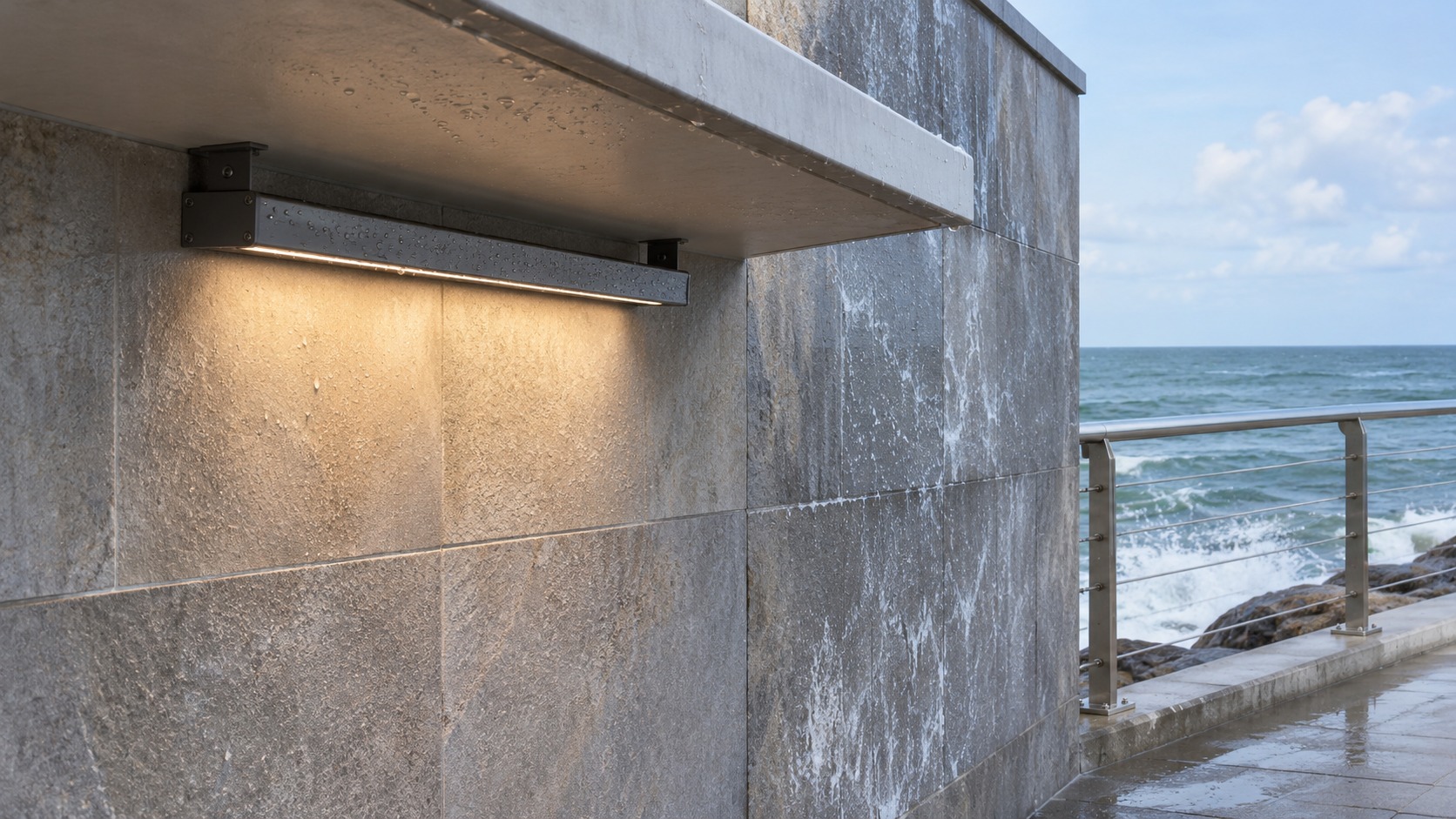
"Coastal" can mean a sheltered entrance, an open boardwalk, or a fixture facing direct seawater splash. Before discussing test hours, give the supplier:
Site photos and the fixture location marked on the building or landscape plan
Mounting height and orientation
Shelter (eaves, recesses) and prevailing wind/splash exposure
Cleaning access and the intended maintenance plan
Distance from the shoreline is useful, but it doesn't describe any of these conditions on its own. If your specifier needs a more formal description, ISO 9223 classifies atmospheric corrosivity (categories C1 to CX) using factors such as airborne salinity and time of wetness.
Separate appearance from function
A finish may be judged on visible staining; a bracket also carries a load. Ask the project's lighting designer or specifier to define what must remain acceptable, under which conditions, and for which components — before asking for a "longer salt spray test."
3. Identify exactly what was tested
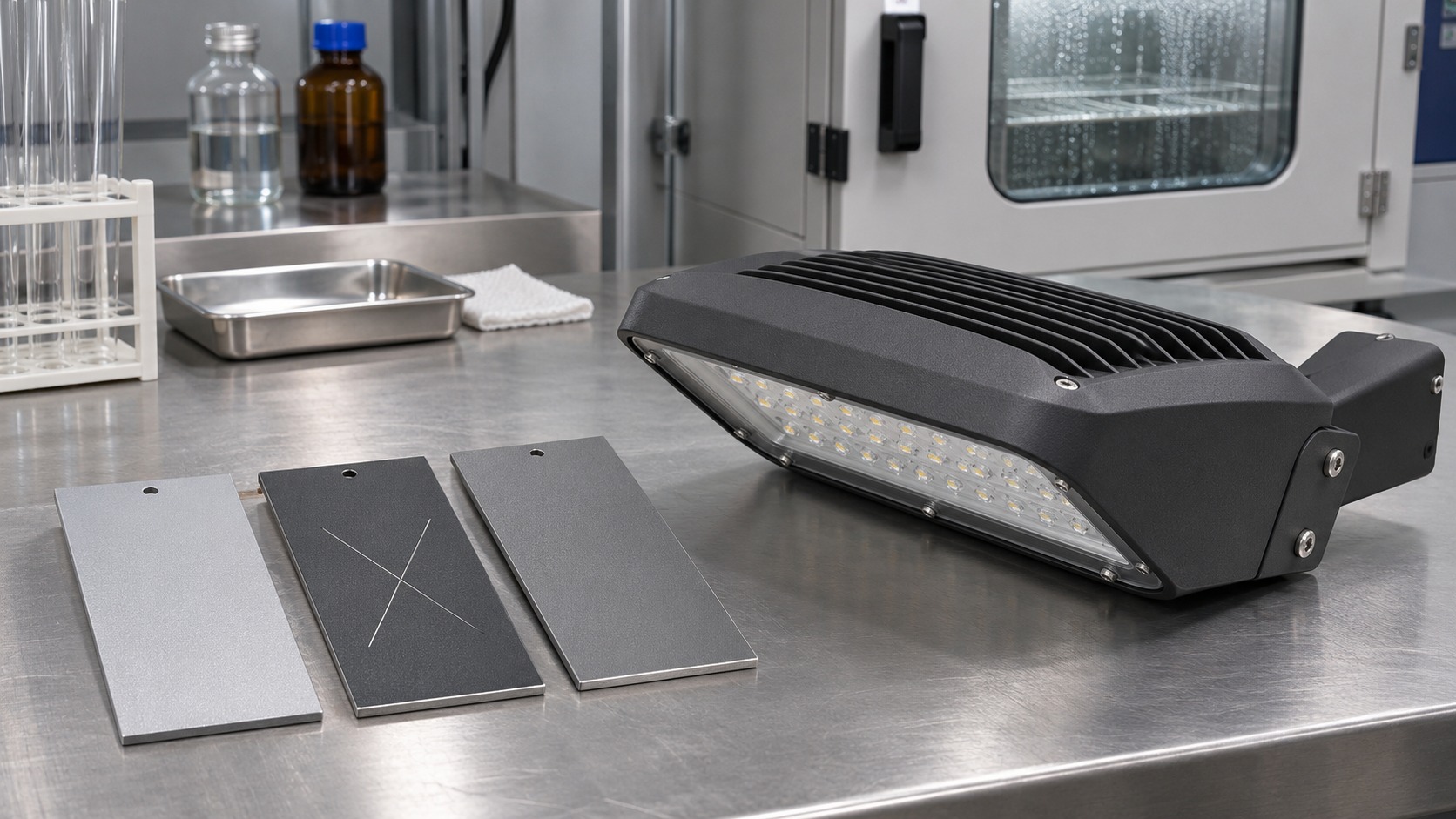
Read the sample description and photos before the conclusion. Was the specimen a coated test panel (coupon), a fixture housing, a mounting component, or a fully assembled luminaire?
Record the model, material, finish code and sample reference stated in the report. If they don't match the version being quoted, ask the supplier to explain the connection in writing.
A coated-panel result can be valid evidence for that coating system. It does not, by itself, cover every exposed edge, joint, bracket or fastener in a real installation. Equally, a photo of a complete fixture is not a substitute for a clear specimen description.
4. Read the test method and the acceptance criteria separately
ASTM B117 (widely cited in North American specifications) describes the apparatus and procedure for running a salt spray (fog) test. ISO 9227 covers neutral salt spray (NSS), acetic acid salt spray (AASS) and copper-accelerated acetic acid salt spray (CASS) methods. Neither standard sets the specimen type, exposure duration or interpretation of results for a particular light fixture — those belong in the product or project specification.
So check two things:
1. Which method and edition the report cites. Older editions (for example ASTM B117-19) still appear on many supplier reports; ask whether the edition cited is acceptable for your project.
2. Which product or project criteria were used to judge the result.
Then check how the recorded observations relate to those criteria: the evaluated areas, any scribe or edge treatment, the specimen's condition at evaluation, and the actual findings. If the conclusion simply says "PASS," ask: pass against what? For painted or coated specimens, ASTM D1654 describes how to evaluate corrosion and loss of adhesion at a scribe mark — ask which evaluation method the report used.
Example: reviewing a typical report line by line
|
Review item |
What the example report states |
What to confirm with the supplier |
|---|---|---|
|
Substrate |
Die-cast aluminum |
Same alloy and casting process as the quoted fixture housing? |
|
Surface treatment |
Pretreatment + polyester powder coating |
Which pretreatment? Coating thickness? Same process reference as production? |
|
Test method |
ASTM B117 (edition stated) |
Is that edition acceptable under the project specification? |
|
Duration |
1,000 hours |
Was the duration set by a product/project requirement, or chosen by the supplier? |
|
Specimen |
Coated aluminum panel, 150 × 75 mm |
Does it represent the actual housing process, edges and joints? |
|
Scribe |
X-scribe through coating to substrate |
How was undercutting from the scribe measured and judged? |
|
Result |
"No obvious corrosion" |
Which rating method and acceptance limit were applied? |
|
Hardware |
Not included |
Bracket, bolt, washer and anchor materials and their evidence? |
In this example, the report is useful evidence for the coating system — but it leaves three open items before approval: the link to the production housing, the acceptance rule, and the mounting hardware.
Planning a coastal or waterfront project? Send your site photos and mounting details to our engineers — we'll recommend a fixture configuration and arrange a sample so you can evaluate the real product, not a test panel. Contact LNJAMI →
5. Match the tested finish to the quoted fixture
"Powder coated" doesn't identify a complete finish system. For both the tested specimen and the supplied product, ask for:
Substrate (e.g. die-cast aluminum alloy, stainless steel grade)
Surface pretreatment
Coating specification, thickness, and the supplier's traceable finish or process reference
If the color has changed from the tested sample, ask whether the evidence still covers the quoted configuration — don't assume it does, and don't assume it fails.
Don't forget brackets, bolts and anchors
The housing report may not mention the mounting bracket, fasteners, washers or site-selected anchors. List these parts next to the fixture in the configuration schedule and assign open questions to the responsible supplier or contractor. A claim that covers the factory product shouldn't silently extend to hardware added on site.
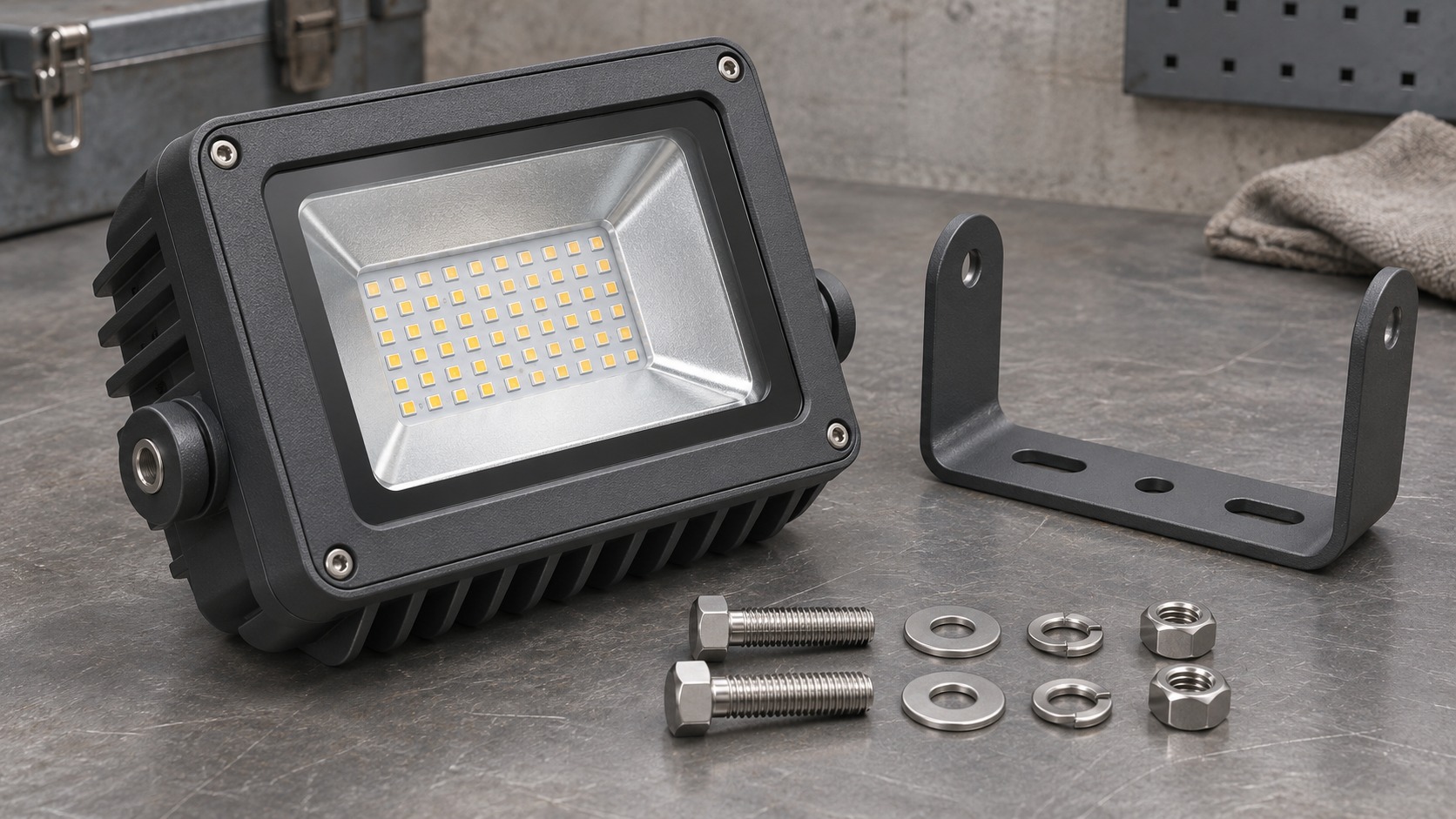
LNJAMI floodlight housing with mounting bracket and fasteners.
6. Don't convert salt spray hours into years of service life
ISO 9227 states that salt spray methods are not intended for ranking different materials against each other or for predicting long-term corrosion resistance. ASTM B117 likewise does not support extrapolating results directly to natural exposure. That means:
There is no standard conversion from test hours to "years at the coast."
A longer test on a different configuration is not automatically better evidence.
Use the test evidence together with the real exposure description, the proposed assembly, relevant service history and the maintenance plan. Treat the warranty as a separate written commitment from the supplier. Long-term performance also depends on thermal design, drivers and sealing — see our guide to LED lifetime.
7. Turn missing links into precise supplier questions
Document-review example, not an actual LNJAMI test. A quotation offers an assembled LED floodlight, but the attached report covers a coated aluminum panel.
|
Evidence received |
Still unresolved |
Follow-up request to the supplier |
|---|---|---|
|
Coated-panel report |
Link to the quoted housing finish |
Matching process/finish reference and a written scope explanation |
|
Complete fixture quotation |
Bracket and fastener materials not specified |
Component list for the quoted assembly and applicable evidence |
|
Conclusion says "PASS" |
Acceptance criteria not attached |
Criteria applied and where the observations are recorded |
Keep the original report reference, the supplier's reply and the agreed configuration together. If the finish, bracket or source changes before delivery, reopen that part of the review.

Illustration (AI-generated), fictional staff and samples.
Comparing coastal fixture options? Ask for a sample of the configuration you're considering, including the bracket and fasteners.
Frequently asked questions
Does an IP67 or IP66 rating prove salt corrosion resistance?
No. The IP Code (IEC 60529) classifies enclosure protection against solids and water ingress. Neither an IP rating nor a wet-location listing is evidence of how the finish or mounting hardware resists corrosion. Impact resistance is another separate rating — see how to choose an IK rating.
Is a 1,000-hour salt spray result a coastal approval?
No. 1,000 hours describes the duration of one particular test. You still need an identified specimen, relevant test conditions and stated acceptance criteria.
Can a coated-panel (coupon) test result be used at all?
Yes, within its stated scope. Ask how its substrate and coating process connect to the supplied part, and what questions remain for the complete assembly.
What does "marine grade" mean for a light fixture?
There is no single definition. Ask the supplier to define it for the quoted product and provide the material and finish specification, supporting evidence, and any exposure, installation or maintenance limitations.
Is a wet-location listing enough for coastal projects in Florida or California?
Not on its own. US projects typically need a wet-location listing (UL, cUL or ETL) for electrical safety where water is present, but that listing does not describe corrosion performance. Specify the finish, fastener materials and mounting hardware separately for the actual exposure.
What should I ask a lighting supplier for on a coastal project?
The material and finish specification for the supplied product; materials for brackets and fasteners; any salt spray evidence with specimen identity, method/edition and acceptance criteria; a sample of the actual configuration for evaluation; and the warranty terms in writing.
Get a free coastal lighting project review
LNJAMI has manufactured outdoor architectural lighting in Shenzhen since 2008, under an ISO 9001-certified quality system with inspection from incoming materials through assembly, finished products and packaging. Every batch goes through waterproof immersion testing and an aging (burn-in) test before packaging, ranging from 24 hours to several days depending on the product and order — checks we keep separate from any claim about corrosion resistance.
Before you order, send us your project details:
Project location and site/exposure photos
Fixture types, quantities and mounting locations
Relevant tender or specification clauses (finish, color, hardware, test method)
Bracket and mounting requirements, if known
Your project timeline
Our engineers will recommend a fixture type and configuration for your exposure. Choose standard brackets and fasteners, or specify custom hardware — custom parts are quoted separately so you can compare the cost before deciding. Samples are available so your team can evaluate the actual housing, finish and hardware.
What LNJAMI can supply for coastal and waterfront projects:
LED wall washers for facades and seawalls
Linear facade lights for building outlines and eaves
LED flood lights for facades, bridges and landmarks
In-ground lights for promenades and plazas
Outdoor wall lights for entrances and walkways
Custom configurations for finish, brackets and mounting details
Request a free coastal project review → · Samples available
Related reading: LED Lighting Quality and Product Testing · LED Lifetime: The Complete Guide to Maximizing Lifespan · Choosing the Best IK Rating for Facade, Bridge, and Landscape Lighting · Bridge lighting projects · Project cases
Technical references
ISO 9227:2022 — Corrosion tests in artificial atmospheres: Salt spray tests (amended by ISO 9227:2022/Amd 1:2024)
ASTM B117-26a — Standard Practice for Operating Salt Spray (Fog) Apparatus
ASTM D1654 — Evaluation of Painted or Coated Specimens Subjected to Corrosive Environments
ISO 9223:2012 — Corrosivity of atmospheres: Classification, determination and estimation
IEC 60529 — Degrees of protection provided by enclosures (IP Code)