
What Malfunctions Are Outdoor LED Lights Prone to During the Rainy Season?
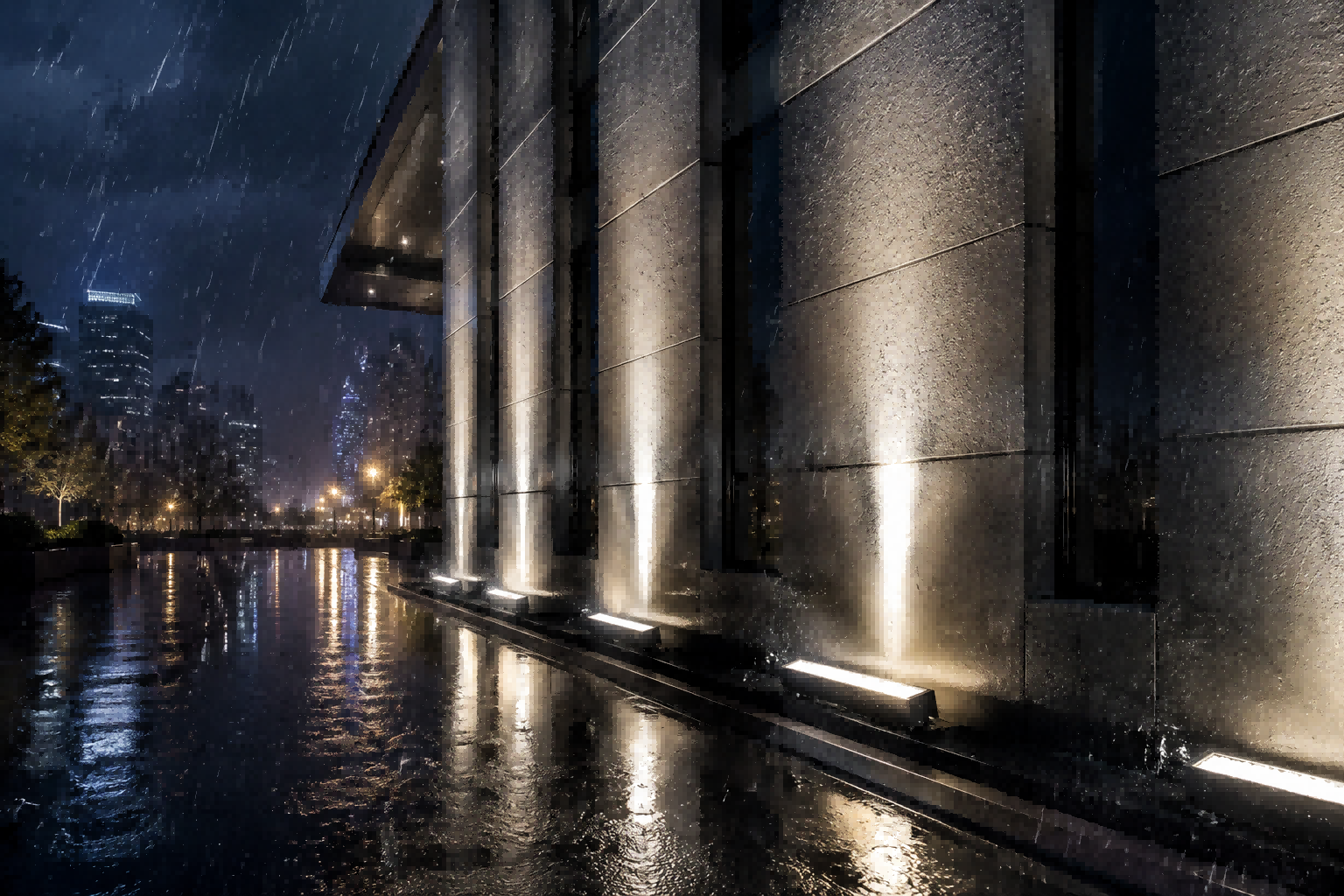
A truly reliable outdoor LED lighting system begins long before the first fixture is mounted on a wall—it starts at the design phase. Engineers and product developers must anticipate the harshest environments the system will face, and few conditions are as relentlessly punishing as the rainy season. Sustained rainfall, near-constant high humidity, and the repeated thermal shock of sudden temperature drops combine to create an environment where every microscopic gap, every slightly under-compressed gasket, and every field-made cable connection is probed for weakness, day after day.
For outdoor LED luminaires and the systems they belong to, the rainy season doesn‘t just bring a single failure mode—it triggers a cascade of interrelated problems. Water ingress leads to corrosion, which in turn causes elevated resistance and heat buildup. Condensation inside sealed housings fogs glass covers and degrades LED lenses. Moisture bridging across circuit board traces produces intermittent short circuits that confuse drivers and trip protective breakers. Even the mechanical integrity of brackets and seals is slowly undermined by constant wetting and drying cycles. Understanding why these malfunctions are so prevalent during wet weather is the first step toward designing, specifying, or maintaining outdoor LED lighting that survives not just one rainy season, but many.
1. Why the Rainy Season Is So Hard on Outdoor LED Lights
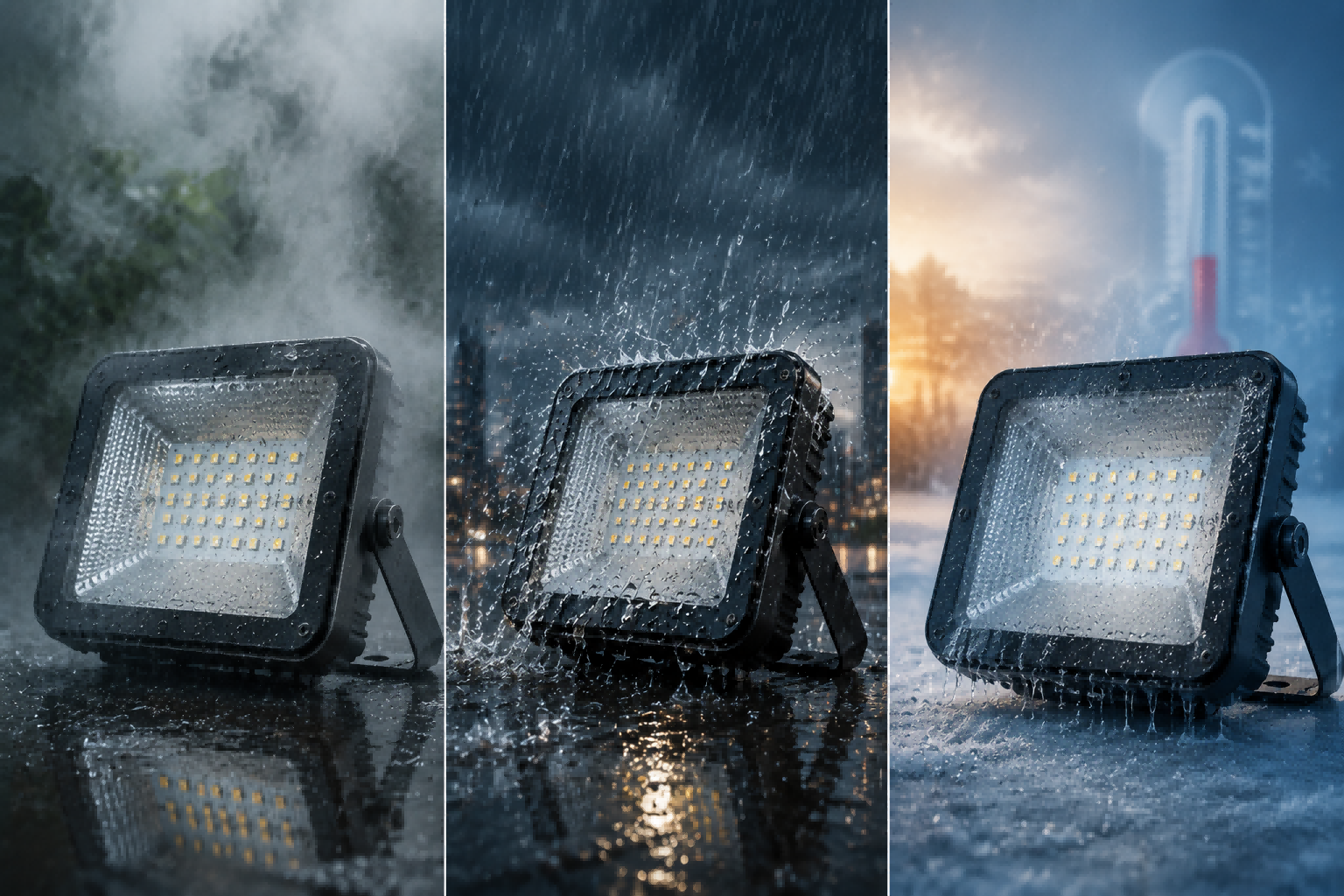
The relentless stress of a rainy season comes from three overlapping environmental forces that attack a fixture simultaneously: sustained high humidity, repeated direct water exposure, and rapid thermal cycling. Individually, each factor tests the limits of seals and materials. Together, they create a compounding effect that can overwhelm even a well-designed luminaire. High humidity slowly saturates the internal air pocket of a housing, making condensation almost inevitable the moment the fixture cools after operation. Heavy rainfall, driven by wind, subjects every gasket, cable gland, and silicone bead to hydrostatic pressure and capillary action, actively pulling water into microscopic voids that a dry-weather inspection would never detect. Meanwhile, the thermal shock of a cold downpour striking a warm, operating light creates a sudden drop in internal pressure, which can actually suck moisture-laden air—and even water droplets—past seals that are already fighting to keep water out. These forces don’t just act in isolation; they weaken the fixture’s defenses layer by layer, setting the stage for the malfunctions described in the next section.
What makes the rainy season uniquely destructive, however, is not just the presence of water—it’s the relentless alternating cycle of wet and dry. A completely submerged light might survive for years if its seals remain perfectly intact, but a fixture that gets soaked, then dries under the sun, then gets soaked again endures far greater stress. Each drying phase evaporates moisture but leaves behind mineral deposits and corrosive residues that attack metal traces, solder joints, and connector pins. Each re-wetting causes gaskets and sealants that have already begun to harden or micro-crack to swell and shift, breaking whatever fragile equilibrium they had regained. This is why a luminaire can perform flawlessly through the first few storms of the season, yet fail completely after a month of intermittent rain. The cumulative damage from wet-dry cycling lowers the fixture’s tolerance threshold little by little, until the next ordinary downpour becomes the one that pushes it over the edge.
2. Common Malfunctions Outdoor LED Lights Experience During the Rainy Season
2.1 Water Ingress and Internal Corrosion
The most common and serious malfunction is direct water penetration. When rainwater finds a path through a degraded silicone seal, a loose end cap, or an improperly tightened cable gland, it pools inside the housing or drips onto the LED board and wiring. Once water contacts live electrical components, corrosion begins almost immediately. You may notice a greenish or whitish crust forming on soldered joints and copper traces, and over time the metal parts of the driver and terminal blocks will rust. This corrosion can create high-resistance connections that generate heat, further degrading the fixture. Even if the light continues to work for a short while, internal corrosion always shortens its lifespan dramatically and may eventually cause a short circuit that blows a fuse or trips a breaker.
2.2 Condensation Inside the Housing (Fogging)
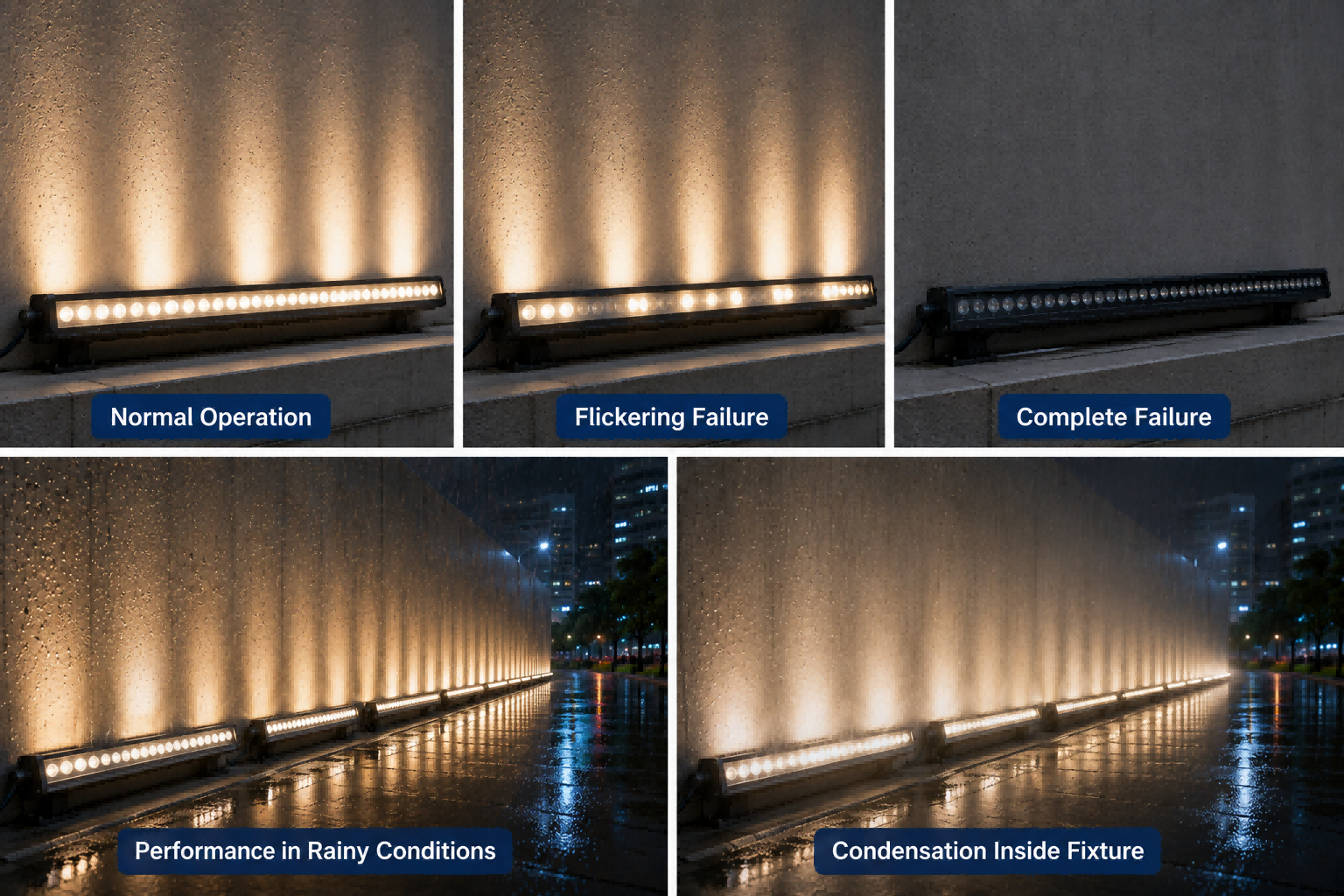
Even well-sealed outdoor lights can suffer from condensation, and the rainy season makes it much worse. When warm, humid air becomes trapped inside the housing during assembly and later cools down rapidly during a rainstorm, the moisture in that air condenses on the inside of the glass cover. The visible fog or water droplets on the glass are telltale signs that the internal atmosphere is damp. While a small amount of fogging that clears during the day might not immediately kill the LED, repeated condensation cycles leave mineral deposits on the glass and LED lenses, reduce light output, and eventually lead to corrosion of the delicate electronic components. A light that constantly fogs up during and after rain is crying out for an improved sealing and ventilation solution.
2.3 Flickering or Complete Failure Due to Short Circuits
Flickering outdoor LED lights are often dismissed as a minor annoyance, but during the rainy season they are a serious red flag. Moisture bridging two adjacent solder pads, or water seeping into a connector and creating a low-impedance path, causes intermittent short circuits that manifest as rapid or rhythmic flickering. In many cases the LED module or driver has a protection circuit that shuts the light down momentarily, leading to an erratic on-off cycle. If the water is not completely dried and the leak path not sealed, the problem will recur with every rain. Eventually the short circuit becomes permanent, either destroying the LED chips or burning out a component on the driver board. A flickering outdoor light should never be ignored—it is an early warning that moisture is already inside.
2.4 LED Driver or Transformer Failure
The LED driver is often the most moisture-sensitive component in the entire fixture. While the LED board itself can sometimes survive brief exposure to dampness if it dries quickly, the electrolytic capacitors and switching transistors inside the driver are far less forgiving. Prolonged high humidity or actual water contact causes capacitors to swell, leak electrolyte, or short out. When the driver fails, the light either stops working entirely or outputs a pulsing, unstable current that visibly stresses the LEDs. Rainy season driver failures are particularly frustrating because they can happen weeks after the initial moisture intrusion, making it hard to link cause and effect.
2.5 Mounting and Physical Damage from Storms
Not all rainy season malfunctions are electrical. Heavy rain is often accompanied by strong winds, which can shake and twist wall-mounted or spike-mounted lights. Over time, a bracket that was never fully tightened may work loose, allowing water to enter through the back of the fixture where the cable emerges. Fallen branches and wind-driven debris can crack the glass cover or dent the aluminum housing, creating new entry points for water. Even the simple vibration from repeated storms can degrade the sealant bond lines around the glass and end caps. After a particularly rough stretch of weather, a physical inspection is just as important as an electrical check.
3. How to Prevent Rainy Season Malfunctions Before They Start
3.1 Choose the Right IP Rating from the Beginning
The first line of defense is selecting outdoor LED lights with an IP rating appropriate for the installation environment. For fixtures directly exposed to driving rain, such as wall washers on an exposed facade, a rating of IP65 offers protection against low-pressure water jets from any direction, while IP66 can handle powerful jets. In flood-prone areas or where the light may be temporarily submerged, IP67 or even IP68 is necessary. Keep in mind that the IP rating applies to the entire assembled fixture, including all connectors and cable entries. A light with an IP65-rated housing is useless if the field-installed cable gland is only IP44.
3.2 Cable Gland and Seal Maintenance
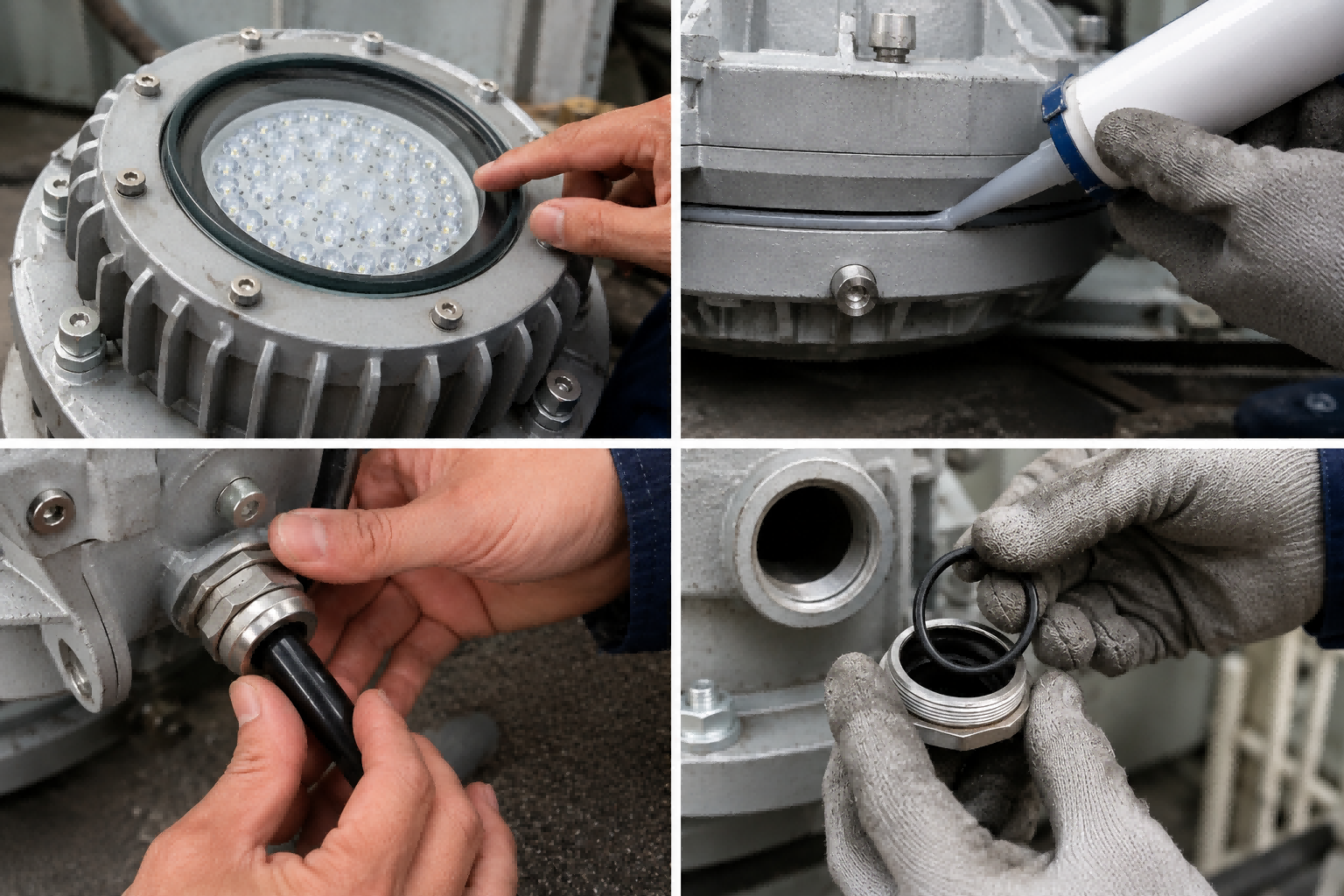
The cable gland is almost always the weakest point in an outdoor light‘s waterproof armor. Regularly check that the gland is tightly compressed around the cable and that no cracks have formed in the plastic or rubber. If the cable looks deformed or crushed where it enters the gland, replace the gland immediately. For end caps, inspect the condition of the rubber gasket or o-ring every few months during the rainy season. If the gasket has become hard or permanently flattened, it will no longer form a reliable seal. Reapplying a thin layer of outdoor-rated silicone grease on the gasket can help maintain elasticity and improve the watertight seal.
3.3 Perform a Visual Check and Reapply Silicone Annually
Before the rainy season kicks in, take half an hour to visually inspect every outdoor LED fixture. Look for hairline cracks in the glass, gaps between the glass and the frame, or signs of rust forming around screw heads. Run your finger around the sealed edges—if you feel any roughness or see a separation, it’s time to scrape away the old silicone and apply a fresh bead of neutral-cure outdoor silicone. Pay special attention to the topmost edges and any horizontal surfaces where water can pool. This simple annual maintenance routine can add years to the life of your outdoor lights.
4. Troubleshooting Common Rainy Season Problems
The table below summarizes what to do when you notice a malfunction during or after wet weather.
|
Problem |
Likely Rainy Season Cause |
Immediate Action |
|
Light is completely off |
Water-shorted driver or tripped breaker |
Turn off power, open housing, inspect for water, dry thoroughly with a low-heat source, check driver output. |
|
Persistent flickering |
Moisture bridging LED pads or inside a connector |
Disconnect power, dry the interior completely using silica gel packs or a gentle warm air stream, locate and seal the leak. |
|
Condensation/fog on glass |
Humid internal air trapped during assembly |
Improve ventilation without compromising IP rating, or dry unit and reseal when humidity is low. |
|
RCD/GFCI trips when it rains |
Earth leakage due to water contacting live parts |
Inspect all seals immediately; this is a serious electrical hazard. |
|
Rusted screws or bracket |
Inadequate stainless steel grade or water pooling |
Replace with 316 marine-grade stainless steel hardware and ensure water drains away from the fixture. |
FAQs
Q1: What IP rating is truly safe for heavy rain?
For sustained heavy rain and wind-driven water, IP65 is the minimum. IP66 provides a meaningful safety margin. But remember, the rating is only valid if the cable gland and all field seals are installed and maintained correctly.
Q2: Can I use a hairdryer to remove condensation from inside the light?
Yes, but only on a low or no-heat setting, and only after the unit is disconnected from power and opened. High heat can damage LED components, warp plastic parts, or cause thermal shock to the glass. Better alternatives are placing silica gel desiccant packets inside the opened housing overnight or simply leaving the housing open in a dry, air-conditioned room for 24 hours.
Q3: How often should I reseal outdoor LED lights?
A full inspection is recommended at least once a year, ideally just before the rainy season begins. If you notice any cracking, peeling, or gap formation in the existing silicone, reapply immediately. In extremely harsh coastal or high-rainfall environments, inspecting twice a year is not excessive.
Q4: Why does my outdoor LED light work again after drying out, but then fail when it rains again?
This is the classic pattern of a moisture-related intermittent fault. When the light dries, the conductive path disappears and the light works. But the water entry point is still there, and the corrosion inside is progressing. Each wet-dry cycle makes the permanent failure more likely. The only lasting fix is to identify and seal the leak.
Q5: Is a flickering outdoor LED light dangerous during the rainy season?
Yes. A flickering light indicates that moisture is inside and causing unpredictable electrical behavior. This can lead to earth leakage that trips a protective device, or it can degrade the driver to a point where it overheats. Any outdoor light that flickers when it rains should be turned off at the breaker and inspected without delay.
Conclusion
Here’s the thing: the rainy season doesn’t kill LED chips. It kills enclosures, seals, and circuitry. And it rarely does it in one dramatic event—it’s the slow, patient accumulation of dozens of tiny wet-dry cycles that goes unnoticed until the light finally quits. That’s why the highest-return investment you can make isn’t a more expensive fixture; it‘s thirty minutes before the storms arrive to run a bead of silicone, tighten a few cable glands, and actually look at the seals. This habit, more than any brand name or IP number on a spec sheet, is what separates a lighting system that becomes a recurring maintenance headache from one that quietly does its job, rain after rain, year after year.


